Summarize with AI





“Anonymous crypto swap” looks like one search query. It’s actually two.
Swapping ETH for XMR for the third time this month is a different problem than swapping it for the first time. The repeat user already knows which provider quotes well on the pair, what the rate usually looks like, and how long settlement takes. The first-time user knows none of that. Two readers, the same query, completely different jobs.
The non-custodial swap industry has split into two tools that serve those two jobs separately. Direct instant exchanges like Godex are built for the first reader. Crypto exchange aggregators like Swapzone are built for the second. They overlap less than the marketing would suggest. And underneath, the actual swap mechanics are nearly identical.
This is the framework for choosing between them honestly. No listicle, no winner, no “best of 2026.” Just the logic.
Direct Exchanges and Aggregators, Briefly
A direct instant exchange is one site, one quote engine, one path. You pick a pair, get a quote, send the source coin from your wallet to the deposit address, and receive the target coin at your wallet. One quote, one provider, one trust relationship. Examples in the non-custodial category: Godex, ChangeNOW, SimpleSwap, FixedFloat.
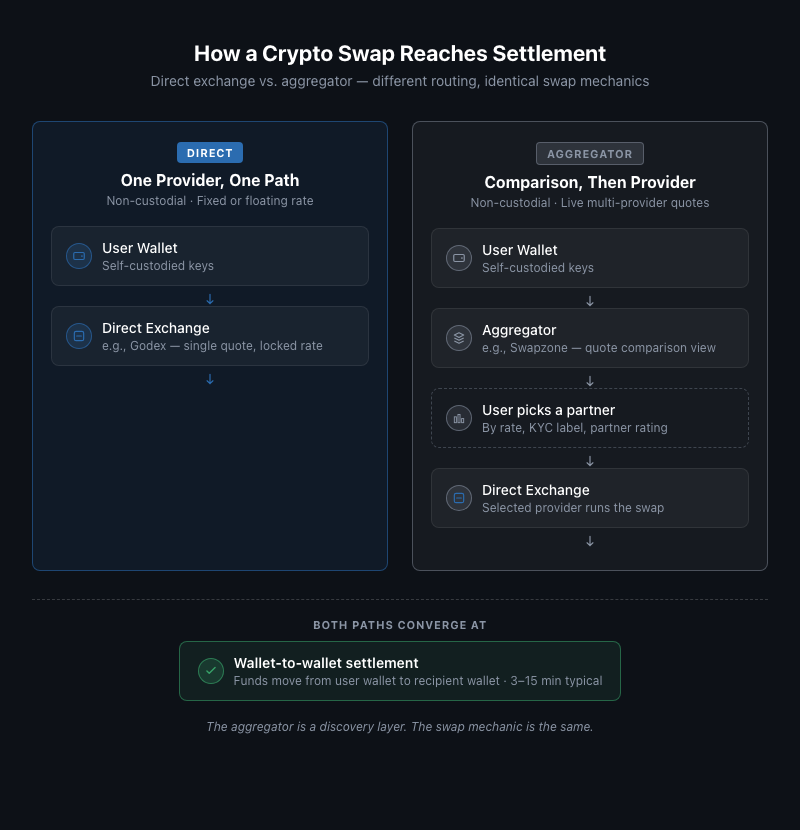
A crypto exchange aggregator is a comparison layer that sits in front of those direct exchanges. You pick a pair, the aggregator queries more than a dozen direct exchanges in parallel, and you see their quotes side by side rate, estimated time, KYC label, and partner rating. You pick one, and the chosen direct exchange does the actual swap. The aggregator never holds your funds and (at the user-facing level) doesn’t charge you a fee. Swapzone is the canonical example.
If a Google Flights analogy helps, the aggregator is the comparison engine; the direct exchange is the airline. The flight gets flown either way. The question is how much homework you want to do before booking.
How Aggregators Actually Work
The mechanic is plainer than most articles make it sound.
The aggregator queries partner exchanges in real time and normalizes their quotes fees baked in, estimated settlement time, KYC label per partner and surfaces them in one comparison view. The user picks a quote. The aggregator hands the user off to the chosen direct exchange’s flow: same deposit address generation, same wallet-to-wallet settlement.
The aggregator never custodies funds. It never sees private keys. It collects an affiliate commission from the partner that performed the swap — typically 0.05–0.25% of the trade, paid by the partner, not by the user. That’s why aggregators can plausibly call themselves fee-free at the user layer; the user-facing economics genuinely are. The fee exists, but it lives in the partner-economics layer, where the user never touches it.
Swapzone is the most established example of this model, scanning 18+ partner exchanges (Godex among them) and surfacing live quotes for crypto-to-crypto swaps with no registration. Other aggregators in the non-custodial space include SwapSpace and ShapeShift, with somewhat different partner mixes and feature sets.
The takeaway: an aggregator is a discovery and routing layer. It is not a separate kind of exchange. The exchange happens downstream, on whichever direct provider the user picks.
How Direct Exchanges Actually Work
A direct instant exchange skips the comparison layer entirely. One site, one quote, one path. The provider sources liquidity — its own book, market makers, or partner liquidity and quotes a single rate. The user picks fixed rate (locked for the swap duration) or floating rate (settles at the rate at execution), sends the deposit, receives the swap.
The simplification is the feature. There is one URL to bookmark, one rate to evaluate, and one trust relationship to maintain. For users who already know their provider, that simplification compounds across hundreds of swaps.
Godex sits in this category. The differentiated specifics:
- 934+ supported coins, including privacy coins (XMR, ZEC, DASH, ZEN)
- Fixed-rate option locks the rate for the full swap duration, with no slippage between quote and execution
- Unconditional no-KYC for standard swaps: no volume threshold that flips identity verification on at $X
- No volume caps
- 3–15 minute typical settlement after the deposit confirms
- Operating since 2017, nine years of continuous service
When Each Is the Right Call
A short decision framework. Match the tool to the job:
Use a direct exchange when:
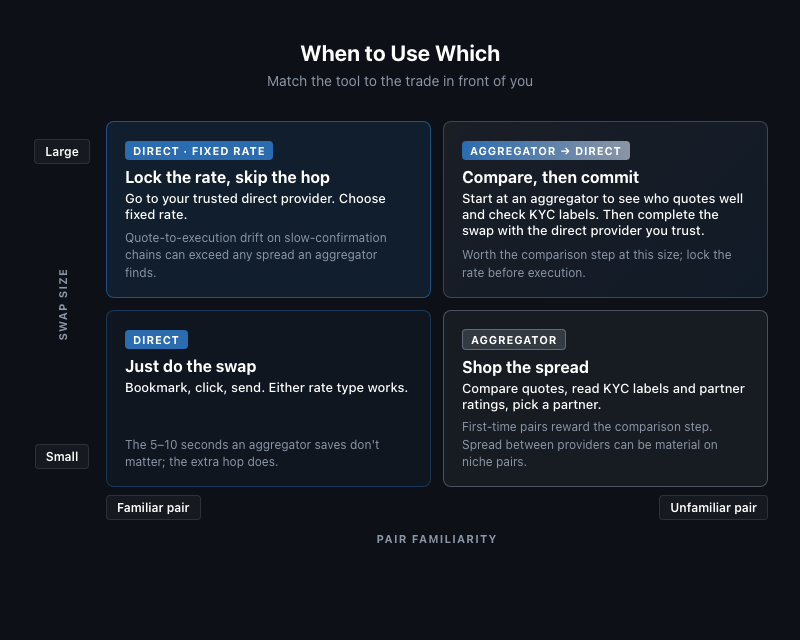
- You’re doing a repeat swap of a familiar pair. You already know who quotes well on it. The 5–10 seconds an aggregator would save you don’t matter; the extra hop does.
- You need fixed-rate certainty. Aggregator quotes refresh. The rate at the moment of click is not always the rate at the moment of execution. For large swaps on slow-confirmation chains, that delta is real money.
- You’re swapping privacy coins. Partner availability through aggregators on XMR, ZEC, and similar pairs varies. Going direct removes the partner-routing variable.
- You value a single trust relationship. Two services in a flow, even when both are non-custodial, mean two services to keep up with.
Use an aggregator when:
- You’re swapping a pair for the first time and don’t know who quotes well on it.
- You want to see KYC labels and partner ratings before committing. Most aggregators surface both.
- You’re in active rate-shopping mode, and the spread between providers is wide enough to justify the comparison step.
- You’re optimizing on rate at execution and accepting that the rate may shift between quote and execution.
The two-by-two version: familiar pair, large swap → direct fixed-rate. Familiar pair, small swap → direct, either rate. Unfamiliar pair, small swap → aggregator. Unfamiliar pair, large swap — start at an aggregator to see who’s quoting, then settle on the direct provider whose terms you trust for the actual swap.
The Honest Tradeoff Most Articles Skip
Aggregator-discovered rates are quotes at one moment in time. The actual rate at execution depends on the partner’s pricing engine and on how long the user takes between the click and deposit confirmation. On chains with 30-plus-minute confirmation windows, that delta can be meaningful — sometimes more than the spread the aggregator surfaced in the first place.
Fixed-rate direct swaps eat that uncertainty by locking the rate up front. The provider takes the spread risk. The user pays slightly more in expected value for certainty in the worst case. Different bets, different math. Aggregators are the right bet when spread shopping beats certainty. A direct fixed rate is the right bet when certainty beats spread shopping.
There is also a quieter point about KYC that listicles tend to skip. Through an aggregator, the no-KYC guarantee depends on which partner you select. Some aggregator partners run conditional no-KYC, no-verification under a threshold, with identity required above it. Picking Godex through an aggregator preserves unconditional no-KYC; picking other partners may not.
This is not a knock on aggregators. It’s the reason the partner label exists in the comparison view. Read it.
Where Direct and Aggregator Converge
The point most articles bury: the actual swap is performed by a direct exchange in both flows. Whether the user reaches Godex by typing godex.io directly or by clicking through Swapzone’s comparison interface and selecting Godex, the on-chain mechanic is identical. Wallet-to-wallet settlement through Godex’s deposit address. Same fixed-rate option, same no-KYC for standard volumes, same coin coverage, same support.
Godex is one of Swapzone’s verified partner exchanges. A user who arrives via Swapzone and selects Godex gets the same Godex flow as a direct user; the aggregator simply added a comparison step before the swap. The direct path and the aggregator path converge on the same swap engine.
That’s why the two tools coexist instead of competing. They serve different parts of the same workflow.
FAQ
An aggregator is a comparison layer that queries multiple direct exchanges in parallel and shows their live quotes for the same pair. The user picks a quote, and the chosen direct exchange runs the swap. Swapzone is the canonical example.
Most non-custodial aggregators are user-facing fee-free. Revenue comes from affiliate commissions paid by partner exchanges (typically 0.05–0.25% per trade), not from the user.
Yes, well-built aggregators never hold user funds. The aggregator routes the user to the partner exchange, and the partner exchange runs the swap wallet-to-wallet. Both layers are non-custodial.
Repeat swaps of familiar pairs, fixed-rate certainty for large swaps, and privacy-coin swaps where partner routing is uneven. Also, any time the comparison step doesn’t change your decision, bookmark the direct provider you trust and skip the hop.
Yes. Godex is a verified Swapzone partner. Users coming through Swapzone can select Godex from the comparison view and get the same Godex flow as a direct user.
The Takeaway
There is no single best tool for anonymous crypto swaps. There is a workflow. New pair, unsure provider, start at an aggregator, see the spread, see the KYC labels, and pick the partner that fits. Familiar pair, fixed-rate priority, large swap go direct.
The Godex/Swapzone relationship works because the two tools cover different parts of that same workflow without stepping on each other. Smart traders bookmark both and pick the right one for the trade in front of them. The wrong move is reflexively defaulting to one tool when the other was the better fit.
For the deeper methods comparison across non-custodial swap, atomic swap, DEX, and P2P, see how to exchange crypto anonymously in 2026.