

Summarize with AI





Key Takeaways
- Gas fees are essential for blockchain transactions, compensating validators and protecting the network from overload.
- They fluctuate based on transaction complexity and network demand, impacting costs significantly during peak times.
- Users can reduce gas fees by timing transactions, batching them, or using networks like BNB Smart Chain and Polygon.
- FlexGas allows fee payment with tokens like USDT, simplifying the process and reducing the need for multiple balances.
- Using gas fee trackers can help users find the best times to transact for lower fees.
Gas fees are the cost of transactions that users have to pay to do operations on blockchains, especially Ethereum. These fees make sure that network validators (miners or stakers) as well as all of the other workers will get paid for their work, keeping the blockchain safe and running.
Transaction fees fluctuate based on network demand, the complexity of the transaction, and blockchain congestion.
Understanding Gas Fees
Every time a transaction is made, a gas fee is required. Operating the transaction costs money and time, so the mandatory fee is basically a decentralized guarantee that blockchain will be working accurately.
The more complex the system, the much higher the cost. In that scenario, smart contract operations are more expensive than a token transfer. And smart contract-built blockchains require more work to maintain. That contains transferring Ether (ETH), swapping tokens, or interacting with decentralized applications (dApps).
How Are Gas Fees Calculated?
Miners’ fees are priced in fractions of Ethereum’s currency, gwei (1 gwei = 10^-9 ETH). In some cases, transactions may also include tips, which are added to the execution costs. A higher tip may potentially expedite the transaction. In contrast, if a user estimates a lower limit, their transaction will be pushed down the queue.
These fees are calculated based on two primary components:
- Gas Limit: The maximum amount of computational work a transaction is expected to require.
- Gas Price: The amount users are willing to pay per unit of computational work. The cost of the particular transaction is the result of the gas limit and gas price.
How is a gas fee calculated?
Try different transaction speeds:
* Base fee of 50 gwei is illustrative — it fluctuates with network congestion in real time. Gas limit of 21,000 is fixed for plain ETH transfers; smart contract calls cost more.
The tip fee, also known as the priority fee, lets users speed up transactions when the network is busy.
“Fast” fee is high: the transaction is done in less than 30 seconds.
“Standard” fee: less than 5 minutes.
“Slow” fee is small: up to 30 minutes.
Why Do Gas Fees Exist?
The fees serve two main purposes:
- Validator Compensation: These fees incentivize validators to process and verify transactions on the blockchain so we can use them in our daily lives.
- Network Protection: They help prevent spam transactions and protect the network from overload. Without these fees, malicious actors could flood the network with unnecessary transactions, and our daily lives wouldn’t be peaceful at all.
Gas Fees and Network Congestion
When the network is in high demand, such as during a popular NFT mint or a surge in DeFi activity, transfer costs rise much more. This is because more users compete for limited block space.
Gas Fee Denominations and Ether Transaction Fees
Computation fees on the Ethereum network are typically dominated by gwei rather than ether. Meaning the gas unit is used to measure the computing power required for an Ethereum transaction.
Gwei represents one billionth of an ETH, which simplifies calculations for users:
0.000000032 ether = 32 gwei = 32,000,000,000 wei
When Are ETH Gas Fees Lowest?
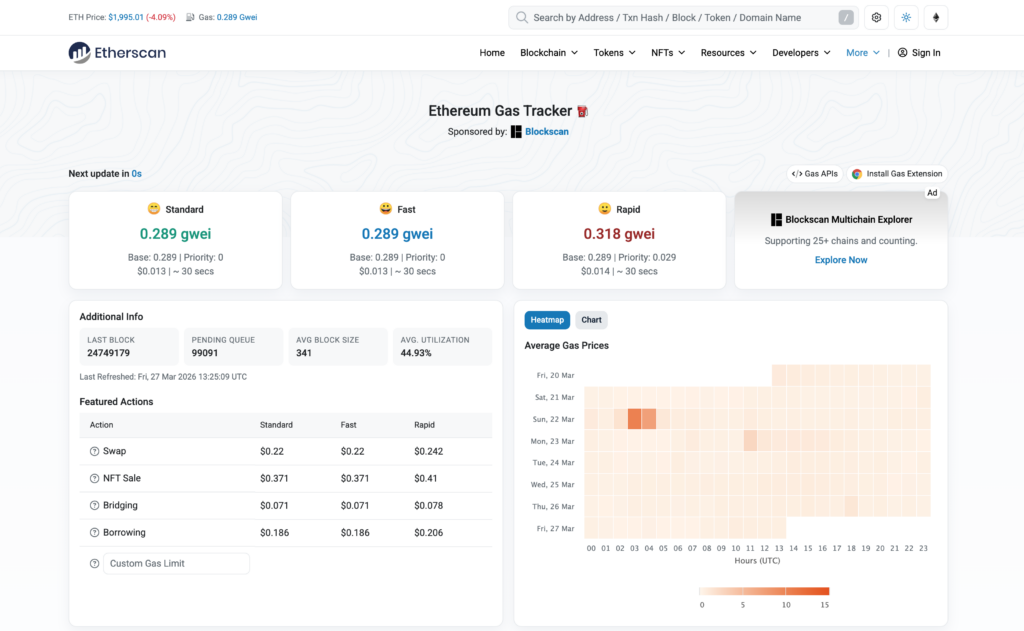
Gas prices decrease when traffic is light, making transactions more affordable. Fees usually drop during weekends or late at night, when there are fewer people waiting for transactions. If you concentrate on low prices, keep an eye on your traffic. Gas fee trackers could help check network conditions and suggest the best time.
Why Do Gas Fees Spike?
The price of gas is fluid. It tends to spike during periods of high network demand. Events like:
- ICO Boom of 2017
- DeFi Summer of 2020
- NFT Boom
These lead to a surge in transaction volume, driving up the price of gas. Solutions like Layer-2 scaling technologies help to mitigate these spikes by offloading transactions to secondary networks.
Who Receives Gas Fees?
Fees go to validators, who process and confirm transactions. On Ethereum, validators’ rewards were once paid to miners under Proof-of-Work, but after The Merge, they now go to validators who stake ETH to secure the network.
But the gas fee is not the only one you should know about. The base fee is an obligated payment calculated based on demand for Ethereum’s block space. This amount is getting burned to reduce the supply of ETH. Transactions waiting to be processed sit in the mempool, and higher tips help prioritize them.
Gwei to Gas Fee Example
Here is the formula for a transaction on the Ethereum network:
(Base Fee + Tip) x Gas Limit = Total Transaction Fee
Let’s calculate how much it costs to send ETH with a base fee of 50 gwei, a tip of 5 gwei, and a limit of 21,000:
(50 gwei + 5 gwei) x 21,000 = 1,155,000 gwei (or 0.001155 ETH)
Advanced Gas Controls
Every transaction in every wallet has the default blockchain fee settings. But if you are serious about crypto and have some remarkable experience, you may be interested in advanced gas control. Essentially, it is a solution for users who want to maximize profits and manage their fees through a mathematical approach.
Most wallets have the option to enter a very specific amount for a gas limit and gwei.
Want to avoid high gas fees? Try swapping crypto on Swapzone!
There is no need to deep dive into complicated fee structures. With Swapzone, you can swap Ethereum, USDT, and over 2000+ cryptocurrencies with zero hidden fees. We cover all the gas fees for you, ensuring a smooth, cost-efficient transaction experience.
Practical Tips for Lowering Gas Fees
To reduce gas costs, look into:
- Timing Your Transactions: Use gas fee trackers to identify the best affordable time.
- Batching Transactions: Combine transactions when possible to reduce the number of fees paid.
- Switching Networks: Meaning using networks with lower fees, such as BNB Smart Chain or Polygon, instead of Ethereum.
Additional Concepts
How Do Gas Fees Work on the Ethereum Network?
Gas fee on Ethereum is pais to validators and miners for processing transactions. The base fee changes depending on network activity, and users can add a priority fee to speed up their transactions.
What Are Sidechains?
Crypto sidechains are blockchains connected to Ethereum that help process transactions much faster and with lower computation costs. Examples include Polygon and Arbitrum.
What Is Polygon (MATIC)?
Polygon (MATIC) is a Layer-2 solution for Ethereum that improves scalability and reduces your fees by processing transactions off-chain before confirming them on Ethereum’s main network.
What Are Ethereum Layer-2 Blockchains and How Do They Work?
Layer-2 blockchains sit on top of Ethereum and handle transactions off-chain. This reduces congestion, lowers protocol fees, and speeds up transactions while maintaining Ethereum’s security.
FlexGas: A Smarter Way to Pay
Trust Wallet’s FlexGas allows users to pay fees with USDT, USDC, or TWT, instead of using Ethereum’s native token (ETH or BNB). This simplifies transactions and eliminates the need to maintain multiple token balances. MetaMask, another crypto wallet, lets you pay with USDT and USDC.
Summary
Gas fees are essential for maintaining blockchain operations. By understanding how they work, you can manage and minimize their impact on your transactions. Tools like MetaMask and Trust Wallet offer solutions to help you control your transfer costs, improving your crypto experience.
Key Takeaways
- Gas fees incentivize network validators and miners.
- Fees change depending on how complicated the transaction is and how much demand there is on the network.
- FlexGas and Layer-2 solutions offer alternatives to reduce gas costs.
FAQs
If the price is too low, your transaction may not be processed in a timely manner or could get stuck for a big moment.
Yes, MetaMask allows you to pay with tokens like USDT and USDC, depending on the network.
Brief Conclusion
Gas fees are an essential aspect of blockchain transactions, ensuring smooth operations, incentivizing validators, and preventing spamming.


