Summarize with AI





When comparing DEX vs CEX in 2026, the differences are stark. Centralized exchanges (CEXs) like Binance offer high liquidity. Specifically, they processed $19.17 trillion in annual spot trading volume for 2025. Moreover, these platforms provide user-friendly interfaces and fiat on-ramps. However, they require custody of your private keys.
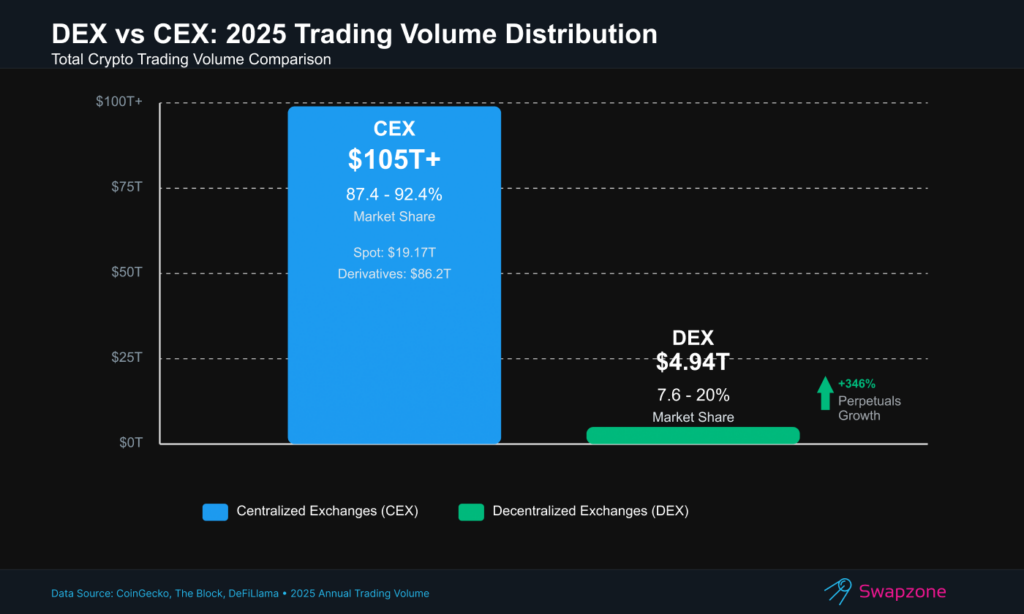
In contrast, decentralized exchanges (DEXs) like Uniswap work differently. They provide non-custodial trading where you control your assets. In fact, DEXs captured 7.6-20% of total crypto trading volume across 2025. Meanwhile, aggregators like Swapzone bridge both worlds by comparing rates across 18+ platforms without custody.
The DEX vs CEX Shift in Crypto Trading
The cryptocurrency trading landscape has transformed dramatically. For instance, DEXs evolved from capturing just 1% of spot volume in 2020 to claiming peaks above 20% by certain quarters of 2025. At the same time, CEXs adapted with enhanced security measures and regulatory compliance.
As we move through 2026, understanding the DEX vs CEX differences becomes crucial. Consequently, real trading volumes, security statistics, and user growth data back these distinctions.
What Is a Centralized Exchange (CEX)?
A centralized exchange operates as a digital marketplace managed by a single organization. These platforms ensure liquidity and maintain security protocols. Furthermore, they act as trusted intermediaries between buyers and sellers.
CEX Market Dominance
CEXs dominate the cryptocurrency market with 87.4-92.4% of total crypto trading volume throughout 2025. For example, Binance alone handled $7.25 trillion in spot trading volume during 2025, maintaining a 38.3% market share. Additionally, the top 10 centralized exchanges combined for $18.7 trillion in spot volume, demonstrating the concentrated liquidity these platforms provide.
KYC Requirements and Custody
These exchanges require users to complete Know Your Customer (KYC) verification processes. In fact, approximately 90% reported full KYC compliance in 2025 as regulatory frameworks tightened globally. Consequently, users deposit their cryptocurrency into custodial wallets controlled by the exchange, surrendering direct control of private keys in exchange for convenience and institutional-grade security measures.
Popular CEX examples include Binance, which processed $27.04 trillion in derivatives volume during 2025. Similarly, Bybit achieved $1.47 trillion in annual spot volume. Meanwhile, MEXC became the fastest-growing major exchange at 90.9% year-over-year growth, reaching $1.5 trillion in 2025 volume.
What Is a Decentralized Exchange (DEX)?
A decentralized exchange enables peer-to-peer cryptocurrency trading through smart contracts on blockchain networks. Importantly, this eliminates intermediaries and allows users to trade directly from their non-custodial wallets. As a result, traders maintain control of their private keys throughout the entire transaction process.
DEX Market Growth in 2025
DEXs captured between 7.6% and 20% of total crypto trading volume across different quarters in 2025. In particular, Q2 2025 alone saw DEXs process $876.3 billion in spot trading volume, representing a 25% increase from the previous quarter. Moreover, the perpetual contracts market on DEXs exploded to $6.7 trillion in 2025-a remarkable 346% increase from 2024’s $1.5 trillion.
User adoption surged throughout 2025. Specifically, 9.7 million unique wallets interacted with DEXs by mid-year, up 43% from 6.8 million in 2024. Perhaps most tellingly, 34% of new traders selected a DEX as their first platform in 2025, compared to just 22% in 2024, indicating a generational shift in how people approach crypto trading.
How DEXs Work
The technical foundation of most DEXs relies on Automated Market Makers (AMMs), which use liquidity pools funded by users rather than traditional order books. In particular, Ethereum-based DEXs account for approximately 87% of decentralized trading by volume. However, other chains like Solana have captured substantial market share, processing $451.2 billion in perpetual DEX trading volume during 2025-surpassing all previous years combined on that network.
Leading DEX Platforms
Leading DEX platforms include Uniswap, which processed over $1 trillion in trading volume during 2025 across 915 million swaps while maintaining a 35.8% market share among DEXs, according to DeFiLlama. Similarly, PancakeSwap achieved 7.4 million unique users in Q2 2025. Additionally, specialized perpetual DEXs like Hyperliquid achieved $2.95 trillion in total trading volume for 2025, commanding 73% of the perpetual DEX market share.
What Is a DEX Aggregator?
A DEX aggregator functions as a smart routing layer that queries multiple decentralized exchanges simultaneously to find the best available prices for token swaps. Instead of manually checking rates across dozens of platforms, traders use aggregators that automatically split orders across multiple liquidity sources to minimize slippage and maximize execution quality.
How Aggregator Algorithms Work
These platforms employ sophisticated algorithms to optimize trade routing. For instance, 1inch’s Pathfinder algorithm scans over 400 liquidity providers across 12 blockchains, reducing gas fees by up to 6.5% compared to single-DEX trades. As a result, 1inch and similar aggregators like Matcha collectively routed approximately $3.9 billion in weekly trading volume, demonstrating significant user reliance on these optimization tools.
Top DEX Aggregators
Leading DEX aggregators include 1inch, which has executed over 29.7 million DeFi transactions with $1.2 billion in trading volume. Similarly, Jupiter dominates as the Solana aggregator processing $30.66 billion monthly through its Juno routing engine. Meanwhile, Rubic supports 70+ chains and integrates with 360+ DEXs and bridges for comprehensive cross-chain trading.
The concept extends beyond DEXs to centralized exchanges as well. For example, platforms like Swapzone operate as CEX aggregators, comparing rates from 18+ instant exchange services across 1,600+ cryptocurrencies. Founded in 2019, Swapzone maintains a 4.7/5 rating by providing transparent DEX vs CEX pricing without custody requirements or KYC verification.
DEX vs CEX: Security Comparison
Security represents one of the most critical differentiators in the DEX vs CEX debate. Indeed, each model presents distinct vulnerability profiles and risk factors that traders must understand before choosing where to store and trade their digital assets. According to Chainalysis, cryptocurrency security threats evolved significantly throughout 2025.
Centralized Exchange Security Risks
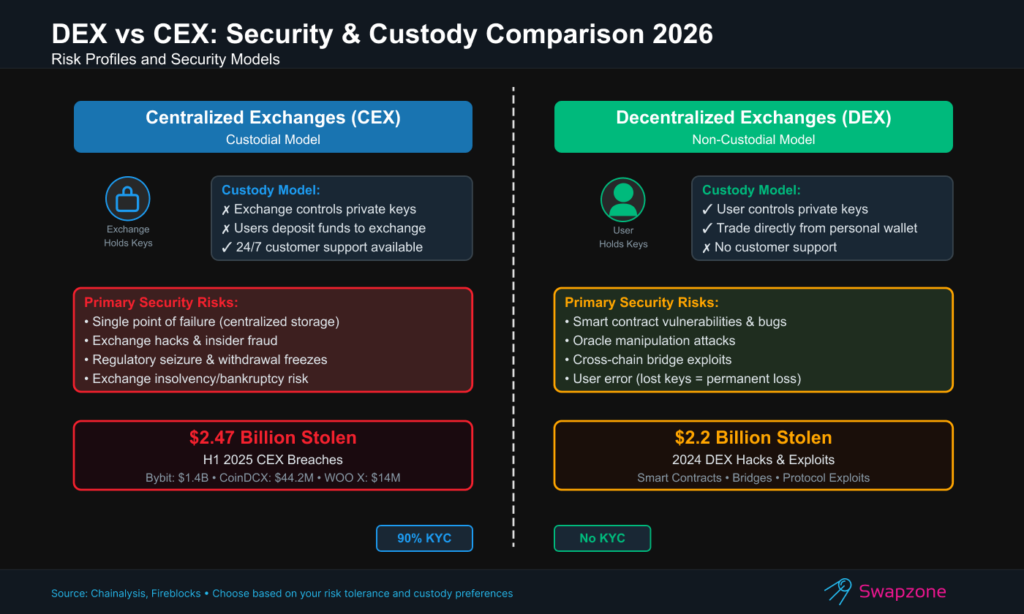
CEXs face concentrated security threats due to their custodial nature. When users deposit funds, the exchange holds private keys for all customer assets, creating a single point of failure that attracts sophisticated attackers. Consequently, the first half of 2025 proved devastating, with $2.47 billion stolen from cryptocurrency services, already surpassing total losses from 2024.
For instance, the Bybit breach in February 2025 marked the largest single theft in crypto history. Hackers stole $1.4 billion worth of Ethereum within minutes, accounting for approximately 69% of all stolen funds in H1 2025. Furthermore, in July 2025, CoinDCX suffered a $44.2 million breach linked to compromised employee credentials, while WOO X lost $14 million to a sophisticated phishing attack targeting a team member’s device.
North Korean state-sponsored hackers emerged as particularly prolific threat actors, responsible for stealing over $2 billion in cryptocurrency by October 2025-nearly triple their 2024 total. Beyond external threats, CEXs face risks from insider fraud, operational mismanagement, exchange insolvency, withdrawal freezes, and regulatory seizure. The centralized custody model means users must trust the exchange to operate fairly, maintain adequate reserves, and implement proper security protocols.
Decentralized Exchange Security Risks
In contrast, DEXs eliminate the custodial risk inherent in CEXs since users retain control of their private keys throughout trading. However, they introduce different security challenges centered on smart contract vulnerabilities and protocol-level exploits. In 2024, approximately $2.2 billion was stolen across DEX hacks and exploits, demonstrating that decentralization doesn’t eliminate security risks-it simply changes their nature.
Smart contract bugs represent the primary threat vector. Even thoroughly audited code can contain subtle vulnerabilities that attackers exploit to drain liquidity pools. Additionally, oracle manipulation attacks can trick protocols into accepting false price data, causing traders to receive unfair exchange rates. Moreover, cross-chain bridges connecting DEXs across different blockchains have proven especially vulnerable, with several high-profile bridge exploits accounting for hundreds of millions in losses.
The non-custodial nature of DEXs means users bear complete responsibility for managing their own security. Losing access to a wallet’s private keys or seed phrase results in permanent, irreversible loss of funds-no customer support team exists to assist with recovery. Similarly, approving malicious smart contracts or falling victim to phishing attacks can drain wallets instantly with no recourse for reversal.
Liquidity and Trading Volume: DEX vs CEX Comparison in 2026
Liquidity determines how easily traders can execute large orders without significantly impacting market prices, making it a crucial factor for both retail and institutional participants. Data from CoinGecko and The Block shows the DEX vs CEX liquidity gap narrowing throughout 2025.
CEX Liquidity Advantages
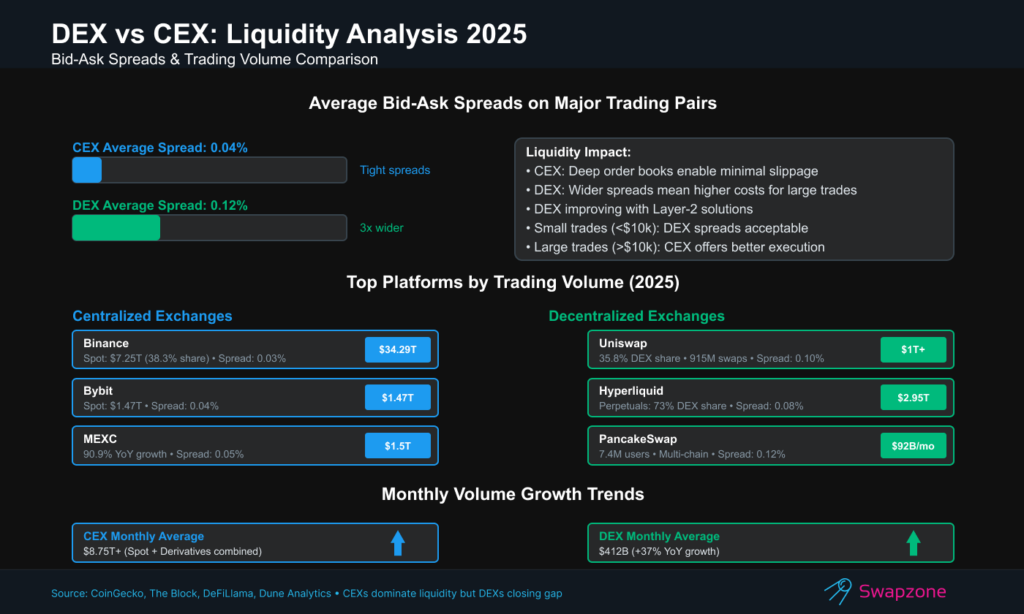
CEXs maintain overwhelming liquidity advantages through concentrated order books and massive user bases. Specifically, the top 10 centralized exchanges processed $18.7 trillion in spot trading volume during 2025, with derivatives adding another $86.2 trillion-a historical high representing 47.4% growth from 2024. Binance alone commanded 38.3% of CEX market share in December 2025, with average bid-ask spreads around 0.04% on major trading pairs.
This deep liquidity enables tight spreads and fast execution that institutional traders require. For example, when a trader executes a $10 million Bitcoin purchase on Binance or Coinbase, the order fills nearly instantly at predictable prices with minimal market impact.
DEX Liquidity Growth
In contrast, DEXs have closed the liquidity gap considerably, though they still trail CEX depth on most trading pairs. The DEX market processed approximately $412 billion in average monthly volume throughout 2025, representing 37% year-over-year growth. Moreover, weekly trading volume averaged $18.6 billion in Q2 2025, climbing to $86 billion by January 2026-a 12% weekly increase demonstrating accelerating adoption.
However, average bid-ask spreads on top DEX pools remain around 0.12%, three times wider than CEX spreads, indicating less dense liquidity. Nevertheless, for smaller trades in popular pairs like ETH to USDT, DEX liquidity often proves sufficient with minimal slippage, though larger trades exceeding $10,000 frequently experience significant price impact.
Layer-2 Solutions Impact
Layer-2 scaling solutions have dramatically improved DEX competitiveness in both speed and cost. For instance, Arbitrum, Optimism, and Base collectively process over $15 billion in monthly swap volume, with average gas fees 95% lower than Ethereum mainnet. Meanwhile, Solana-based DEXs process over $1.5 billion in daily trades with block times under 400 milliseconds and transaction costs below $0.01, rivaling centralized exchanges in speed and cost efficiency.
The top DEXs by weekly volume in early January 2026 included Meteora leading at over $10 billion, followed by Uniswap at $10 billion, PancakeSwap at $5.54 billion, and Raydium at $2.72 billion, according to Dune Analytics. These figures demonstrate that leading DEXs now handle institutional-grade daily volumes comparable to smaller CEXs.
User Experience: DEX vs CEX in 2026
The practical experience of trading on centralized versus decentralized exchanges differs substantially, affecting everything from account setup to order execution and customer support.
CEX User Experience
Centralized exchanges prioritize user-friendly interfaces that resemble traditional stock trading platforms. The typical CEX onboarding process involves creating an account, completing KYC verification by submitting government-issued identification, and depositing funds through bank transfers or credit cards.
Once verified, traders access comprehensive dashboards with advanced charting tools and various order types. Additionally, approximately 80% of top-10 CEXs offer fiat on-ramps, allowing users to buy crypto directly with USD, EUR, or JPY through integrated payment processors-a feature virtually absent from pure DEXs.
Customer support teams available 24/7 can assist with forgotten passwords, frozen withdrawals, and technical issues. However, the tradeoff for this convenience is comprehensive data collection, as 90% of CEXs reported full KYC compliance in 2025.
DEX User Experience
In contrast, decentralized exchanges require users to connect non-custodial wallets like MetaMask or Ledger rather than creating traditional accounts. The learning curve is steeper, as users must understand concepts like gas fees, slippage tolerance, and liquidity pools before executing their first trade.
Nevertheless, DEX interfaces have improved dramatically. Modern platforms like Uniswap v4 and Jupiter feature intuitive swap interfaces that abstract technical complexity, showing clear fee breakdowns, estimated completion times, and price impact warnings.
Gas fees remain a significant user experience challenge. On Ethereum mainnet, a simple swap during network congestion might cost $30-50 in gas fees. However, Layer-2 solutions have largely solved this problem, reducing fees by 95%. Meanwhile, Solana DEXs charge less than $0.01 per transaction.
Fees: DEX vs CEX Trading Costs
Understanding the complete fee structure for each exchange type is essential for calculating actual trading costs and determining which platform offers better value for specific use cases in the DEX vs CEX decision.
CEX Fee Structure
CEXs employ transparent but multi-layered fee structures. Trading fees typically range from 0.1% to 0.3% per trade depending on the platform and user’s 30-day trading volume. For instance, Binance charges 0.1% for standard users but reduces fees to as low as 0.02% for users trading over $300 million monthly. Beyond trading fees, exchanges charge withdrawal fees that vary by cryptocurrency and deposit fees for certain payment methods.
For fiat deposits, CEXs charge between 0.5% to 4.99% depending on payment method. However, these platforms offer the unique ability to move directly between fiat and cryptocurrency without requiring multiple transactions.
DEX Fee Structure
In contrast, DEXs charge swap fees between 0.01% and 1%, with most mainstream platforms clustering around 0.3%. These fees go directly to liquidity providers who fund the pools enabling trades, rather than to a centralized company. For example, Uniswap v3 allows different fee tiers (0.01%, 0.05%, 0.30%, 1%) depending on pair volatility and competition.
The critical additional cost on DEXs is blockchain gas fees, which vary dramatically by network. Ethereum mainnet fees during congestion can exceed $50 per transaction, making DEX trading prohibitively expensive for small trades. Nevertheless, Layer-2 networks like Arbitrum and Optimism have reduced fees by 95%, charging $0.50-2 per transaction, while Solana transactions cost less than $0.01.
Hidden Costs: Slippage
Slippage represents another hidden cost on DEXs that traders must consider. When executing a $5,000 swap on a thin liquidity pool, the actual execution price might be 1-3% worse than the quoted price, effectively adding to trading costs. Meanwhile, CEXs with deep order books minimize slippage to negligible levels for all but the largest trades.
For large trades on popular pairs like BTC to ETH, CEXs typically offer lower total costs due to tighter spreads and absence of gas fees. In contrast, for small-to-medium trades on alternative networks or newer tokens not yet listed on CEXs, DEXs can be more cost-effective, especially when factoring in free withdrawals and no account maintenance fees.
The 10 Best Decentralized Exchanges in 2026
The DEX landscape features diverse platforms optimized for different use cases, blockchains, and trading strategies.
1. Uniswap
The pioneering AMM processed over $1 trillion in trading volume during 2025 across 915 million swaps, maintaining a 35.8% market share among DEXs according to Uniswap Labs. Deployed on 40+ blockchain networks, Uniswap v4 introduces customizable hooks enabling on-chain limit orders and dynamic fee structures.
2. Jupiter
Dominating Solana’s DEX ecosystem, Jupiter processes $30.66 billion in monthly volume through its Juno routing engine that intelligently splits trades across dozens of Solana DEXs and market makers.
3. PancakeSwap
The BNB Chain powerhouse recorded $92 billion in monthly trading volume during August 2025 with 7.4 million unique users in Q2 2025. Operating across multiple chains, PancakeSwap offers extremely low gas fees and high-APY farms.
4. Hyperliquid
This specialized perpetuals DEX achieved $2.95 trillion in total trading volume during 2025, commanding 73% of the perpetual DEX market share according to CoinMarketCap. The platform averages $8.34 billion in daily volume and has pioneered tokenized stock trading.
5. Raydium
A leading Solana DEX combining AMM pools with an on-chain order book, Raydium processed $2.72 billion in weekly volume during early January 2026.
6. Curve Finance
Specialized for stablecoin and similar-asset swaps, Curve maintains relevance in 2026 with $9.4 million in daily volume, making it the preferred platform for large stablecoin conversions.
7. Meteora
Emerging as a Solana ecosystem leader, Meteora claimed the #1 spot among DEXs by weekly volume in early January 2026, processing over $10.8 billion weekly.
8. Orca
Known for its user-friendly interface and concentrated liquidity pools on Solana, Orca achieved $1.61 billion in weekly volume.
9. 1inch
As a DEX aggregator rather than a standalone exchange, 1inch scans liquidity across 400+ providers spanning 12 blockchains to guarantee optimal execution.
10. SushiSwap
Evolved from a Uniswap fork into a comprehensive DeFi platform operating across 30+ blockchain networks with consistent experiences.
When to Use a CEX vs When to Use a DEX
Choosing between centralized and decentralized exchanges depends on your specific needs, technical comfort level, and trading priorities.
Use a CEX when you need fiat on-ramps and off-ramps to convert between traditional currency and cryptocurrency. Additionally, use CEXs when you require responsive customer support for account issues or frozen transactions. Furthermore, they’re ideal when you want to trade derivatives and margin products with high leverage or engage in high-frequency trading requiring institutional-grade liquidity.
Use a DEX when privacy is paramount and you want to trade without KYC verification or personal data collection. Moreover, use DEXs when maintaining custody of your assets throughout transactions is non-negotiable, avoiding exchange insolvency risks. Additionally, they’re essential when trading niche or newly-launched tokens not yet listed on centralized platforms or when participating in DeFi ecosystems requiring direct protocol interaction.
Use an aggregator when you want the best available rates without committing to a single platform. For instance, platforms like Swapzone’s multi-chain DEX aggregator or its traditional exchange comparison service for centralized options provide this flexibility without requiring custody or registration.
Many sophisticated traders maintain accounts on both exchange types, using CEXs for fiat conversion and high-volume trading while leveraging DEXs for privacy-sensitive transactions, new token access, and DeFi participation.
The Future of Crypto Trading: CEX, DEX, and Aggregators in 2026 and Beyond
The cryptocurrency exchange landscape continues evolving rapidly, with several clear trends emerging that will shape trading infrastructure through the rest of the decade.
Hybrid Exchange Models
Hybrid models combining CEX convenience with DEX custody are proliferating. For example, some centralized exchanges now offer self-custody options or integrate with non-custodial wallets, reporting up to 18% higher deposit inflows than pure custodial models. Conversely, certain DEXs are exploring optional KYC layers and compliance features to attract institutional capital while maintaining permissionless access for retail users.
Regulatory Framework Development
Regulatory frameworks solidified throughout 2025, with the European Union’s MiCA regime becoming operational and establishing clear licensing requirements for crypto asset service providers. In the United States, the GENIUS Act signed into law in July 2025 established safeguards for payment stablecoins. Meanwhile, 99 jurisdictions implemented the Travel Rule for virtual asset service providers, requiring exchanges to collect and share customer information for transactions above certain thresholds.
This regulatory clarity, while increasing compliance burdens for exchanges, reduces market uncertainty and enables broader institutional adoption. Consequently, both CEXs and compliant DEX interfaces are adapting to these new frameworks while maintaining their core value propositions.
Cross-Chain and Layer Scaling
Cross-chain dominance is expected to accelerate as bridge aggregators and Layer-3 scaling solutions simplify asset movement between blockchains. DEX aggregators that seamlessly route trades across Ethereum, Solana, BNB Chain, and emerging networks will capture increasing market share as users demand unified liquidity access.
Already, platforms like Rubic demonstrate this multi-chain future by supporting 70+ chains and 360+ DEXs. Layer-2 and alternative Layer-1 adoption will continue redistributing DEX activity away from expensive Ethereum mainnet. As these networks mature offering 95% fee reductions and sub-cent transactions, more sophisticated DeFi applications will emerge, with complex derivatives and institutional-grade products migrating on-chain.
Market Share Projections
Market share projections suggest DEXs could capture 20-30% of total crypto trading volume by 2030 if current growth trends persist. Indeed, the 346% increase in DEX perpetual volume during 2025 indicates derivatives trading-historically a CEX stronghold-is rapidly decentralizing. As protocols like Hyperliquid prove that sophisticated trading products can operate without centralized intermediaries, more traders will migrate to non-custodial alternatives.
The Role of Aggregators
The role of aggregators becomes increasingly critical as liquidity fragments across hundreds of venues. Rather than users picking sides between CEX and DEX, intelligent routing layers will abstract away this choice, automatically directing each transaction to wherever execution is optimal. This infrastructure layer connecting traditional and decentralized finance represents perhaps the most important development for practical crypto adoption.
Conclusion
The DEX vs CEX choice in 2026 isn’t binary-both models serve essential functions within the broader crypto ecosystem.
CEXs processed $105+ trillion in combined trading volume during 2025, maintaining 87.4-92.4% market share through superior liquidity, user-friendly interfaces, fiat integration, and comprehensive trading features. However, their custodial model introduces security risks demonstrated by $2.47 billion in losses during H1 2025, as reported by Fireblocks.
In contrast, DEXs captured 7.6-20% of trading volume across 2025’s quarters with 9.7 million active wallets and $412 billion in average monthly volume, offering genuine financial sovereignty where users control private keys, trade anonymously, and access thousands of tokens immediately upon launch.
For traders who want to access both CEX and DEX liquidity without choosing sides in the DEX vs CEX debate, platforms like Swapzone aggregate rates from 18+ exchanges, offering transparent comparison across 1,600+ cryptocurrencies with no custody requirements or KYC verification. By comparing offers from both centralized partners and decentralized protocols simultaneously, aggregators help traders find optimal rates whether swapping Bitcoin, Ethereum, Uniswap tokens, or any of the thousands of available digital assets.
Ultimately, the future of crypto trading isn’t CEX versus DEX-it’s CEX and DEX working together through intelligent aggregation layers that route each transaction to wherever execution is best. As regulatory frameworks mature, technology improves, and user education spreads, both models will coexist serving different needs within an increasingly sophisticated financial ecosystem. The DEX vs CEX comparison will continue evolving as each model adapts to market demands.
Ready to find the best rates across centralized and decentralized exchanges? Explore your options on Swapzone and discover competitive pricing without custody or registration requirements.
Resources and References
This DEX vs CEX comparison guide draws on data and insights from leading industry sources:
Market Data & Analytics
- CoinGecko – Comprehensive cryptocurrency market data and trading volume statistics
- The Block – Real-time crypto market research and institutional trading data
- CoinMarketCap – Global cryptocurrency rankings and market capitalization tracking
- DeFiLlama – DeFi protocol analytics and total value locked (TVL) data
- Dune Analytics – On-chain data visualization and DEX trading metrics
Security Research
- Chainalysis – Blockchain intelligence and cryptocurrency security threat analysis
- Fireblocks – Digital asset security infrastructure and breach reporting
DEX Platforms & Aggregators
- Uniswap Labs – Leading decentralized exchange protocol documentation
- 1inch – DEX aggregator with multi-chain routing capabilities
- Jupiter – Solana’s premier DEX aggregator platform
- Rubic – Cross-chain DEX aggregator supporting 70+ networks
Exchange Aggregation
- Swapzone – CEX and DEX rate comparison across 18+ platforms without custody