

Uniswap (UNI) Exchange
Looking to exchange UNI? Swapzone compares live offers from partner exchanges by rate, speed and KYC label. No account, no custody, 0% platform fee. UNI is an ERC-20 token on Ethereum and also available on several L2 networks: confirm the network.


Swapzone fee: 0%

Uniswap Market Data & Key Metrics
PriceUniswap Price Chart and Market Analysis
Popular UNI Exchange Pairs


Other Cryptocurrencies to Exchange
 Cardano
 Solana
 GRAM
GRAM Pirate Chain
 Game7
Game7 MMT
MMT Banana For Scale
 Babylon
 Kekius Maximus (kekiusmaximus.vip)
 tokenbot
 DRV
DRV Avalon Labs (AVL)
 CZ'S Dog (broccoli.gg)
 MyShell
 Heima
Heima DIAM
DIAM Story
Story KAITO
KAITOPopular Alternatives to Buy
What is UNI?
About Uniswap
UNI is the governance and value-accrual token of Uniswap, a decentralized exchange (DEX) protocol launched in November 2018. Uniswap pioneered the automated market maker (AMM) model that eliminated traditional order books: liquidity providers deposit token pairs into smart contract pools, and traders swap against that pooled liquidity at algorithmically determined prices. Founded by Hayden Adams, Uniswap has evolved through four protocol versions (V1 through V4), deployed across many blockchain networks, and in 2025 launched Unichain, its own Optimism-based Layer 2 blockchain purpose-built for DeFi trading. The UNI token was introduced on September 16, 2020 through a retroactive airdrop to users who had interacted with the protocol.
UNI tokenomics
UNI's tokenomics fundamentally changed in December 2025 when the DAO passed the UNIfication proposal with 125.34 million votes in favor. Before UNIfication, UNI was a governance-only token with no direct link to the trading fees generated by Uniswap's pools. UNIfication activated the fee switch and created an automated buy-and-burn mechanism, permanently shifting UNI from passive governance to deflationary value accrual.
Maximum supply — 1,000,000,000 UNI (1 billion)
Treasury burn — 100 million UNI permanently destroyed from the treasury on 28 December 2025 as part of UNIfication
Fee switch mechanism — protocol fees collected from V2 and V3 pools (V4 pools are subject to a separate governance vote) flow into TokenJar; accumulated fees are used to buy UNI on the open market and burn tokens permanently through Firepit
Unichain sequencer revenue — net sequencer fees from Unichain (after L1 data costs and a 15% share to Optimism) are routed directly into the UNI burn mechanism
Protocol Fee Discount Auctions (PFDA) — traders bid for short-window fee exemptions; winning bids are burned as UNI
Growth budget — 20 million UNI per year allocated for ecosystem growth; for UNI to become structurally deflationary, the burn rate must exceed this issuance
What determines UNI's value
UNI's value is now directly tied to Uniswap's trading volume across all deployments. Every swap on a fee-switch-enabled pool generates protocol revenue that flows to UNI burns through the TokenJar/Firepit mechanism, and sequencer fees from Unichain feed the same burn mechanism. The more volume the protocol captures, the more UNI can be burned.
Uniswap V4, launched with hooks (customizable smart contract logic that developers embed directly into liquidity pools), expands the protocol's addressable market beyond simple token swaps into dynamic fee management, impermanent loss hedging, MEV protection, and KYC-gated institutional pools.
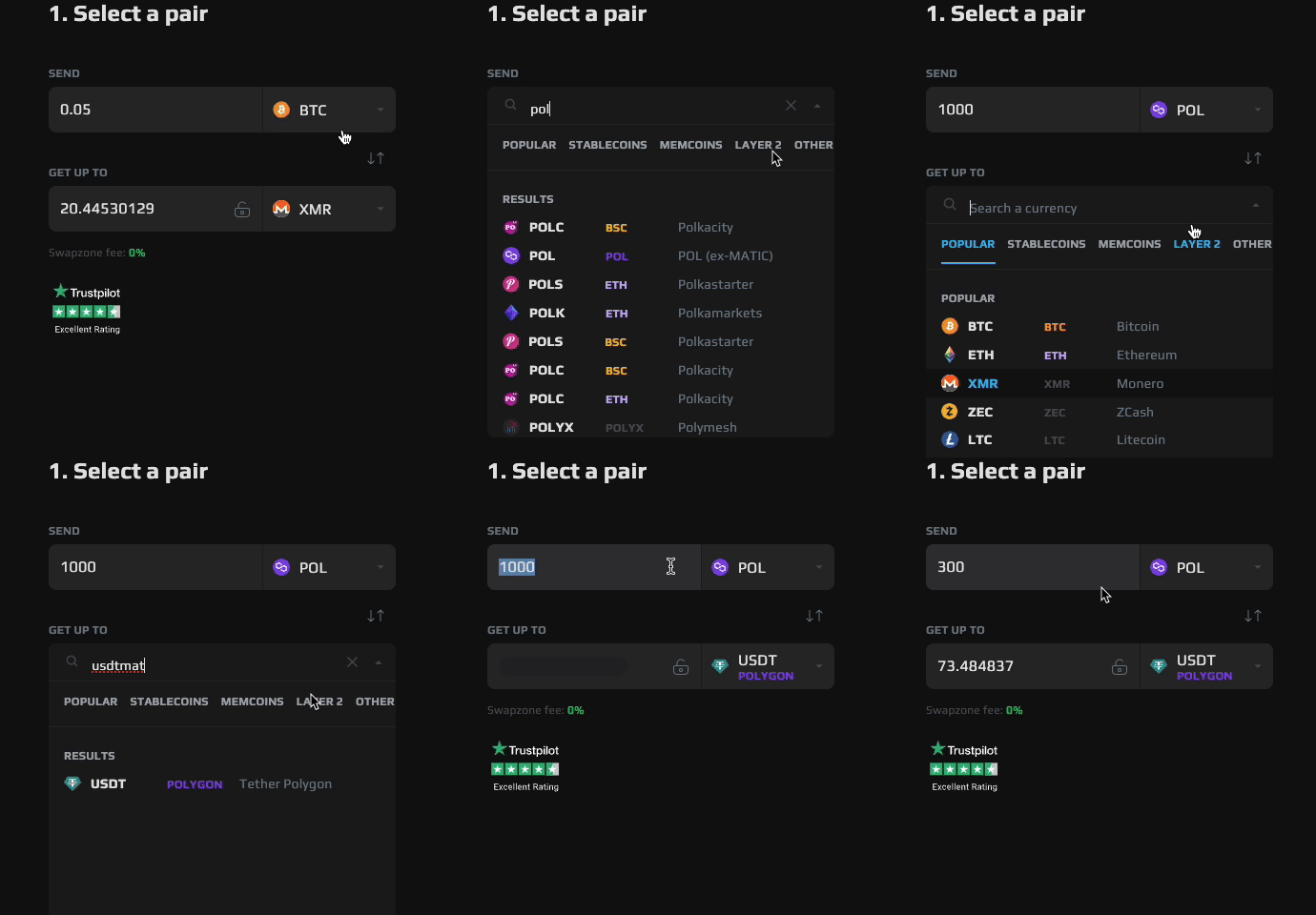
How to Exchange Uniswap on Swapzone

How to Choose a Uniswap Exchange


Uniswap (UNI) Price Analysis
Frequently Asked Questions About Uniswap (UNI)

UNI is the governance token of Uniswap, and since the December 2025 UNIfication proposal it also accrues value: protocol fees buy UNI on the open market and burn it. Before that vote it was governance-only with no direct link to fees.
It is the proposal the Uniswap DAO passed in December 2025 with 125.34 million votes in favor. It activated the fee switch, created an automated buy-and-burn mechanism, and burned 100 million UNI from the treasury.
Protocol fees from V2 and V3 pools (V4 pools are subject to a separate governance vote) flow into TokenJar. The accumulated fees are used to buy UNI on the open market, and the purchased tokens are burned permanently through Firepit.
Unichain is Uniswap's Optimism-based Layer 2, launched in 2025. Its net sequencer fees, after L1 data costs and a 15% share to Optimism, go into the UNI burn mechanism.
Traders bid for short windows of fee exemption, and winning bids are burned as UNI.
Not automatically. The maximum supply is 1 billion UNI and the treasury burn removed 100 million, but 20 million UNI per year is allocated to ecosystem growth. UNI becomes structurally deflationary only if the burn rate exceeds that issuance.
Hooks are customizable smart contract logic that developers embed directly into liquidity pools. They enable dynamic fees, impermanent loss hedging, MEV protection, and KYC-gated institutional pools.
BlackRock's tokenized US Treasury fund BUIDL, issued with Securitize, became tradable through UniswapX on 11 February 2026, for qualified, whitelisted institutional investors only. Robinhood Chain launched on mainnet on 1 July 2026, and Uniswap deployed an automated market maker there as its main public liquidity layer. Neither is a forecast of demand for UNI.
UNI was introduced on September 16, 2020 through a retroactive airdrop to users who had already interacted with the Uniswap protocol.
UNI is an ERC-20 token on Ethereum and is also available on several L2 networks. Send on the network the swap offer states; the same 0x address format is used on several networks, so a wrong-network transfer is easy to make and hard to recover.
Open swapzone.io/exchange/uniswap, enter the amount, and compare offers. Paste your receiving address, send UNI to the generated deposit address on the stated network, and track the order. No MEMO is needed.
Why Exchange Uniswap with Swapzone?

Non-custodial aggregator: you send UNI to the partner's deposit address and receive funds in your own wallet, never through Swapzone.

Live UNI offers from exchange partners side by side.

Swap UNI with 1,800+ cryptocurrencies."

Reviews from TrustPilot


Good and Fast Support
Tyler from Swapzone's Support team was very kind and helps me out proactively. Highly recommend this site.
Excellent and reliable platform
Reliable and easy to use without the cumbersome KYC! Excellent exchange platform.
Quick service
Quick service. Transaction was processed with ease. Thank you Swapzone
Learn More About Cryptocurrencies


Our exchange partners for Uniswap
Contact us for partnership