Summarize with AI





Key Takeaways
- Hidden fees in crypto can account for 1-5% in transaction costs, often obscured from advertised rates.
- Types of hidden fees include spread markup, rate padding, network fee inflation, and slippage, which significantly increase actual costs.
- Users should always compare rates across multiple platforms to uncover hidden fees and save money on transactions.
- Swapzone helps reduce hidden fees in crypto by enabling transparent comparisons across 18+ exchanges and showing all-inclusive rates.
- Understanding these hidden fees can help users make informed trading decisions and minimize their transaction costs.

When you buy or sell cryptocurrency, advertised rates rarely show the complete picture. Hidden fees in crypto including transaction costs, exchange fees, and withdrawal charges – can extract 1-5% from every swap without appearing on fee schedules. A comprehensive investigation analyzing $1 million in test swaps revealed that advertised fees represent only 30-50% of actual cryptocurrency transaction fees.
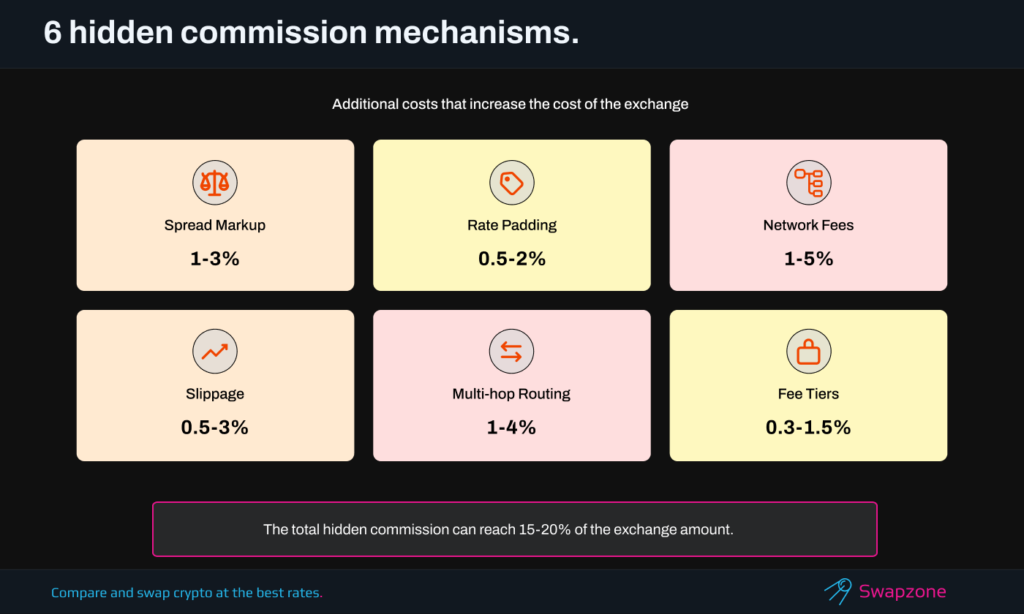
Understanding transaction fees explained transforms casual crypto users into informed traders. This guide breaks down six hidden fee mechanisms that drain value from your crypto transactions and shows you how to minimize these costs.
Types of Fees That Cost You More Than Expected
The cryptocurrency exchange industry extracts value through multiple hidden mechanisms. These types of fees work together, creating substantial gaps between advertised and actual costs.
Spread Markup: The Invisible Transaction Fee
Spread markup represents the most common hidden fee mechanism. Platforms quote buy/sell prices that differ from actual market rates, pocketing the difference without displaying it as a fee. Independent testing found platforms advertising “zero fees” consistently embedded 1-3% spreads in their exchange rates.
This technique succeeds because users must actively compare quotes to price trackers like CoinGecko or CoinMarketCap to detect it. Most never take this step, losing hundreds in hidden transaction costs annually.
Rate Padding and Conversion Fees
Rate padding adds invisible margins to mid-market rates. Conservative implementations extract 0.5-1%, while aggressive platforms take 2-3% per swap. Conversion fees amplify these costs fiat-to-crypto transactions often include currency exchange markups of 1-2% on top of crypto spreads.
For example, using a wire transfer to buy crypto with EUR involves converting EUR to USD (with markup), then USD to crypto (another markup). Each step extracts value through hidden costs.
Network Fee Inflation: When Withdrawal Fees Don’t Match Reality
Network fee inflation has become what analysts call one of the sneakiest hidden fee mechanisms. Blockchain networks charge actual gas fees of $5-20 for Ethereum transactions. Yet some platforms charge $15-50+ a markup of 50-200% over actual network costs.
Research on hidden crypto exchange fees found users rarely question whether charged amounts reflect reality. A Bitcoin withdrawal fee of $20 when actual network costs sit at $3-5 represents pure platform profit.
Monitor withdrawal fees against blockchain conditions using tools like Etherscan Gas Tracker. Platforms charging consistent rates regardless of network congestion are likely inflating transaction fees.
Slippage: Trading Fees You Can’t See Coming
Slippage occurs when platforms execute trades at worse prices than necessary, keeping the difference. Natural market slippage from volatility typically costs 0.5-1%. However, intentional slippage through delayed execution can add 1-5% to transaction costs.
Kraken’s slippage analysis recommends custom tolerance settings below 1%. Yet most users accept platform defaults of 0.5-1%, creating targets for value extraction. This represents a hidden fee that never appears in advertised fee structures.
Multi-Hop Conversions Multiply Hidden Costs
Multi-hop conversions accumulate hidden fees when trades require intermediate steps. Each conversion adds 0.3-0.7%. A three-step conversion (crypto to crypto to fiat) can lose 2-4% before funds reach your bank through deposit and withdrawal fees.
Platforms using proprietary internal rates extract additional value at each hop. Converting BTC to EUR might route through BTC→USDT→USD→EUR, with each step taking a cut through multiple exchange fees.
Deceptive Fee Tiers Promise Rates You’ll Never Access
Fee structures often promise headline rates requiring massive volumes to unlock. The “$0.1% trading fee” typically requires $10-250M monthly volume. Retail traders actually pay 0.4-0.6% after all conditions apply.
This creates misleading advertising targeting the best crypto exchange searches. New users see attractive rates during research but discover those rates apply only to institutional traders. Actual costs for regular users sit much higher.
Real Platform Data: What You Actually Pay Across Crypto Exchanges
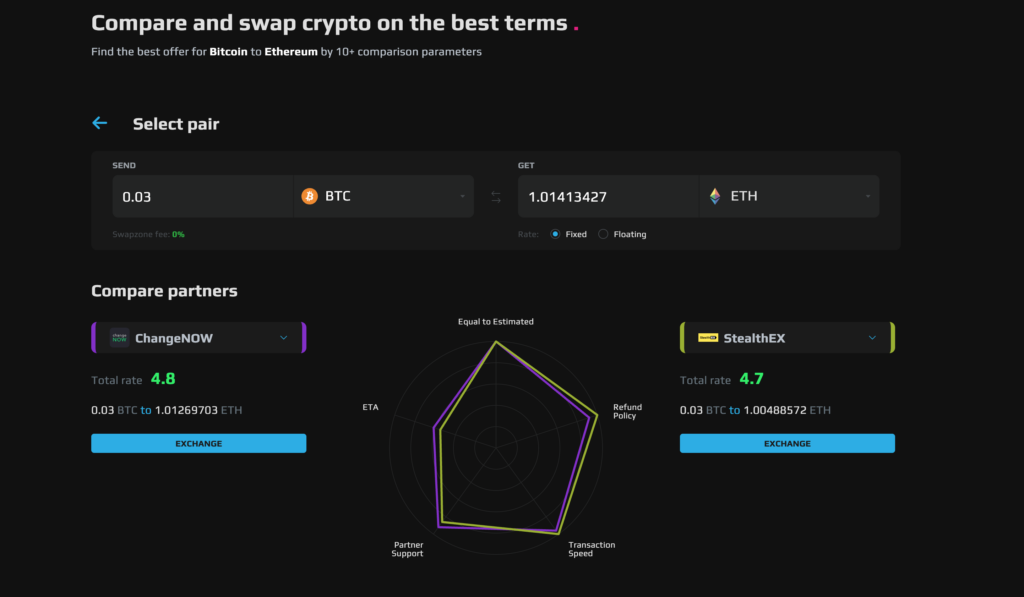
Independent testing across major instant swap services reveals that actual crypto exchange fees can vary significantly depending on multiple factors like market conditions, liquidity, blockchain congestion, and exchange routing. The same $1,000 BTC-to-ETH swap executed across different platforms at different times can show variations of 0.3-1.5% in total costs.
This variation stems from how each platform structures its fee model:
- Fixed-rate platforms: Typically charge 0.5-1.5% in total costs, offering guaranteed rates but often with higher fees to compensate for market risk
- Floating-rate platforms: Usually provide better rates (0.3-1.2% total cost) but expose users to market volatility during transaction processing
- Network fee handling: Some platforms charge exact blockchain costs, while others add markups of 20-200%
- Spread differences: Mid-market rate variations of 0.2-0.8% between providers at any given moment
The key insight: no single platform consistently offers the best rates. Rate competitiveness shifts based on trading pairs, transaction sizes, market volatility, and blockchain network conditions. A platform offering the best rate for BTC-to-ETH at 9:00 AM might be 0.5% more expensive than competitors by 10:00 AM.
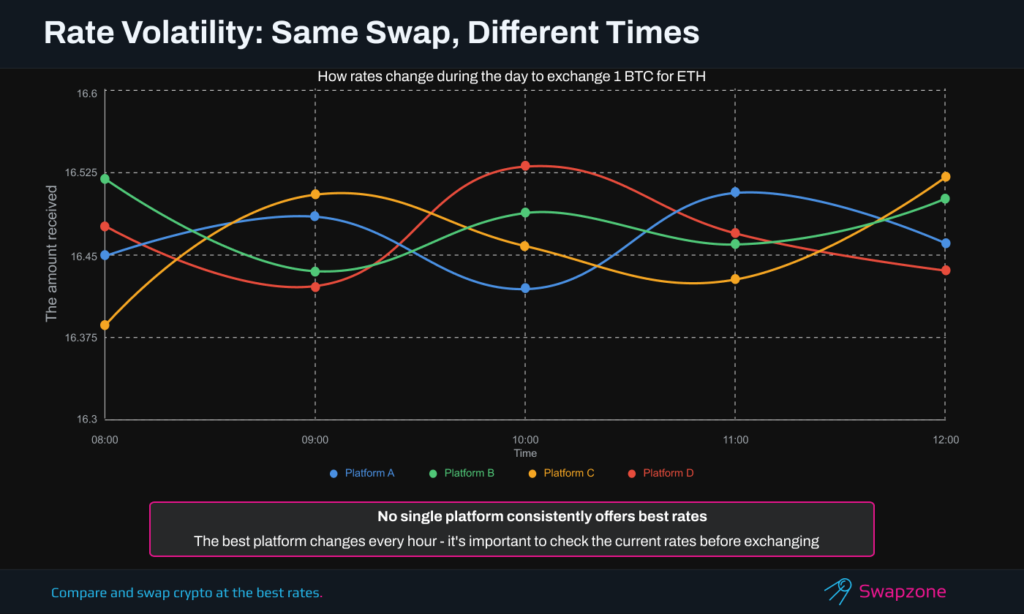
For users making $10,000 in monthly swaps, these rate variations compound to $360-1,200 annually in potential savings through consistent comparison. This represents money recovered from hidden spreads and inflated exchange fees by finding optimal rates for each specific transaction.
The $1 Million Investigation: Hidden Transaction Costs at Scale
A larger investigation analyzing $1 million in aggregate transaction volume across 25+ exchanges found troubling patterns. A detailed breakdown of a $10,000 trade through a “low fees” exchange revealed:
- Card deposit fees: $300 (3%)
- Trading fees: $81.60 (0.4% buy + sell)
- Hidden spread cost: $150 (1.5%)
- Withdrawal fee inflation: $65
- Total: $596.60 in fees on $400 profit = NET LOSS of $196.60
The investigation concluded that crypto platforms advertising 0.1% can cost substantially more than competitors openly charging 0.3% once all cryptocurrency transaction fees are included. Hidden fees during volatile periods pushed “zero fees” platform costs to 2-3% per trade.
Industry-Wide Hidden Transaction Fee Burden
Coinbase data illustrates the scale of crypto fees. The exchange collected $1.1 billion in trading revenue on $193 billion in volume effectively 0.57% per transaction. These crypto exchange fees make crypto trading 57x more expensive than traditional finance, where NYSE charges approximately 0.01% per transaction.
How Major Crypto Platforms Structure Transaction Fees
Understanding how different cryptocurrency exchange types implement fee structures helps you identify where hidden fees in crypto emerge:
Centralized Exchanges: Visible and Invisible Costs
Centralized exchanges like Binance and Coinbase typically charge fees through:
- Trading fees: 0.1-0.5% per trade (visible)
- Spread markup: 0.5-2% (hidden)
- Withdrawal fees: Often 2-5x actual network costs
- Fiat deposit and withdrawal fees: 1-5% depending on method
Popular crypto exchanges advertise low transaction fees while extracting value through hidden spreads and inflated network charges. The combination creates total costs of 1-3% per crypto transaction.
Instant Swap Services: Understanding Non-Custodial Fee Structures
Non-custodial instant swap platforms offer hidden fee transparency challenges due to their business model. These services provide privacy-focused, registration-free swaps a valuable service for users seeking anonymity. However, the convenience comes with specific cost structures:
- Rate padding: 0.5-3% above mid-market rates
- Network fee handling: Varies by platform, with some charging exact costs while others add markups
- Fixed-rate premiums: 0.3-1% for guaranteed price protection
These crypto platforms serve users prioritizing privacy and speed over minimal costs. Understanding their fee structures helps users make informed choices based on their priorities whether that’s anonymity, speed, or lowest possible rates. Different platforms excel in different scenarios, which is why comparison becomes crucial.
DEX Aggregators: Gas Fees and Hidden Transaction Costs
Decentralized crypto exchange aggregators like 1inch and Jupiter charge fees differently:
- No platform trading fees (advertised)
- Gas fees paid to blockchain networks
- Slippage: 0.5-5% depending on liquidity
- Router optimization fees: Often hidden in final rates
While DEX platforms advertise zero fees, transaction costs from slippage and gas fees can exceed centralized exchange fees for smaller trades. Understanding fees explained requires calculating total costs including all blockchain interactions.
Strategies to Reduce Hidden Fees in Crypto Transactions
Armed with knowledge about hidden fees in crypto, you can implement strategies to minimize transaction costs:
Always Compare Rates Across Multiple Crypto Platforms
Never accept the first quote. Compare crypto exchange fees across multiple services before executing swaps. Even 0.5% differences compound to hundreds annually at moderate volumes.
Use aggregators to surface rate variations that would otherwise require manually checking each cryptocurrency exchange. Users report savings of up to 20% through systematic comparison recovering money lost to hidden fees.
Calculate Total Transaction Costs Including All Fees
Calculate complete costs including:
- Trading fees (advertised)
- Spread markup (compare to mid-market rates)
- Deposit and withdrawal fees
- Network fees (verify against blockchain reality)
- Conversion fees for fiat transactions
Execute small test trades to measure actual versus expected outcomes. Review complete documentation, not just headline rates. Withdrawal charges, network fee markups, and currency conversion fees accumulate substantially.
Monitor Network Fees Against Blockchain Conditions
Monitor withdrawal fees against actual blockchain network conditions. Platforms charging $20 Bitcoin withdrawals when actual network fees sit at $1-5 extract 300-500% markups.
Test during low-congestion periods for baseline comparisons. This reveals whether platforms adjust based on actual conditions or maintain static markups regardless of blockchain state a key indicator of hidden fees.
Optimize DEX Trading to Lower Transaction Fees
For DEX trades, set slippage tolerance to 1% or less rather than accepting defaults. Break large orders into smaller chunks to reduce price impact. Trade during high-liquidity periods when natural slippage decreases.
Use limit orders instead of market orders for better price control. Limit orders execute only at specified prices, protecting against hidden transaction costs from slippage exploitation.
Review Terms for Hidden Exchange Fees
Check for inactivity charges and minimum balance requirements in terms of service. Review fee structures to understand what you’ll actually pay at your volume level. Advertised rates often require institutional-scale trading to access.
Many crypto platforms advertise their lowest fees without clarifying volume requirements. Retail traders making $10,000 monthly swaps never access rates designed for traders doing $100M monthly.
How Swapzone Eliminates Hidden Transaction Costs
Exchange aggregators address hidden fees in crypto by surfacing competition and enabling direct comparison. Swapzone, operating since 2019 as a “Skyscanner for crypto,” integrates with 18+ exchange partners covering 1,600+ cryptocurrencies across networks including Ethereum, BSC, Polygon, Avalanche, and TON.
Zero Platform Fees With Transparent Comparison
Swapzone charges users zero transaction fees. Instead, the platform earns revenue through affiliate commissions from exchange partners. Partners pay 0.05-0.25% of Swapzone’s profit per crypto transaction through volume-based tiers.
This model aligns incentives with finding users the best crypto rates. Swapzone only earns when partners complete transactions successfully no incentive to direct users toward higher-fee partners or hide costs.
Real-Time Rate Updates Show All Transaction Costs
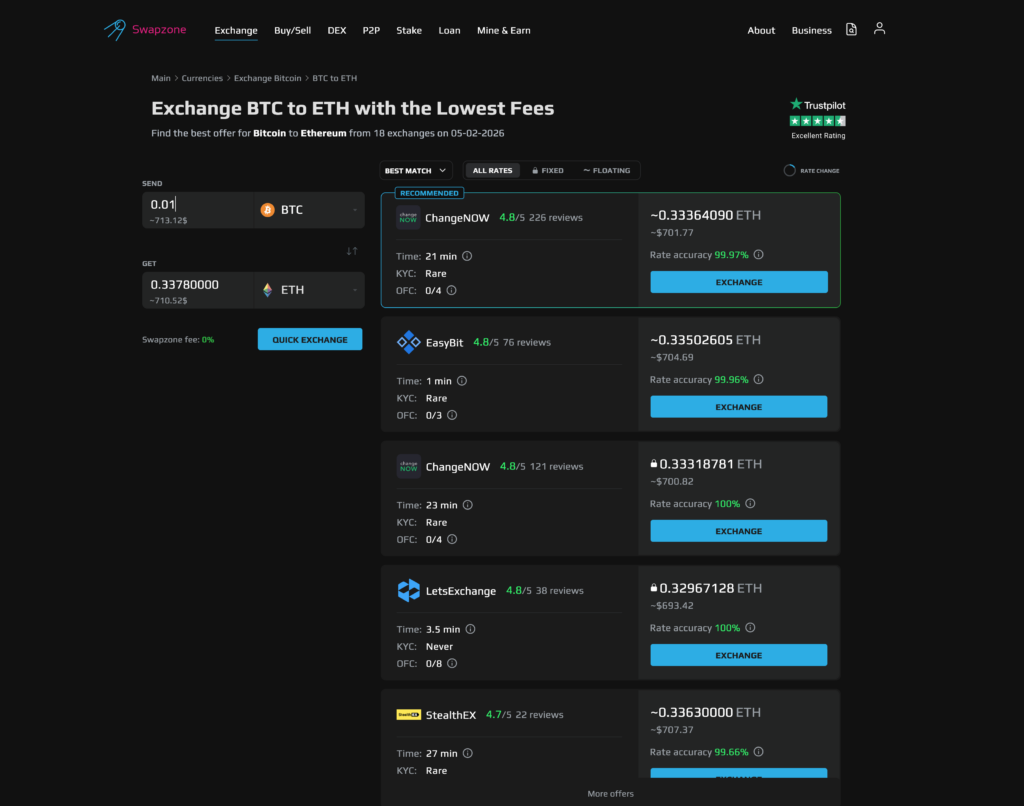
Critically, all exchange fees and network fees are incorporated into displayed rates. This enables true apples-to-apples comparison across crypto platforms. The algorithm updates rates every 5-7 seconds from partner APIs, ensuring accuracy.
Users can sort offers by:
- Best Rate: Highest amount received
- Rate Type: Fixed vs. Floating
- Estimated Time: Based on asset confirmation requirements
- Provider Ratings: Trustpilot scores and user feedback
The “Recommended” tag uses algorithmic analysis balancing rate, speed, and reliability. This transparency exposes rate variations across platforms that would otherwise require manually checking each service eliminating information asymmetry enabling hidden fee extraction.
Multi-Chain Access Through Single Interface
Swapzone provides DEX aggregator functionality across 15+ blockchain networks including Ethereum, BSC, Polygon, Avalanche, Arbitrum, and Optimism. The platform routes trades through a network of 90+ decentralized exchanges, automatically finding optimal liquidity sources from protocols like Uniswap, PancakeSwap, QuickSwap, and others based on the best available rates.
By showing all-inclusive rates upfront, aggregators eliminate the information asymmetry that enables hidden transaction costs. Fees across different providers become immediately visible, helping users find the best crypto exchange for their specific needs.
Take Control of Your Crypto Transaction Costs
Hidden fees in crypto represent not inevitable costs but market inefficiencies. Comparison and education can dramatically reduce fees. In an industry where 0.57% per transaction remains 57x higher than traditional finance, substantial room for improvement exists.
The shift toward transparency benefits users and honest platforms alike. As regulatory pressure increases, platforms proactively embracing explicit fee structures position themselves advantageously.
Armed with knowledge about transaction fees explained, you can:
- Always compare across multiple platforms using aggregators
- Calculate total costs including deposits, trading, spreads, and withdrawals
- Verify network fees against actual blockchain conditions
- Prefer transparent platforms that explicitly state all types of fees
- Size transactions appropriately; larger trades often secure better rates
Compare your next crypto swap on Swapzone to see exactly how much you’re saving versus single-exchange trading. Whether you’re swapping Bitcoin, Ethereum, Monero, or any of 1,600+ supported tokens, transparent comparison helps you avoid hidden costs and find the best crypto exchange rates.
Don’t let hidden transaction fees drain your portfolio. Start comparing rates across 18+ exchanges in real-time today.
Resources
The following authoritative sources provide additional context and validation for the information presented in this article:
- Crypto.news Investigation: Hidden Fees Investigation: What $1M in Test Swaps Revealed – Comprehensive analysis of actual costs versus advertised fees across major exchanges
- CoinGecko: Cryptocurrency Price Tracker – Real-time market data for verifying exchange rates
- CoinMarketCap: Crypto Market Data – Independent price tracking for detecting spread manipulation
- CoinGape Education: Hidden Crypto Exchange Fees – Educational resource on fee mechanisms
- Kraken Learn: What is Slippage in Crypto – Expert analysis of slippage costs and mitigation strategies
- Etherscan Gas Tracker: Real-Time Gas Prices – Tool for verifying actual network fees
- Investopedia: Best Crypto Exchanges – Review of popular cryptocurrency exchanges
- Swapzone DEX: Multi-Chain DEX Aggregator – Decentralized exchange aggregation platform
About Swapzone: Swapzone is a cryptocurrency exchange aggregator founded in 2019. The platform compares rates from 18+ instant swap services and DEX aggregators across 1,600+ cryptocurrencies. Users benefit from transparent pricing, zero platform fees, and the ability to find the best rates without registration or KYC. Learn more at swapzone.io.