Summarize with AI





Monero stands out as one of the most privacy-focused cryptocurrencies in the crypto space, and if you want to mine Monero, you’re in the right place. Unlike Bitcoin and many other cryptocurrencies, Monero uses the RandomX algorithm-a proof-of-work system specifically designed for CPU mining. This makes Monero mining accessible to anyone with a standard computer, without requiring expensive specialized hardware like ASICs.
In this comprehensive guide, we’ll walk you through everything you need to know about XMR mining: from setting up your wallet and choosing the right mining software to understanding mining pools and calculating your profitability. Whether you prefer to solo mine or join a mining pool, mine with your CPU or GPU, this guide covers all the options for monero mining in 2024 and beyond.
What Is Monero and Why Mine XMR?
Monero (XMR) is an untraceable digital currency that prioritizes privacy above all else. Launched in 2014, the Monero network uses advanced cryptographic techniques like ring signatures, stealth addresses, and confidential transactions to keep all transaction details hidden. This makes Monero one of the most private crypto options available.
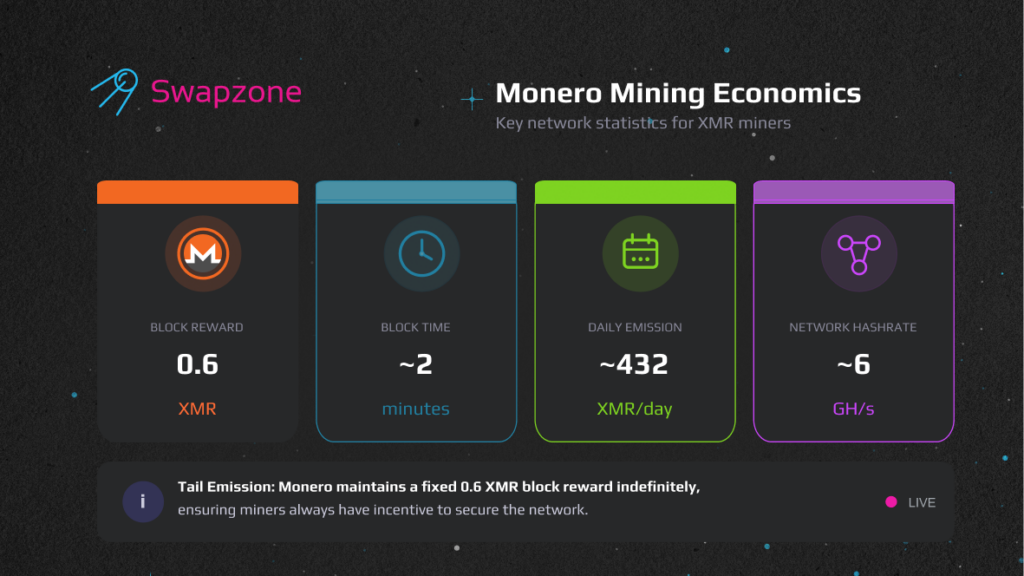
The Monero blockchain operates on a proof-of-work consensus mechanism, which means miners use computational power to validate transactions and secure the network. In return, miners receive block rewards-currently fixed at approximately 0.6 XMR per block through what’s called “tail emission.” With blocks being produced roughly every 2 minutes, that’s about 720 blocks per day, distributing around 432 XMR daily to miners worldwide.
What makes Monero mining particularly attractive is its commitment to egalitarian mining. The Monero community developed the RandomX algorithm specifically to prevent ASIC mining dominance. This means you can mine Monero using consumer-grade hardware-your regular CPU performs extremely well, and while GPU mining is possible, CPUs actually have the advantage here.
How Does the RandomX Algorithm for Mining Work?
RandomX is a proof-of-work algorithm developed by Monero contributors and adopted by the Monero network in November 2019. This innovative PoW algorithm is optimized for CPUs and uses random code execution combined with memory-heavy techniques to achieve ASIC resistance.
The algorithm requires roughly 2GB of RAM to operate in “fast mode,” which is why CPU and GPU mining on standard hardware works so well. The randomness built into RandomX means that specialized hardware can’t gain a significant advantage-your Ryzen processor or Intel i7 competes fairly against everyone else. This keeps the hash power distributed across many individual miners rather than concentrated in large mining operations with specialized hardware.
For miners, RandomX offers several benefits: lower barrier to entry (no need for expensive ASICs), better decentralization across the monero network, and genuine opportunity for smaller miners to earn rewards. The algorithm underwent four independent security audits before deployment, ensuring it’s both secure and effective at its goal of egalitarian mining.
Monero Mining Hardware: CPU vs GPU Mining
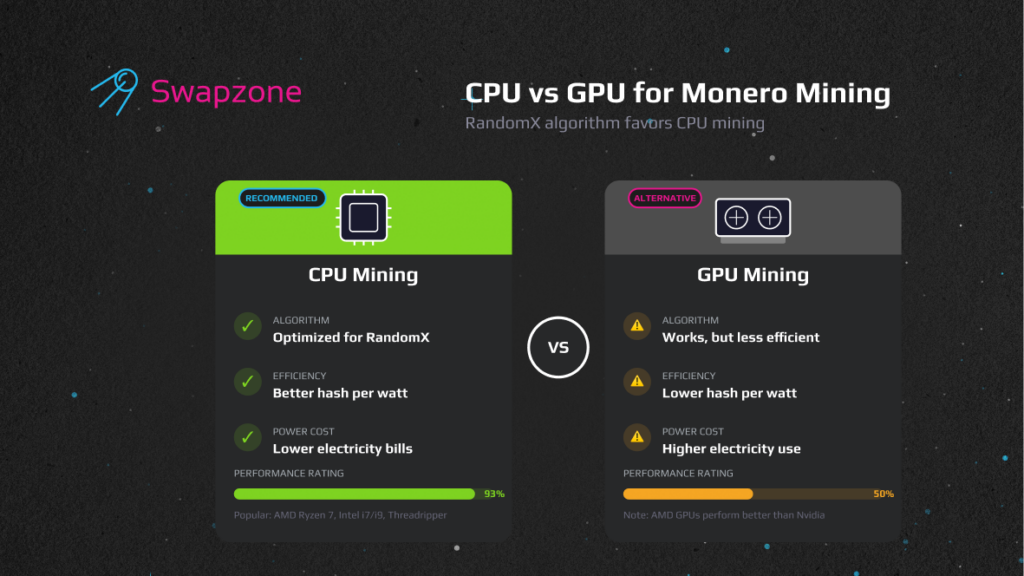
When it comes to monero mining hardware, you have two main options: CPU mining and GPU mining. Here’s what you need to know about each approach.
CPU Mining: The Preferred Method
CPU mining is the most efficient way to mine Monero. The RandomX algorithm was specifically designed to favor general-purpose processors, making your desktop or laptop CPU a viable mining rig. Modern CPUs with large L3 cache perform best-AMD Ryzen 5000/7000 series processors and Intel i7/i9 chips deliver excellent hashrate results.
A typical consumer CPU can achieve hashrates between 5,000-15,000 H/s (hashes per second), with high-end processors like AMD Threadripper models reaching even higher. The key factors affecting your CPU mining performance include: core count, L3 cache size, RAM speed, and whether you enable huge pages (which can boost performance by up to 50%).
GPU Mining: Still an Option
While GPU mining is technically possible with Monero, GPUs are at a disadvantage compared to CPUs when running RandomX. AMD GPUs generally perform better than Nvidia for XMR mining, but neither matches the efficiency of a good CPU. If you already have GPUs from mining other cryptocurrencies like Ethereum, you can still mine with a GPU, but don’t expect the same returns as cpu mining.
That said, you can combine cpu and gpu mining for maximum hash power. Some miners run XMRig on both their processor and GPUs simultaneously, though the electricity costs of GPU hardware often make this less profitable than CPU-only setups.
Best Monero Mining Software: XMRig and Alternatives
Choosing the right mining software is crucial for optimizing your monero miner setup. Here are the top options available.
XMRig: The Industry Standard
XMRig is the most popular and efficient monero mining software available. It’s open-source, highly customizable, and supports both CPU and GPU mining in a single unified miner. You can download XMRig from the official XMRig GitHub repository with pre-built binaries available for Windows, Linux, macOS, and FreeBSD.
XMRig offers a configuration wizard at xmrig.com/wizard that makes setup straightforward. The software includes a small developer fee (1% by default) that supports ongoing development, though this can be modified if you compile from source.
Key XMRig features include: support for multiple algorithms including RandomX, detailed hashrate monitoring, automatic CPU optimization, huge pages support, and both config file and command-line configuration options.
Alternative Mining Software Options
Beyond XMRig, other mining software options include CSminer and various GUI-based miners. The official Monero GUI wallet also includes built-in mining functionality for those who prefer a simpler approach-you can mine directly from the gui wallet without installing additional software. The Monero CLI wallet offers similar functionality for command-line users.
Solo Mine or Join a Mining Pool?
One of the first decisions you’ll need to make is whether to solo mine or join a mining pool. Each approach has distinct advantages.
Solo Mining: Full Rewards, Higher Variance
When you solo mine, you’re competing independently to find blocks. If you succeed, you keep the entire block reward (0.6 XMR plus transaction fees). However, depending on your hashrate, it might take months before you find a block-this is often called “lottery mining.”
Solo mining directly supports network decentralization and security. You can solo mine using the official Monero GUI wallet or CLI wallet without any additional software.
Pool Mining: Consistent Payouts
Pool mining combines the hash power of many miners working together. When the pool finds a block, rewards are distributed among all participants based on their contributed hashrate. This means more frequent (but smaller) payouts compared to solo mining. Most mining pools charge a small fee (typically 0.5-2%) for their services. You can find a list of monero mining pools at miningpoolstats.stream/monero.
The main consideration with pool mining is centralization-if too many miners join a single pool, it could theoretically control more than 50% of the network hashrate, which poses security risks. Choose your mining pool wisely and consider smaller pools to help maintain network health.
P2Pool: The Best of Both Worlds
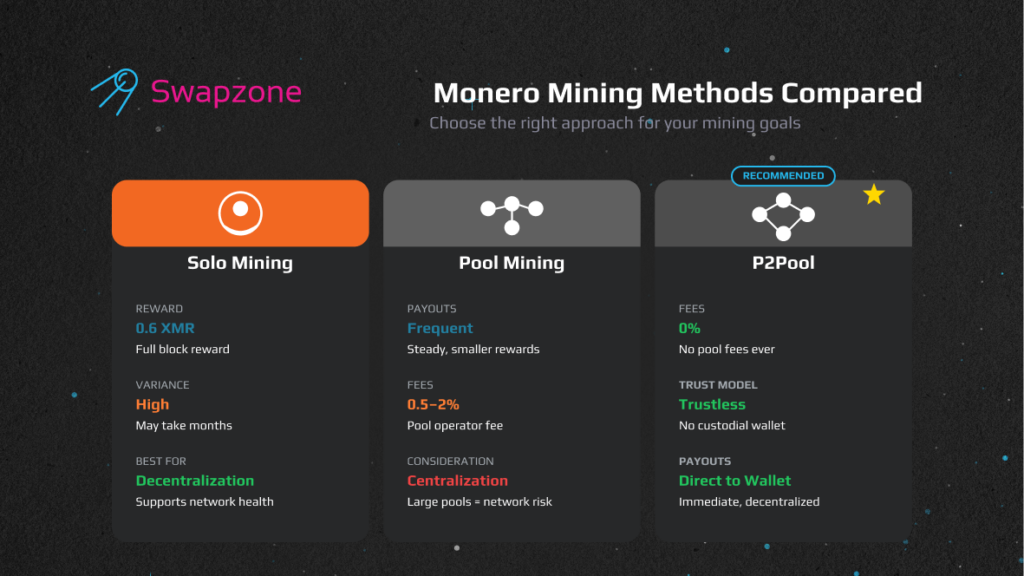
P2Pool represents a revolutionary approach to cryptocurrency mining that combines solo and pool mining benefits. Developed by SChernykh and released in October 2021, P2Pool is a decentralized, peer-to-peer mining solution. You can learn more at the official P2Pool announcement.
P2Pool’s key advantages include: 0% pool fee, trustless operation (no pool wallet holding your funds), permissionless mining (no registration required), immediate payout directly to your wallet address, and less than 0.0004 XMR minimum payout. All miners in the PPLNS window receive direct payments through the coinbase transaction when blocks are found.
How to Start Mining Monero: Step-by-Step Guide
Ready to start mining? Here’s the process of mining Monero from setup to your first payout.
Step 1: Set Up Your Monero Wallet
Before you can mine, you need a monero wallet to receive your mining rewards. The official Monero GUI Wallet is the recommended option for most users-it’s user-friendly and allows you to mine monero using your cpu directly from the interface. Download it from getmonero.org and follow the setup instructions to create your wallet address.
Alternative wallet options include the CLI wallet for advanced users, hardware wallets like Ledger for maximum security, or mobile wallets like Cake Wallet. Whatever you choose, make sure to securely backup your seed phrase-losing it means losing access to your XMR coins forever.
Step 2: Download Mining Software
Download XMRig or your preferred monero mining software. For XMRig, head to the GitHub releases page and download the appropriate version for your operating system. Extract the archive to a memorable location like your desktop.
Note: Some antivirus programs flag mining software as potentially unwanted because it’s commonly used in malware. If you download from official sources, it’s safe to add XMRig to your antivirus whitelist.
Step 3: Configure Your Miner
Configure your mining software with your wallet address and pool details. For XMRig, edit the config.json file or use command-line parameters. A basic configuration includes: the pool URL (e.g., pool.supportxmr.com:443), your wallet address as the username, and “x” as the password.
Example command line: ./xmrig -o pool.hashvault.pro:443 -u YOUR_WALLET_ADDRESS -p x
For better performance, enable huge pages on your system. On Windows, run XMRig once as administrator. On Linux, configure huge pages through sysctl settings.
Step 4: Start Mining and Monitor Results
Launch your miner and watch for accepted shares. Green messages indicating accepted shares mean everything is working correctly. Monitor your hashrate-it should stabilize after a few minutes as the algorithm’s dataset is built in memory.
Most pools provide web dashboards where you can track your mining statistics, pending balance, and payout history. Check your pool’s website using your wallet address to see your contributed hash power and estimated earnings.
Is Monero Mining Profitable? Calculating Your Returns
The profitability of mining Monero depends on several factors: your hashrate, electricity costs, hardware expenses, the price of Monero, and current mining difficulty. Let’s break down monero mining profitability.
Key Factors Affecting Profitability
Your hashrate (H) determines your share of the network’s mining rewards. With the network hashrate around 6 GH/s and a daily emission of about 432 XMR, your daily earnings equal (Your Hashrate / Network Hashrate) × 432 XMR.
Electricity is typically the largest ongoing cost. A CPU consuming 100W running 24/7 uses about 72 kWh per month. At $0.10/kWh, that’s $7.20 monthly-but rates vary dramatically by location. Miners in regions with cheap power (under $0.05/kWh) have a significant advantage.
Mining difficulty adjusts based on total network hash power. As more miners join, difficulty increases, reducing individual earnings. However, Monero’s tail emission provides a stable 0.6 XMR per block indefinitely, unlike Bitcoin’s halving schedule.
Using a Mining Calculator
Use online calculators to estimate your potential earnings. Sites like CoinWarz, minerstat, and CryptoCompare offer XMR mining calculators where you input your hashrate, power consumption, and electricity rate to see estimated daily/monthly profits.
As an example: a Ryzen 7 5800X achieving 12,000 H/s might earn approximately 0.004 XMR per day. At current XMR prices around $400, that’s roughly $1.60 daily-before electricity costs. Whether that represents profit depends entirely on your power rates and the equipment you already own.
FAQ: Common Questions About Monero Mining
How Long Does It Take to Mine 1 Monero?
The time it takes to mine one XMR varies dramatically based on your hashrate. With a typical consumer CPU achieving 10,000 H/s, you’re looking at roughly 200+ days to mine 1 XMR through pool mining. Solo mining could theoretically get you 0.6 XMR instantly if you find a block, but with low hashrate, finding that block might take years.
Can I Mine Monero on My Phone or Laptop?
Technically yes, but it’s not recommended. Phones lack the processing power for meaningful mining and may overheat. Laptops can mine but often have inadequate cooling for continuous operation. Desktop systems with proper ventilation are ideal for cpu and gpu mining.
What About ASIC Mining for Monero?
ASIC mining doesn’t work for Monero. The RandomX algorithm is specifically designed to be asic resistant, meaning specialized hardware provides no advantage over consumer-grade equipment. Any ASIC built for mining Monero would perform no better than a regular CPU, making the investment pointless.
How Do Mining Rewards and Payouts Work?
Mining rewards come from newly minted XMR plus transaction fees. The current block reward sits at 0.6 XMR through Monero’s tail emission system. When pool mining, your payout arrives once you reach the pool’s minimum threshold-often around 0.1 XMR. P2Pool has a much lower minimum payout of under 0.0004 XMR. Payout frequency depends on your hashrate and the pool’s payout scheme.
Getting Started with Your Monero Mining Journey
Monero mining remains accessible to everyday users thanks to the RandomX algorithm’s CPU-friendly design. Whether you want to mine Monero for profit, to support network decentralization, or simply to acquire XMR without going through exchanges, the barrier to entry is lower than with most other cryptocurrencies.
Start by setting up your monero wallet, download dedicated software like XMRig, and decide whether pool mining or P2Pool suits your situation better. Monitor your mining operations, keep an eye on profitability, and adjust your setup as needed. The monero community is active and helpful if you encounter issues.
Once you’ve mined some XMR or want to trade for other crypto assets, platforms like Swapzone make it easy to exchange your Monero. Swapzone aggregates rates from 28+ exchange partners, supports 4,500+ tokens, and requires no KYC-fitting perfectly with Monero’s privacy-first philosophy. Check out the Monero exchange page on Swapzone to compare the best rates when you’re ready to swap your mining rewards.
Happy mining!
Sources
• Official Monero Mining Guide: getmonero.org/get-started/mining
• RandomX Algorithm Documentation: github.com/tevador/RandomX
• XMRig Miner: github.com/xmrig/xmrig
• P2Pool Documentation: github.com/SChernykh/p2pool
• Mining Pool Statistics: miningpoolstats.stream/monero