Summarize with AI





⚠️ This guide is for informational purposes only and does not constitute financial advice. Cryptocurrency transactions carry risk, including total loss of funds. Always do your own research before swapping crypto.
What Does “Swapping” ETH to BTC Actually Mean?
Swapping ETH to BTC entails exchanging Ethereum (ETH) directly for Bitcoin (BTC), without the need for traditional currencies such as USD. This process takes place on a cryptocurrency platform, where you trade one cryptocurrency for another.
A swap, as opposed to a regular buy/sell, allows you to exchange the two coins directly rather than first selling ETH for fiat (regular money) and then buying BTC. This operation is typically carried out via crypto exchange providers, both centralized and decentralized, that handle the cross-chain routing behind the scenes. Aggregators like Swapzone connect you to multiple such providers simultaneously.. A smart contract is a piece of code that executes every step of the transaction from beginning to end. There is no vertical hierarchy in DEXs because the code can’t be higher than a trader.
Importantly, swapping ETH to BTC is a cross-chain operation because you’re moving from one blockchain (Ethereum) to another (Bitcoin). This means the process involves both networks and platforms that handle these operations. Decentralized aggregators simplify the process for you. You see the comparison of the rates while the complexity is handled in the background.
For a beginner, this is a simpler, quicker way to trade ETH for BTC without the need for banks or complex processes.
Table of contents
Table of contents
- What Does “Swapping” ETH to BTC Actually Mean?
- How a Crypto Swap Aggregator Works
- Step-by-Step: How to Swap ETH to BTC Using Swapzone.io
- Fees and Rates: What You Actually Pay When Swapping ETH to BTC
- Is It Safe to Swap ETH to BTC? Risks You Should Know
- ETH to BTC Swap and US Taxes: What You Need to Know
- Frequently Asked Questions
- 1. Is swapping ETH to BTC taxable in the US?
- 2. How long does it take to swap ETH to BTC?
- 3. What are the fees for swapping ETH to BTC?
- 4. Do I need KYC to swap ETH to BTC on Swapzone.io?
- 5. What is slippage and how does it affect my swap?
- 6. How to exchange Ethereum for Bitcoin directly from my hardware wallet?
- 7. What happens if I send ETH to the wrong address?
- 8. Is Swapzone safe to use?
- 9. What’s the difference between swapping and selling crypto?
- 10. What is the minimum amount I can swap?
- Useful Resources
How a Crypto Swap Aggregator Works
A crypto swap aggregator like Swapzone.io scans the rates across multiple exchanges to find the best possible deal for your crypto-to-crypto swap. Instead of manually checking each exchange individually, these platforms compare real-time prices and automatically route your trade through the most favorable option.
Aggregator vs. Direct Exchange: Key Differences as of March 2026
| Feature | Aggregator | CEX (Centralized Exchange) | DEX (Decentralized Exchange) |
| Speed | Fast, real-time routing | Fast but dependent on the exchange | Varies (can be slower) |
| KYC | No KYC (if applicable) | Yes | No |
| Fees | Lower fees, minimal spread | Higher fees, some hidden charges | Gas fees + low spread |
| Control over Keys | Non-custodial | Custodial | Non-custodial |
| Supported Pairs | Multiple (varied by aggregator) | Limited to exchange listings | Limited to network pairs |
Scanning multiple exchanges and their performances to find the most optimal options is called “Best Rate Routing.” This minimizes the potential for slippage (when the price changes right in the middle of the transaction process) and avoids the need to compare rates on each platform by hand.
In comparison, using a single exchange (CEX or DEX) means you’re stuck with their pricing and liquidity, while an aggregator gives you access to multiple options.
Step-by-Step: How to Swap ETH to BTC Using Swapzone.io
What You’ll Need Before You Start
Before you start swapping ETH to BTC, make sure you have the following:
- ETH Wallet: A wallet that supports ETH and BTC (e.g., MetaMask, Ledger, or Trezor). Be sure the wallet supports both assets and networks.
- BTC Address: Blockchain transactions are irreversible, and sending to a wrong address means permanent loss of funds.
- Sufficient ETH: Ensure your wallet has enough ETH to perform the swap and cover the network fees.
- Understanding Gas Fees: Ethereum transactions require gas fees that can vary based on network congestion. Make sure you have extra ETH to cover them. We made a comprehensive guide to them here
- Stable Internet Connection: A reliable internet connection is essential to ensure a smooth transaction.
Follow these simple steps to swap ETH to BTC using Swapzone, decentralized crypto aggregator founded in 2020. This guide is perfect for beginners, so even if you’re new to crypto, you can follow along easily!
Step-by-Step Instructions
Step 1: Go to Swapzone.io and Choose the ETH → BTC Pair
1.1 Open your browser and go to Swapzone.io.
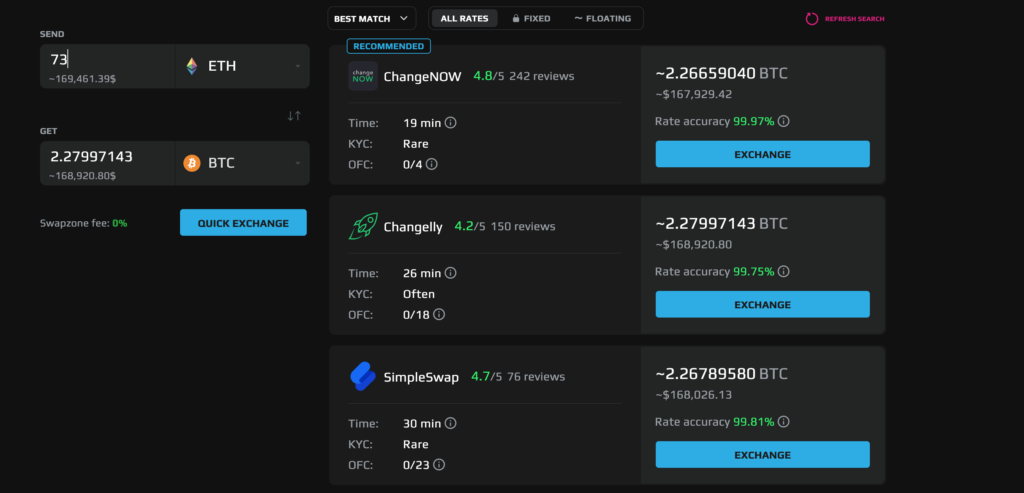
1.2 Select “ETH” as your starting cryptocurrency and “BTC” as your target cryptocurrency for the swap. Don’t worry about the registration, it is not needed.
Step 2: Enter the Amount and Check the Preliminary Rate and Fee
2.1 Input the amount of ETH you want to swap to BTC.
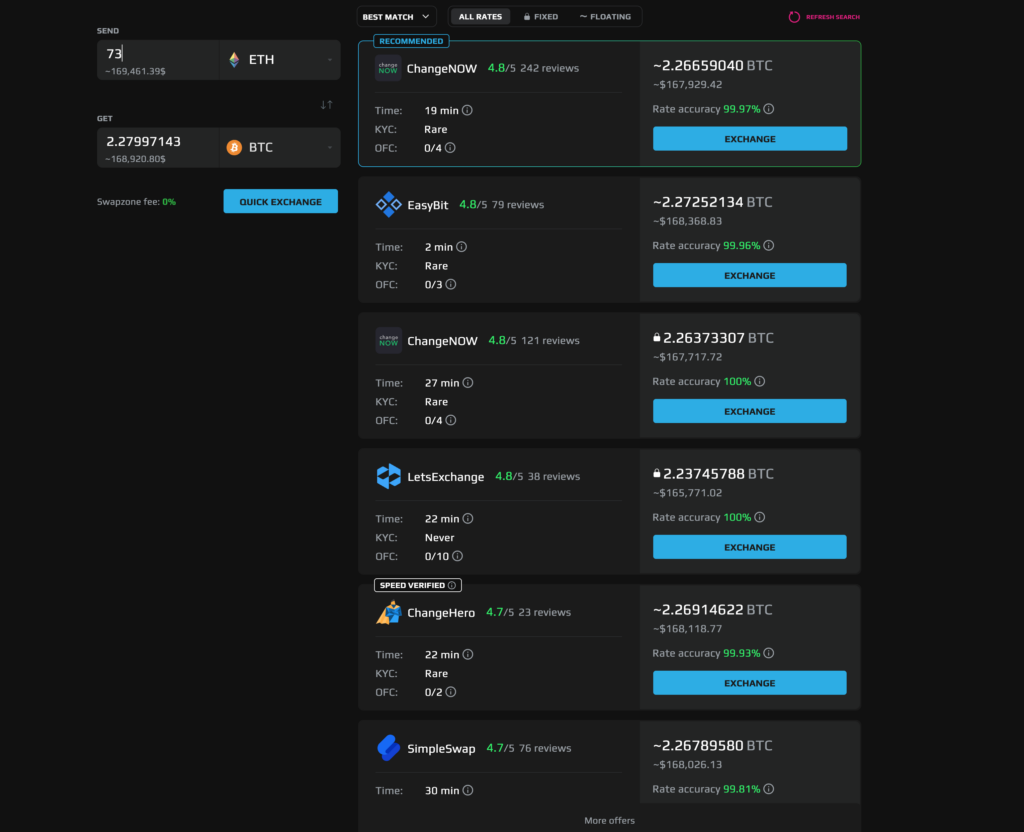
2.2 Review the estimated rate and the transaction fee. Ensure you’re comfortable with the rate offered before proceeding. We’ll talk about them in a minute
Step 3: Enter the BTC Wallet Address (Double Check the Address)
3.1 Enter the BTC wallet address where you want to receive your Bitcoin.
3.2 Important: Double-check the address. Transactions are irreversible once sent to the wrong address, and you cannot recover your funds.
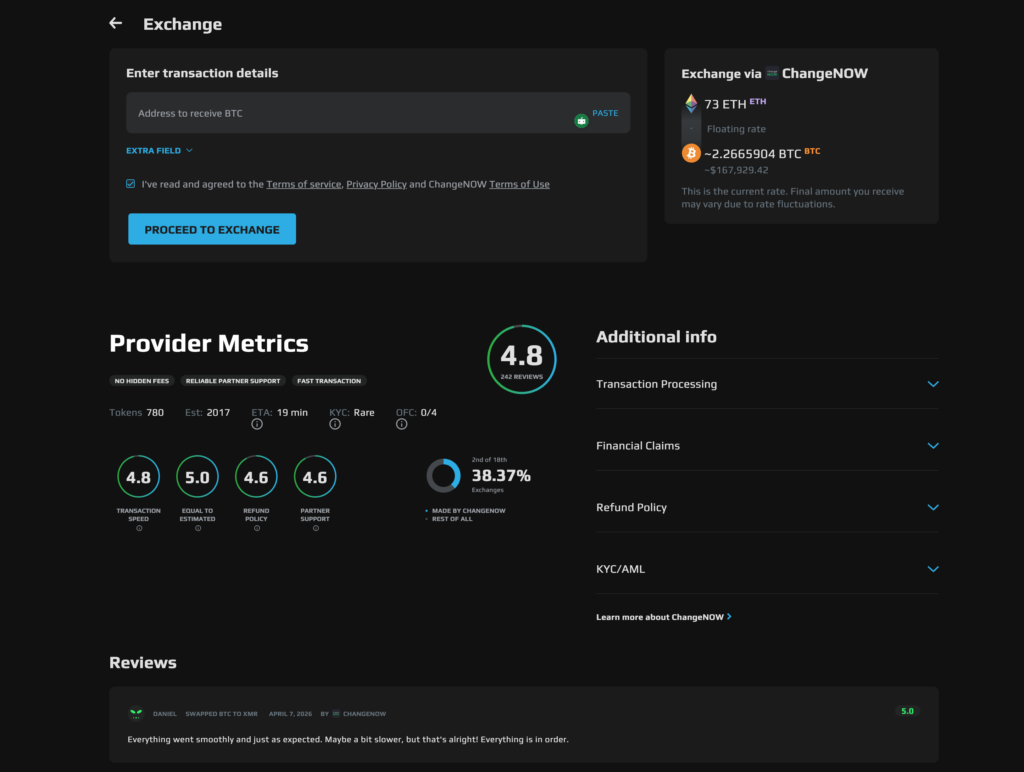
Step 4: Confirm the Transaction and Send ETH
4.1 Confirm the swap details and click “Swap.”
4.2 You will then be prompted to send the specified amount of ETH to the provided address.
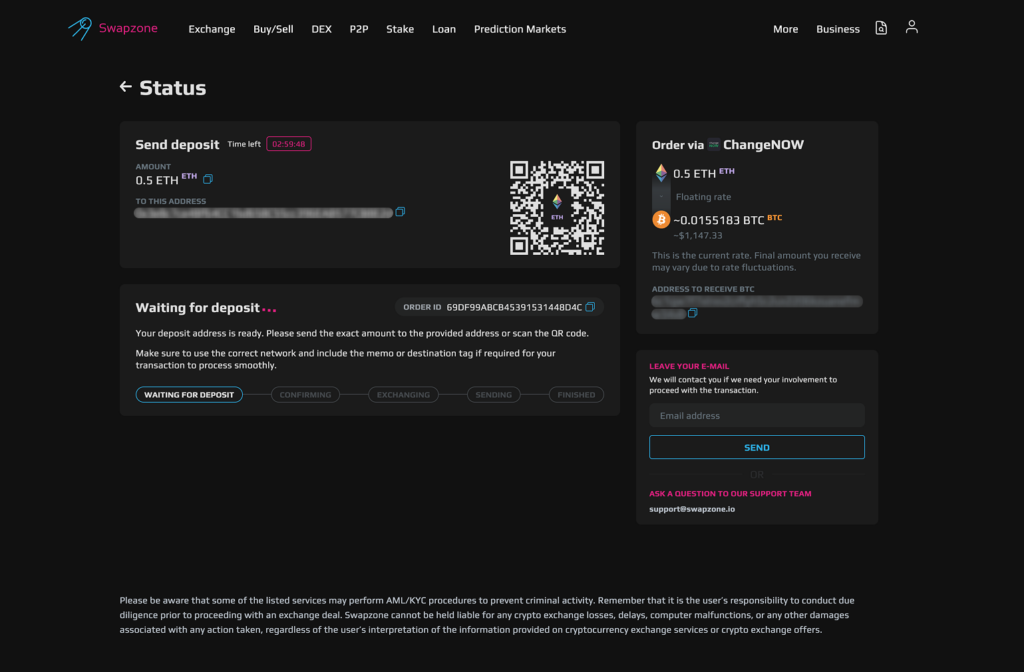
Step 5: Wait for Network Confirmations and Check the Status
5.1 Once you’ve sent ETH, the transaction will need to be confirmed by the Ethereum network.
5.2 You can track the progress of your transaction on Swapzone’s status page, or use the transaction hash to check the network status.
Step 6: Receive BTC in Your Wallet. After the network confirmations, you will receive the equivalent amount of BTC in the BTC wallet address you provided.
How to Check Swap Status and Confirm Receipt
Once your transaction is completed on Swapzone or similar platforms, let’s track its progress. Here’s how you can check:
- Use a Block Explorer:
1.1 After initiating your swap, you’ll be given a transaction hash (TXID). This unique identifier allows you to track your transaction on a blockchain explorer likeEtherscan for ETH orBlockchain.com Explorer for BTC. The more info about TXID
1.2 Paste the transaction hash in the search bar of the explorer to check the status of your transaction.
- Number of Confirmations:
2.1 ETH to BTC swaps generally require several confirmations before your transaction is fully processed. For Ethereum transactions, you typically need 12–15 confirmations, and for Bitcoin, 3–6 confirmations.
2.2 More confirmations provide additional security, ensuring the transaction is fully validated on the blockchain.
What to Do if the Transaction is Stuck:
- Check the Status: If your transaction is taking longer than expected, check the status on the block explorer. Sometimes, transactions may be delayed due to network congestion or insufficient gas fees.
- Confirm Gas Fees: If the gas fee was too low, Ethereum transactions may take longer. You can try increasing the gas fees (though this will depend on the platform and your wallet settings).
- Wait for Additional Confirmations: Transactions can take longer if the network is overloaded. Be patient, as it might resolve once additional blocks are mined.
- Contact Support: If your transaction is still stuck after a fair amount of time, reach out to the platform’s customer support for assistance. Swapzone has a very friendly and knowledgeable support team.
Always ensure you see the BTC in your wallet before considering the swap fully complete.
Fees and Rates: What You Actually Pay When Swapping ETH to BTC
When transferring ETH to BTC, you will encounter the following fees:
– Network (Gas) Fees: These are paid to miners for processing the transaction on the blockchain. For ETH to BTC, both networks (Ethereum and Bitcoin) require gas fees.
– Swap Fees: These are the fees that the swap platform charges for their services, which vary depending on the platform. Swapzone has none of them—0% swap fee.
– Spread: The difference between the buy and sell prices provided by exchanges. This is common in non-custodial services like Swapzone, which aggregates rates from different providers.
Is It Safe to Swap ETH to BTC? Risks You Should Know
While swapping ETH to BTC on platforms like Swapzone is generally secure because of the decent providers and customer support, you should be aware of the specific risks:
- Volatility: Cryptocurrency markets are highly volatile, and prices can fluctuate rapidly right during your transaction. It could affect the final amount you receive, especially when the swap takes 30+ minutes.
- Network Congestion: The time it takes to swap ETH to BTC can change based on network congestion and the gas fees you choose. This can also influence slippage as far as transactions taking longer.
- Smart Contract Vulnerabilities: If using a DEX, ensure that the smart contract is audited regularly to avoid vulnerabilities and potential loss of money. You can check that on a site of the project.
Security Best Practices for Swapping Crypto
- Always use a non-custodial wallet (e.g., MetaMask or Ledger) to retain full control over your private keys.
- Enable two-factor authentication (2FA) on your platform and wallet to add an extra layer of security.
- Double-check addresses before sending any cryptocurrency to avoid irreversible errors.
ETH to BTC Swap and US Taxes: What You Need to Know
Swapping ETH to BTC is considered a taxable event by the IRS. This means that any gains or losses from the transaction may need to be reported, as crypto-to-crypto exchanges are generally treated as “like-kind exchanges.” For more information on how this applies, refer to the official IRS guidelines on cryptocurrency taxation at IRS.gov.
It is always recommended to consult a tax professional familiar with cryptocurrency regulations in your jurisdiction to ensure compliance.
Frequently Asked Questions
1. Is swapping ETH to BTC taxable in the US?
Yes, the IRS treats crypto-to-crypto transactions as taxable events. Even if no KYC is involved, you are responsible for reporting gains or losses from the swap. For further guidance, consult a tax professional, and check out the IRS’scryptocurrency tax guidelines.
2. How long does it take to swap ETH to BTC?
The swap time depends on network congestion and gas fees. On average, ETH to BTC swaps complete in 5-30 minutes depending on network congestion and the gas fee you set. In low-traffic conditions, some providers execute in under 5 minutes, but plan for up to an hour during peak times.Always check your swap platform for the estimated time and adjust the gas price accordingly.
3. What are the fees for swapping ETH to BTC?
Fees typically include network fees, swap fees, and the spread. Network fees depend on the Ethereum and Bitcoin networks, while swap fees vary by platform. You can check live rates and fees on platforms like CoinGecko to stay updated.
4. Do I need KYC to swap ETH to BTC on Swapzone.io?
No, Swapzone does not require KYC for smaller swaps. However, for larger transactions, verification may be requested. Refer to Swapzone’s Terms of Service for more details.
5. What is slippage and how does it affect my swap?
Slippage occurs when the final price of the swap differs from the expected price due to market volatility. You can adjust your slippage tolerance in the platform settings. Typically, ETH/BTC pairs have a slippage tolerance set between 0.5% and 2%, depending on market conditions.
6. How to exchange Ethereum for Bitcoin directly from my hardware wallet?
Platforms like Swapzone support hardware wallets such as Ledger and Trezor. To connect, simply use a wallet extension or app, and ensure your device is unlocked and ready to approve the transaction.
7. What happens if I send ETH to the wrong address?
Blockchain transactions are irreversible, and funds sent to the wrong address are lost forever. Always double-check the recipient’s wallet address before sending any crypto.
8. Is Swapzone safe to use?
Yes, Swapzone is non-custodial, meaning you retain control of your funds. The platform uses security practices, such as encryption, to provide the best way to swap ETH to BTC. However, no platform can guarantee 100% security, so always follow safety protocols.
9. What’s the difference between swapping and selling crypto?
Swapping involves exchanging one cryptocurrency for another directly, whereas selling involves converting crypto to fiat (e.g., USD) and then purchasing another crypto. The tax implications also differ, as swaps are treated as taxable events by the IRS.
10. What is the minimum amount I can swap?
The minimum amount depends on the platform’s rules and the network fees. Swapzone has a minimum swap limit based on current network conditions to cover transaction fees.
This article is for educational purposes only and does not constitute financial or investment advice. Cryptocurrency swaps involve risk, including potential loss of funds due to market volatility, user error, or network issues. Always verify recipient addresses before sending. Transactions on blockchain are irreversible.Tax treatment of crypto swaps may vary by jurisdiction. Consult a qualified tax professional.
Useful Resources
Ethereum.org Official Ethereum Documentation is the primary reference for gas fees and smart contracts.
Bitcoin.org Bitcoin Developer Guide official explanation of BTC confirmations.
IRS Digital Assets Tax Guidance official IRS stance on crypto-to-crypto tax treatment.
Etherscan Ethereum blockchain explorer for tracking ETH transactions.
Blockchain.com Explorer Bitcoin blockchain explorer for verifying BTC receipt.
Binance Academy What Is Slippage? explanation of slippage and swap outcomes.
CoinGecko ETH/BTC Live Rates real-time price data to benchmark swap rates.
Disclaimer: This article is provided for educational purposes only and does not constitute financial, investment, or legal advice. Cryptocurrency markets are highly volatile, and the value of digital assets can fluctuate significantly in short periods of time.
Swapping ETH to BTC involves real financial risk, including but not limited to: market volatility during transaction processing, irreversible loss of funds due to incorrect wallet addresses, smart contract vulnerabilities on decentralized platforms, and regulatory uncertainty in your jurisdiction.
Tax treatment of crypto-to-crypto swaps varies by country. In the United States, the IRS treats such transactions as taxable events. Consult a qualified tax professional before making any decisions.
Swapzone does not hold your funds at any point during the swap process. Always verify recipient addresses independently before sending cryptocurrency.