Summarize with AI





Quickex is an instant non-custodial swap platform. It allows users to exchange cryptocurrencies registration-free and without identity verification. If you want to trade quickly and skip KYC procedures, this guide walks you through how Quickex works, what it costs, and how it compares to similar services.
In this article, you’ll learn the Quickex review. How its fees and security work and how to use it effectively. Straight-forward reminder, if there is no KYC required, users must still keep up with their local tax responsibilities.
What Is Quickex?
How Does Quickex Work?
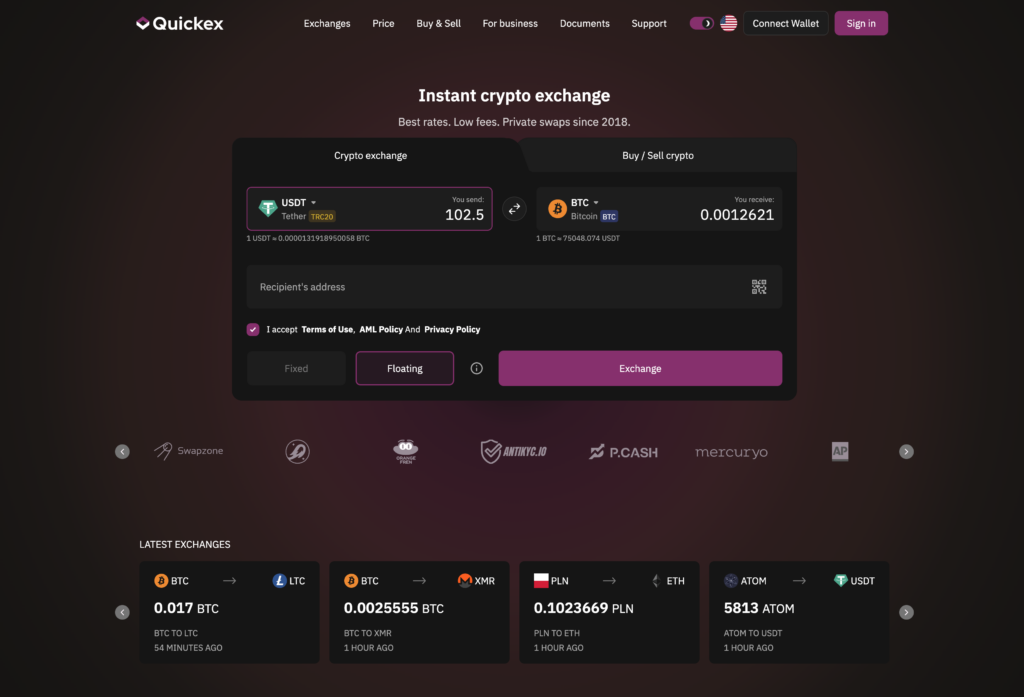
Quickex exchange operates like a currency exchange kiosk. You walk in, give some money, receive some money, and walk away.
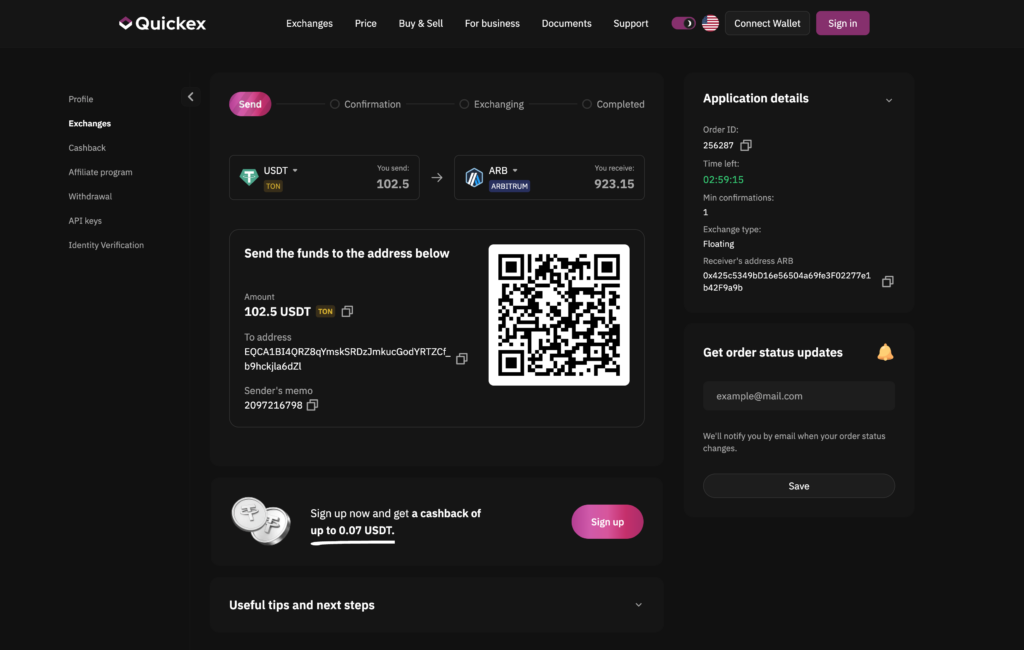
On Quickex you select the crypto pair you want to swap and enter the amount. The system then shows the exchange rate and the recipient address. Now you send your coins from your wallet. Once the system confirms, you will receive your new crypto on the provided address in the average time of 16 minutes.
You don’t need to register or give out your email, while the exchange doesn’t store your funds or info.
- Choose the pair (e.g., BTC to ETH).
- Enter the amount.
- The system shows the rate and address.
- Send from your wallet to the address.
- Wait for the exchange to complete.
- Receive the swapped crypto.
Is Quickex Custodial or Non-Custodial?
Quickex is a non-custodial platform. Your crypto is only moving through its infrastructure during the swap process. The main difference is that centralized exchanges (CEXs) hold your money on the exchange’s balance right until withdrawal. Since Quickex doesn’t hold anything, risks of hacks or mismanagement of funds are much lower than with CEXs. To understand the full difference, see Swapzone’s explainer on custodial vs. non-custodial crypto services.
Key Features of Quickex
No KYC Required
There’s no need for account creation, only the recipient’s wallet address. For casual usage Quickex doesn’t ask for your phone number or email or especially government ID. You can still register if you want additional features.
Tax obligations in your jurisdiction are mandatory regardless of a “non-KYC” policy. When you’re entering crypto without KYC, it doesn’t mean you’re becoming completely invisible and anonymous. The exchange might still monitor transaction history to adhere to AML (Anti-Money Laundering) requirements, but it does not collect personal data.
Always check the platform’s policy on your jurisdiction. For more info, check IRS guidance on virtual currency taxes.
Cryptocurrency swaps may be taxable events in your jurisdiction. Tax treatment varies by country. Consult a qualified tax professional.
Supported Cryptocurrencies
Quickex supports some of the most popular, including Bitcoin (BTC), Ethereum (ETH), Solana (SOL), Tether (USDT), and USD Coin (USDC). As of early 2026, the platform lists 100+ coins. Privacy coins like Monero (XMR) are listed too, but you should always double-check the current situation on the official website.
Exchange Rates and Fees
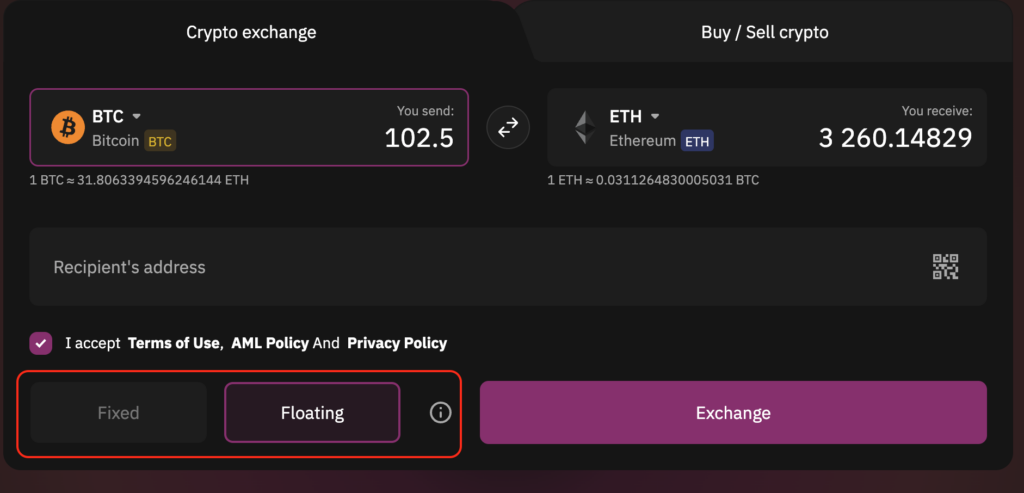
Quickex offers two rate options: fixed and floating.
- Fixed Rate means that the exchange rate is locked at the moment of order placement, protecting you from market volatility. You receive exactly the amount you’ve been promised.
- Floating Rate is subject to change based on the market price at the time the transaction is done. If it goes down, you receive less. If it rises, the final amount will exceed what you were promised by a fixed rate.
Why choose a fixed rate then? When the market swings drastically and you are going to swap a large amount of crypto, the fixed rate will give you the best security possible in this situation.
The service fee depends on the rate type and selected crypto pair. For floating-rate swaps it’s generally around 0.5%; for fixed-rate swaps the fee is typically higher — around 0.5–1% — because the platform absorbs market movement risk. Network (gas/miner) fees are charged on top by the blockchain and are not set by Quickex. For current rates, check quickex.io.
Also, users have to pay network fees. These are additional fees from the blockchain network (e.g., gas fees for Ethereum). The gas/mining fees go to the validators for their labor on the blockchain.
| Rate Type | How Rate Is Set | Best For | Risk |
| Fixed Rate | Rate locked at order placement | Volatile markets or large sums | Slight loss in market movement |
| Floating Rate | Rate depends on market price | Smaller or quicker swaps | Higher exposure to market swings |
Exchange rates, fees, and supported assets are subject to change. Verify current data on quickex.io before initiating a swap.
Transaction Speed
The transaction time changes depending on the blockchain network congestion, going with the average of 16 minutes according to the Quickex official site. For example, a BTC-to-ETH swap typically takes 10 to 30 minutes.
Network congestion or the number of confirmations required by the specific coin are main reasons for delays. If there is an issue with the transaction, users can contact support and provide the transaction ID for troubleshooting.
If you’ve ever had issues with a stuck swap, Swapzone’s guide on common instant exchange challenges covers how to troubleshoot them across platforms.
How to Use Quickex: Step-by-Step
- Open the Quickex website and select the cryptocurrency pair you want to exchange on the calculator.
- Fill in the amount you want to swap in the same field. If it’s too small to perform exchange, the platform will tell you the appropriate minimum.
- Check how much crypto you’ll receive in the targeted coin.
- Select either a fixed or floating exchange rate.
- Enter the wallet address you want to receive your crypto to. Copy and paste the address and verify the first and last 4 figures.
- Double-check the address and rate type before proceeding (ERC-20 vs. BEP-20).
Always verify recipient wallet addresses before sending. Blockchain transactions are irreversible. - Use your wallet to send the selected amount.
- After the transaction is processed, your funds will be sent to the provided address.
If the Transaction is Stuck:
- Check the Transaction ID (TXID):
Find your TXID from the platform and paste it into a blockchain explorer (e.g., Etherscan for Ethereum). - Analyze Status:
- Pending: May be due to network congestion or low fees.
- Confirmed: If confirmed on the blockchain but not received, contact support.
- Failed: Check error details (e.g., insufficient funds, wrong address).
- Contact support and provide them the TXID and transaction details.
Is Quickex Safe? Security and Trust
A non-custodial operation model reduces the risks. Since Quickex doesn’t hold your assets or your info, basically, there is nothing to hack. Plus, it performs AML checks on transaction history to reduce the chance of dealing with illicit cash.
Users are solely responsible for the security of their wallets and the accuracy of their addresses. If you want to feel safe, you should work for it. Quickex and other non-custodial aggregators do not have the same insurance options that regulated CEXs do. For the regulatory context, see the FATF Guidance for a Risk-Based Approach to Virtual Assets and VASPs – the international standard that non-custodial exchanges like Quickex operate within.
Using non-custodial swap services means you are solely responsible for the accuracy of the recipient address. Errors cannot be reversed.
Quickex Pros and Cons
Quickex is a non-custodial crypto-to-crypto exchange that doesn’t require KYC or registration. This makes it perfect for people who want swaps to be quick and simple. But the lack of order books and regulatory protections doesn’t serve people who want more security and advanced trades. It is a flexible solution for crypto enthusiasts, even though it has some limitations.
Pros
- No KYC or registration required.
- Non-custodial platform.
- Fixed and floating exchange rates available.
- Fast transactions.
- Wide range of supported cryptocurrencies
Cons
- No fiat deposits or withdrawals (crypto-to-crypto only).
- No order book or limit orders.
- No regulatory protection compared to CEX platforms.
- AML checks may cause delays.
Quickex Alternatives: How to Compare Rates Before Swapping
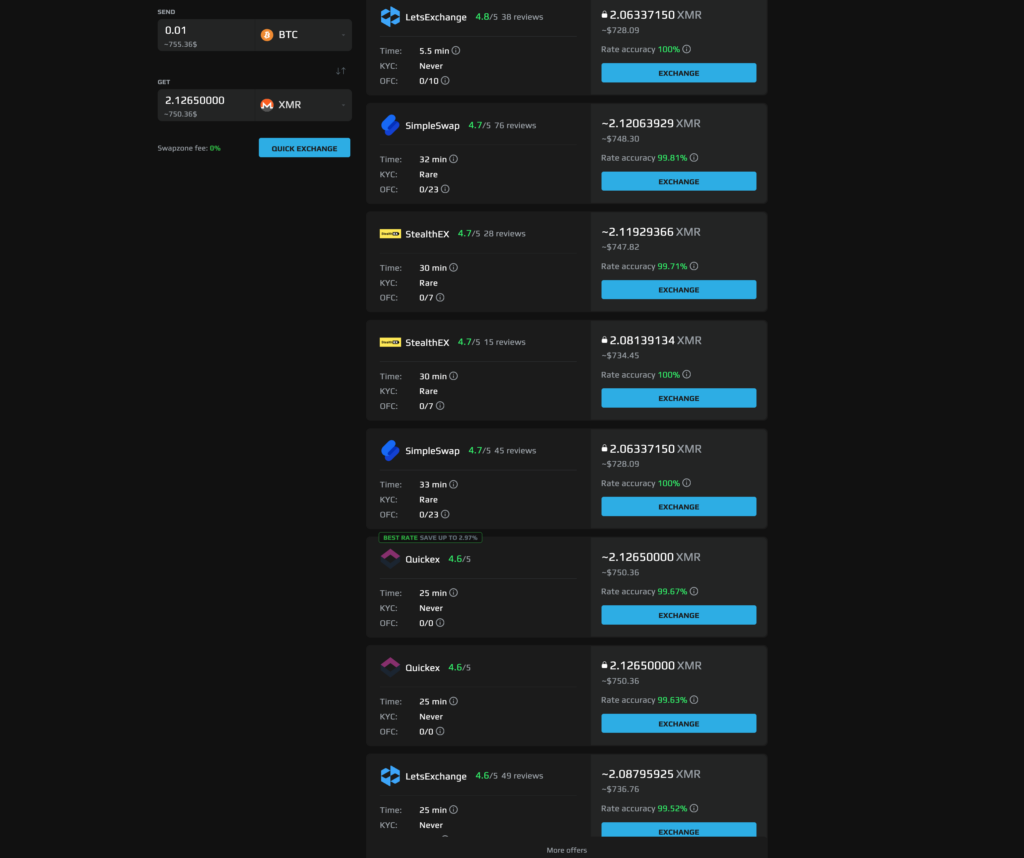
Other instant swap services worth comparing include SimpleSwap, Changelly, and ChangeNOW. Before committing to any of them – or to Quickex – it makes sense to check rates across multiple providers at once. That’s what Swapzone does: it’s not an exchange itself but an aggregator that pulls live offers from 28+ partner exchanges into one view, so you can pick the best rate without opening a dozen tabs. Independent review platforms like Cryptoradar also list user ratings for Quickex if you want a third-party perspective before swapping.
Always check the rates before moving forward, as spreads can be very different on different platforms. For instance, if you check rates before swapping 0.1 BTC to ETH, you’ll look at 5 services in 30 seconds but save $10-30.
Not Sure Quickex Has the Best Rate Right Now?
Swap rates change by the minute. Swapzone aggregates rates from 28+ partner exchanges, including no-KYC instant swap services. Compare before committing. Your funds go directly from your wallet to the chosen exchange. Swapzone never holds your crypto.
FAQ Section
Quickex is an instant no-kyc exchange. On Quickex, users can buy crypto anonymously without creating an account or going through KYC verification. You select the pair, input the amount, send your crypto, and receive the exchanged coins to the provided wallet address.
No, Quickex does not require KYC or account registration. However, it may perform AML checks on incoming coins. And remember that you are still responsible for complying with tax obligations.
Quickex’s fee structure depends on the rate type you choose and the underlying blockchain network costs. With a fixed rate, the service fee is typically around 0.5–1% plus blockchain network fees. With a floating rate, it’s generally around 0.5% plus network fees. The spread varies by pair and market conditions. Always verify on quickex.io before swapping.
As of early 2026, an average time on Quickex is 16 minutes. It depends on network traffic and confirmation times. If your transaction takes too long, provide the transaction ID to customer support.
Quickex’s non-custodial design reduces the risk of platform breaches. However, there’s no regulatory protection like with centralized exchanges. Users must secure their wallets and verify addresses themselves to be safe.
Disclaimers
Not financial advice. This article is for educational purposes only. Nothing in this article constitutes financial, investment, or legal advice. Always do your own research before making any cryptocurrency transaction.
Tax obligations. Cryptocurrency swaps may be taxable events in your jurisdiction. Tax treatment varies by country. US taxpayers should refer to the IRS Digital Assets guidance. Consult a qualified tax professional for advice specific to your situation.
No custody guarantee. Using non-custodial swap services means you are solely responsible for the accuracy of the recipient wallet address. Blockchain transactions are irreversible. Neither Quickex nor any aggregator can recover funds sent to incorrect addresses.
Data accuracy. Exchange rates, fees, supported assets, and platform features are subject to change without notice. Always verify current data directly on quickex.io before initiating a swap.
AML compliance. Even without KYC, non-custodial platforms may perform AML screening on incoming transactions. “No KYC” does not mean complete anonymity or exemption from local regulations.