Summarize with AI





The battle for financial confidentiality has been raging in the crypto space for years, and Monero has firmly established itself as the king of private transactions. As we move into 2026, more people are looking to exchange Monero. This trend continues despite increasing regulatory scrutiny. Yet the price of XMR has shown remarkable resilience. It’s cemented its status as the go-to privacy coin for completely untraceable transactions.
This comprehensive step-by-step guide will walk you through the process from start to finish. Need to swap Bitcoin for XMR or buy XMR directly? This guide’s got you covered – from choosing the right exchange platform to keeping your Monero wallet nice and secure.
Why Bother Exchanging Monero in 2026? Privacy is More than Just a Nice Idea
When you trade Bitcoin for Monero, USDT for XMR, or ETH for XMR, you’re moving from complete transparency to total anonymity. Your transactions become completely untraceable. The Bitcoin blockchain permanently shows the world your transactions. Monero uses ring signatures, stealth addresses, and RingCT to keep transactions completely private.
The whole privacy coin sector has been on a bit of a roll in recent years. That market cap? It just passed the $42 billion mark in 2025. Monero led the charge, climbing from $190 to over $440 by year’s end. This performance left many mainstream coins behind.
Major exchanges delisted XMR as regulatory pressure increased. But trading hasn’t stopped. Activity has shifted to aggregators, decentralized exchanges, and instant swap services that don’t require KYC verification.
Getting Your Head Around Monero Price and Exchange Rates in 2026
Before exchanging Monero, understand how the price behaves. Currently, XMR trades between $400 and $500. Several factors drive this range. Predictable supply and low inflation support the price. Meanwhile, users seeking privacy from financial surveillance drive demand higher.
XMR tends to follow the herd when it comes to Bitcoin during the big market moves, but you can rely on it to hold its own when the regulators come knocking. When exchanges delist XMR, the price may temporarily drop. But users quickly find alternative platforms, driving the price back up.
The best trading pairs for optimal rates are BTC/XMR, USDT/XMR, and ETH/XMR. These pairs offer the highest volumes, which means tighter spreads and better trading experiences.
How to Swap Monero – A Step-by-Step Guide to XMR Exchanges in 2026
This guide covers the complete exchange process for 2026. We’ll walk through swapping Bitcoin for XMR, trading USDT for Monero, or converting ETH to XMR.
Step 1: Picking Your Monero Trading Pair
Your first decision is choosing which cryptocurrency to trade for Monero. The most liquid trading pairs offer the best rates and fastest execution.
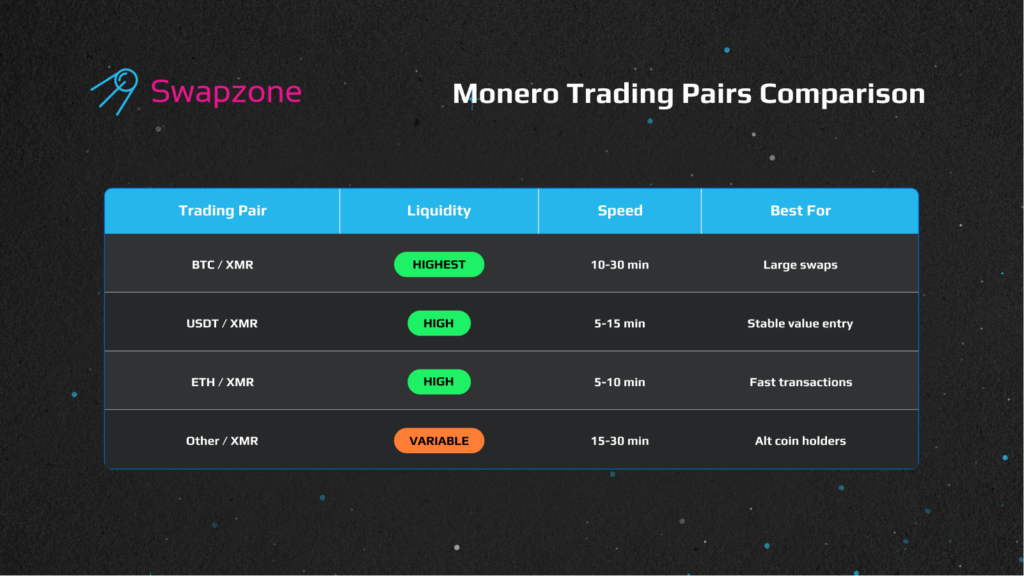
BTC/XMR is the most popular trading pair. When you swap Bitcoin for XMR, you move from the most surveilled cryptocurrency to the most private. That’s significant. Bitcoin’s massive liquidity ensures competitive Monero exchange rates.
Trading USDT to Monero is a good option for stability. Tether maintains a $1 peg, making calculations straightforward. Many users buy USDT first, then immediately swap USDT for Monero to avoid BTC and ETH volatility.
ETH to Monero swaps process faster due to shorter block times and offer competitive rates. However, gas fees can spike during network congestion. ETH to Monero exchanges remain popular despite occasional fee fluctuations.
Other trading options include SOL to XMR, ADA to Monero, XRP to XMR, BNB, MATIC, LTC, BCH, and TRON.
Step 2: Checking Monero Exchange Rates Across Different Platforms
Don’t accept the first rate you see. Monero prices vary between platforms. Comparing rates saves 2-5% per transaction, especially on larger swaps.
Aggregator sites search multiple exchanges simultaneously. They display all available rates for your trading pair and identify the best deal for your Bitcoin, Ethereum, or USDT. These platforms show which exchange gives you the most XMR for your crypto.
Compare these factors: the exchange rate (XMR per BTC/ETH/USDT), trading fees (typically 0.5-3%), network fees, and your total XMR after all costs.
Example: Swapping 0.5 BTC might yield 52.3 XMR on one exchange versus 53.1 XMR on another. That’s a $320+ difference at current prices.
Step 3: Get Ready to Receive Your Monero
Before swapping for Monero, prepare a secure wallet for your XMR. The Monero blockchain requires compatible wallets that support its privacy features.
Hardware wallets like Ledger Nano S Plus or Trezor Model T provide optimal security. Move your XMR to cold storage immediately after swapping to protect it.
Software wallets suit users who trade Monero frequently. The official Monero wallet supports full nodes. Mobile options like Cake Wallet and Monerujo also work well.
Get your Monero wallet address sorted before you start. This address starts with ‘4’ and receives your XMR after the exchange completes. Make sure you triple-check this address. Once a transaction is done, you can’t go back and change it.
Step 4: Actually Swap Your Cryptocurrency for Monero
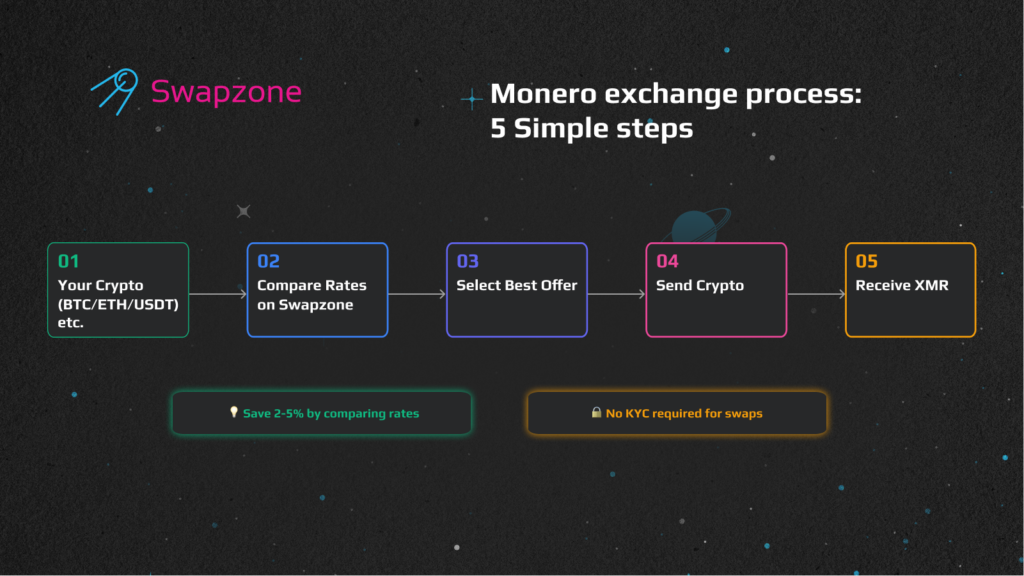
Now comes the actual swap of your cryptocurrency for Monero. If you’re using a platform like Swapzone:
- Pick which cryptocurrency you want to swap out of (e.g. 0.5 BTC)
- Choose XMR as the one your swapping into
- Look at the rates offered by 18 or more exchanges all at once
- Pick the one that offers the best deal on Monero
- Give them your Monero wallet address
- Send the other currency to the address they give you
- Wait for the blockchain to do its thing (this usually takes 10-30 minutes)
- You should see your Monero arrive in your wallet
Instant swap services complete transactions quickly. Most swaps complete within 15-20 minutes after sending your crypto.
Fixed versus floating rates matter during volatile markets. Fixed rates lock in your exchange rate at transaction start, protecting against price swings. Floating rates are riskier. They may offer better rates but can change unexpectedly.
Step 5: Double Check Your Monero is Safe and Secure
After the swap completes, verify your Monero arrived in your wallet. Check your balance matches the quoted rate.
Move large XMR amounts to a hardware wallet for security. Back up your wallet seed phrase somewhere secure, and never share your wallet login details with anyone.
The Best Monero Exchange Platforms to Buy and Swap XMR in 2026
Monero exchanges have transformed dramatically. Traditional exchanges have dropped XMR support. However, a new ecosystem emerged to meet growing trading demand.
The Best Cryptocurrency Aggregators for Buying and Swapping Monero
Aggregator platforms have really come into their own as the go-to option for swapping Monero in 2026. Swapzone is a great example of this. When you want to trade in Monero, it searches 18+ partner exchanges simultaneously, listing rates, fees, and completion times for each.
What makes aggregators ideal for Monero trading? They compare exchange rates across numerous platforms for BTC, ETH, or USDT swaps. Most crypto-to-crypto transactions don’t require account creation. They support over 1,500 trading pairs and display transparent fee breakdowns. Best of all? You can swap any amount, from tiny test transactions to large exchanges.
Decentralized Exchanges – Where Privacy Meets Monero
Decentralized exchanges prioritize user control and data privacy. DEX platforms enable trading without accounts or personal information. Atomic swap protocols enable trustless Bitcoin trades. Neither party can steal funds from the other.
That’s a huge draw for users who want to buy Monero in secret. No KYC requirements, no transaction databases, and no corporate entity regulators can pressure.
Instant Swap Services That Will Get You Monero Fast
Some platforms take a different approach altogether. They focus on speed and ease-of-use. These services maintain liquidity pools and execute trades within minutes. This is much faster than DEXs requiring multiple blockchain confirmations.
They typically support the most liquid pairs: BTC to XMR, ETH to XMR, and USDT to XMR. Sometimes you might even see less common pairs like SOL to XMR or ADA to XMR.
How to Buy Monero – From Fiat to Cryptocurrency
Most major exchanges don’t support direct fiat-to-XMR purchases. Users typically follow a two-step process. First, buy Bitcoin, Ethereum, or USDT on a major exchange using bank transfers or credit cards. Then exchange that crypto for Monero using an aggregator for the best rate.
Bank transfers offer the cheapest option: SEPA in Europe, ACH in the US, or wire transfers globally. These methods have lower fees than credit cards, which add 3-5%. Instant payment systems like FPS enable immediate swaps for Monero.
Other platforms let you use all sorts of payment methods, from PayPal to cash deposits and local systems. But just be aware that these can cost you 5-10% more than market price.
Storing Your Monero After Trading
After acquiring Monero, proper storage becomes critical for security. Hardware wallets like Ledger Nano S Plus or Trezor Model T provide optimal long-term security. They keep private keys offline. For smaller amounts, software wallets offer convenient access. Options include the official Monero GUI, Cake Wallet (mobile), or Feather Wallet (desktop).
Your wallet’s 25-word seed phrase is the key to regenerating your entire Monero wallet. Take these precautions: write your seed phrase on paper, create multiple copies stored separately, never store digitally, and use metal backup plates for durability.
Rule of thumb: Immediately move Monero from exchanges to your personal wallet. Exchange wallets risk hacking, insolvency, or regulatory seizure. Transfer to your wallet within minutes. Never use exchanges for long-term storage.
Monero’s Transaction Privacy Features in a Nutshell
Understanding Monero’s privacy features is essential for traders. Monero uses three core technologies that work together in perfect harmony:
Ring signatures mix your transaction with 15 decoys from the blockchain. This makes tracing the source virtually impossible. Observers cant even tell which one is the real deal.
Stealth addresses create one-time destination addresses. These can’t be linked to your public wallet address. Your public address never appears on the blockchain.
RingCT hides transaction amounts while allowing the network to verify no coins were created or destroyed. This stops people from trying to track you down by knowing what you spent.
These three technologies make transactions completely untraceable. No one can determine the sender, receiver, or amount. Thats why people choose to trade Bitcoin for Monero instead of dealing with the transparent kind.
Trading and Selling Monero in 2026 and Beyond
After acquiring Monero, learn how to trade it for other cryptocurrencies. The most liquid exit is swapping for Bitcoin. Converting to USDT locks in profits without selling to fiat. XMR to ETH trades work well for moving between privacy coins and DeFi.
When trading Monero for other crypto, compare rates across as many platforms as possible, factor in all the trading fees and use fixed-rate swaps when things get really volatile to lock in the price.
Selling Monero for fiat requires two steps. First, trade for Bitcoin or USDT. Then sell that on a regulated exchange. Peer-to-peer platforms offer direct sales for bank transfer payments. However, sellers typically receive 3-8% below market rates.
Frequently Asked Questions About Exchanging Monero
Getting Started with Monero Swaps
Where can I safely swap Monero in 2026?
You can swap Monero reliably through those cryptocurrency aggregator platforms like Swapzone, or on some decent decentralized exchanges that support atomic swaps. When swapping Bitcoin for XMR, USDT for Monero, or ETH for XMR, verify you’re using the legitimate platform URL. Then immediately withdraw Monero to your personal wallet.
How do I swap Bitcoin for Monero?
You can try using an aggregator like Swapzone to compare how much you get at a time across around 18+ exchanges. To swap BTC to XMR: enter your Bitcoin amount, check the exchange rate and fees, prepare your XMR wallet address, then send BTC to the provided deposit address. Your Monero arrives within 15-30 minutes.
Monero Pricing and Exchange Rates
What’s the current Monero price and exchange rate?
In 2026, XMR trades between $400-$500 depending on market conditions. Exchange rates fluctuate constantly. For example, the BTC to Monero rate is roughly 0.004 BTC per XMR when Bitcoin is at $100,000. For USDT, since Tether stays near $1, the XMR to USDT rate matches the USD price. Always check real-time rates on your exchange platform.
Security and Storage
How do I store Monero after buying or swapping?
Store Monero safely in a wallet compatible with XMR’s blockchain structure. Hardware wallets like Ledger Nano S Plus or Trezor Model T provide ultimate long-term protection. Software wallets like Monero GUI or Cake Wallet work well for smaller amounts. Always back up your 25-word seed phrase securely. Losing it means losing access to your Monero if your device fails.
Buying Monero with Fiat
Can I buy Monero with a bank transfer in 2026?
Direct bank transfers to Monero are rare in 2026. Instead, use bank transfers to buy Bitcoin, Ethereum, or USDT first, then swap for Monero. SEPA transfers work well in Europe, ACH in the US. Wire transfers function globally but cost more.
Related Resources: More Ways to Exchange Crypto
Popular Monero Trading Pairs:
- Bitcoin to Monero (BTC to XMR) – Most liquid XMR trading pair
- Ethereum to Monero (ETH to XMR) – Fast ETH to privacy coin swaps
- USDT to Monero – Stable entry point for buying XMR
- Monero to Bitcoin (XMR to BTC) – Exit XMR back to BTC
Other Popular Exchanges:
- Zcash Exchange – Another privacy coin option
- Bitcoin Exchange – Swap BTC with 1,500+ cryptocurrencies
- Ethereum Exchange – Trade ETH for any crypto
- Tether Exchange – Stablecoin swaps
Sources & References
This guide draws from cryptocurrency sources:
Market Data: Privacy coin market cap and trading volume data from CoinMarketCap, CoinGecko, and aggregated exchange statistics (2025-2026).
Technical Resources: Monero Official Website for protocol documentation, Monero Research Lab publications on privacy technology, and hardware wallet manufacturer documentation.
Market Analysis: CoinFomania’s privacy coin market analysis, WorldCoinIndex’s Monero performance reports, and Brave New Coin’s regulatory impact studies.
Disclaimer: Cryptocurrency markets are highly volatile. Prices and platform availability mentioned reflect early 2026 conditions and may change. Always verify current Monero exchange rates and conduct your own research before trading.
Conclusion: Exchanging Monero in 2026 – Taking the Leap to Economic Sovereignty
Financial privacy isn’t a luxury–it’s a human right. Monero protects this better than any other cryptocurrency. Exchanging Monero safely is essential for financial control in an age of widespread surveillance.
What You’ve Learned About Swapping Monero
This guide covered the essentials of safe XMR trading: tracking Monero prices and exchange rates, swapping Bitcoin or USDT for Monero efficiently, identifying the best exchanges and tools for optimal deals, and securing your Monero in safe wallets.
Key Takeaways for Trading Monero in 2026
Use aggregators to compare prices across multiple platforms. You’ll save 3-5% per trade–significant savings on large Bitcoin to Monero or USDT to Monero swaps. Stick with liquid pairs: Bitcoin to Monero, USDT to Monero, and Ethereum to Monero for the best deals. Transfer swapped Monero to your wallet immediately–within minutes of completing the trade. For amounts exceeding $500, use a hardware wallet for maximum security.
Ready to Start Swapping for XMR?
Now you’re ready to start swapping for XMR. Check Swapzone exchange rates for the best deals on BTC to Monero, USDT to Monero, ETH to Monero, and 1,500+ other trading pairs. Whether you’re new to Monero or trading large amounts, expect competitive rates and secure transactions in just a few clicks.
The journey to exchanging Monero starts with one decision: choosing privacy and freedom over surveillance and control. Your financial privacy matters. Protect it by swapping for Monero.