Summarize with AI





Crypto moves fast. Rates shift in seconds. When you’re mid-swap, the discrepancy between the rate you initially observed and the rate you receive can be quite frustrating. That’s where understanding fixed and floating exchange rates becomes your first line of defense. A fixed rate locks your cryptoasset conversion rate at the moment you initiate a swap; your final amount is guaranteed, no matter what the market does between initiation and execution. A floating rate reflects real-time market conditions at the exact moment your transaction executes; you might get more, or you might get less.
Both options exist on Swapzone, a cryptocurrency exchange aggregator founded in 2019 that compares rates across 28 partner services and 1,500+ tokens with zero KYC requirements. Here’s the insight that matters: choosing between rate types isn’t just a preference call. It’s a key tool for managing volatility. In this cryptocurrency survival guide, you’ll learn exactly when to use which and why it matters more than most traders realize.
What Does Exchange Rate Mean in Bitcoin and Crypto?
Before choosing a rate type, it helps to understand what a cryptocurrency rate of exchange actually is and why it behaves so differently from what most people expect.
How Cryptocurrency Conversion Rate Work
A cryptocurrency conversion rate tells you how much of one currency you’ll receive when swapping for another. If you’re exchanging Bitcoin for Ethereum, the rate defines how many ETH your BTC is worth at that exact moment. Crypto rate of exchange are entirely market-driven. They shift constantly based on supply, demand, trading volume, and sentiment across hundreds of exchanges worldwide. There’s no single “official” rate. Each platform reflects its own real-time snapshot of global market activity.
The distinction matters because the rate you see when you initiate a swap and the rate at execution can differ. At times, these differences can be as small as fractions of a percent. Occasionally, the difference can be significantly greater, particularly during periods of high turbulence.
Why Cryptocurrency Rates Are Different from Traditional Foreign Conversion Rates
In traditional foreign exchange, a central bank may intervene to stabilize its currency. Governments hold foreign reserves specifically to protect the value of a currency during periods of stress. The system has oversight, regulation, and built-in buffers.
Crypto has none of that. No central authority manages the price of Bitcoin or Ethereum. No foreign reserve backstop exists. Cryptocurrencies trade continuously, with no closing bell and no institutional floor. As a result, cryptoassets rates react far more sharply to news, sentiment, and liquidity shifts than any traditional foreign exchange pair. That’s what makes rate type selection so consequential.
Fixed Rate vs. Floating Rate Key Differences Explained
The key differences between fixed and floating interest rates go beyond fees. At their core, they’re about who carries the risk when the market moves during your transaction.
How a Fixed Exchange Rate Works in Cryptocurrency
Transaction Rate Timeline
When you choose a fixed exchange rate on a swap platform, you lock the rate the moment you initiate. That rate becomes your unique conversion rate for that specific swap. It won’t change while your transaction processes. If Bitcoin’s price drops 5% between initiation and execution, you still receive the amount shown upfront. The provider absorbs the rate risk during the transaction interval.
Implementing fixed-rates comes at a small cost; providers charge slightly higher fees to offset that volatility exposure they’re taking on. Think of it as an insurance premium on your swap. For large transactions or high-turbulence periods, that premium is usually well worth it. Your final amount is guaranteed. No surprises. No recalculating after the fact.
Concrete example: you initiate a BTC-to-USDT swap at a fixed-rate of $65,000 per BTC. Even if Bitcoin drops to $62,000 before your transaction confirms, you still receive the USDT amount calculated at $65,000. That’s what fixed protection actually delivers.
How a Floating Exchange Rate Works in Cryptocurrency
A floating exchange rate works differently. Rather than locking the rate at initiation, the platform waits until execution and applies the live market price at that exact moment. This is the standard flow for most DeFi and decentralized exchange transactions.
The benefit is lower fees. Because the provider absorbs no volatility risk, there’s no risk premium baked in. The tradeoff is exposure to rate turbulence between initiation and execution. In calm conditions, the difference is minimal. But during fast-moving markets, the spread between the estimated amount and your final amount can widen.
Ever-changing network fees impact floating-rate outcomes too. Time to process matters significantly here. A transaction that clears within minutes in a stable market carries much less rate exposure than one that drags on for hours during a sharp market move. That timing gap is where floating rate risk lives.
Which Rate Type Should You Use?
Rate Type Comparison
Fixed Rate
Rate locked at initiation
Floating Rate
Rate set at execution
Here’s a practical decision map:
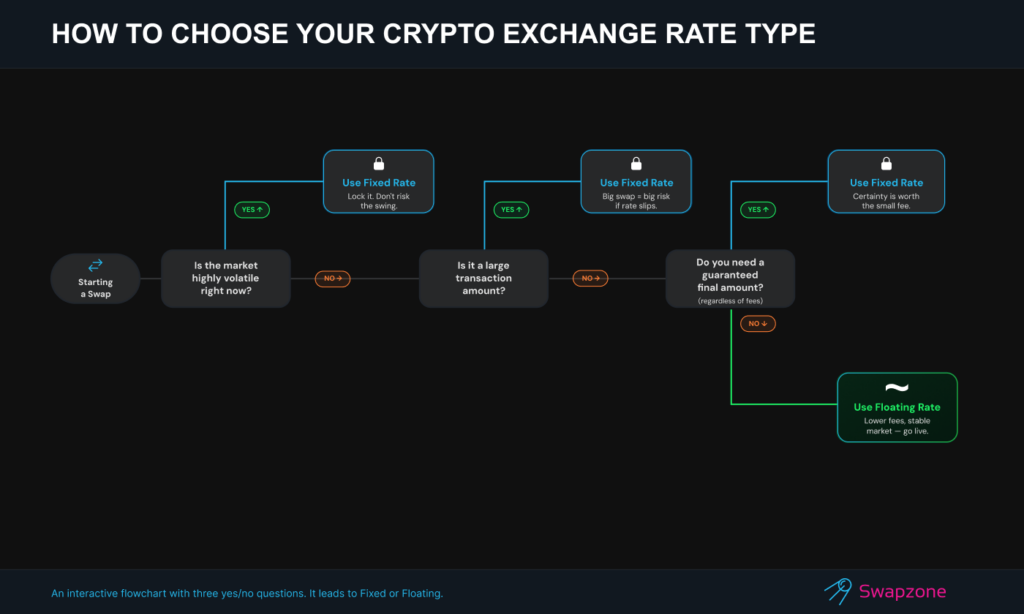
Considering the market’s current state, the suggested price category is “high volatility.” A fixed rate is appropriate for large transaction sizes. Fixed-rate The cost is fluctuating rapidly. This option is suitable for stable market circumstances and a set price. A small amount is exchanged at a variable rate. If you want the lowest fees, go with the floating rate.
The core logic is straightforward: Fixed-rate = certainty over cost. A floating rate provides real-time pricing with reduced fees. The volatile market you’re operating in should drive the choice, not habit.
Why Is Crypto So Volatile?
Understanding digital currency volatility isn’t just academic. It directly shapes which rate type makes sense for your next swap.
The Core Drivers of Crypto Market Turbulence
The cryptoasset market trades 24/7 with no circuit breakers to pause activity during sharp moves. Stock markets halt trading when prices swing too far, too fast. Crypto doesn’t. This structural difference alone amplifies price volatility significantly.
Beyond market structure, digital currencies operate with lower liquidity compared to traditional asset classes like gold or equities. Lower liquidity means larger orders move prices more dramatically. Add macro-sensitive interest rate decisions, inflation data, and geopolitical events, and you have a market that reacts to global news in real time, all day, every day. Both cryptocurrency trading and the triggers for price swings are constantly active.
Retail-driven markets also tend to show stronger emotional responses to news than institutional-dominated ones. Market fluctuations in crypto aren’t random; they follow identifiable triggers. But those triggers can fire at any time, without warning.
Why Is Bitcoin’s Price So Volatile Specifically?
Volatility Comparison
Annualized Volatility: Crypto vs Traditional Assets
30-day annualized historical volatility (%) — long-term averages
Source: BlackRock / iShares Bitcoin Volatility Trends · BitMEX BVOL Index
Bitcoin carries unique volatility drivers. The approval of spot ETFs in the US in January 2024 increased institutional participation, but it also introduced a new layer of price sensitivity. Large ETF inflows and outflows now influence Bitcoin’s price in ways that weren’t present before 2024.
Meanwhile, whale concentration remains high: a relatively small number of wallets hold a significant share of circulating Bitcoin supply, meaning large trades can move the market meaningfully. Regulatory news amplifies this further. A single policy announcement from a major economy can trigger double-digit percentage swings within hours. According to data tracked by the Bitcoin Volatility Index (BVOL), Bitcoin’s annualized 30-day volatility has historically ranged between 50% and 80%, roughly three to five times more volatile than gold, which typically sits around 15–20% annualized.
Most Volatile Crypto Assets. What Traders Should Know
Bitcoin is volatile, but many altcoins make it look stable by comparison. Ethereum, while more mature than most, still experiences sharp price fluctuations during market-wide stress events. Smaller-cap assets amplify volatility further.
Polygon (ex MATIC) is a well-documented example of high volatility dynamics in the cryptocurrency market. Its Polygon token price has swung 20–40% within single trading sessions during periods of high volatility, particularly around network upgrades and broader decentralized finance (DeFi) sentiment shifts. For any investor dealing with assets at this volatility level, the rate type chosen at swap time directly affects the outcome. Most volatile cryptoassets tend to have thinner order books and sharper reactions to sector-specific news. That makes the fixed vs. floating decision even more consequential.
Your Crypto Survival Guide: Managing Volatility Like a Pro
Knowing that volatility exists is step one. Having practical tools to manage it is what separates a deliberate trader from a reactive one.
How to Avoid Exchange Rate Risk During Transactions
The most direct way to avoid exchange rate risk during a swap is to choose a Fixed-rate. This is the practical mechanism behind implementing fixed rates as a transaction-level risk tool. When you lock the rate upfront, you eliminate risk during the transaction interval from initiation to confirmed execution.
On Swapzone, the fixed-rate option is available across its 28 partner services for thousands of trading pairs. You see the guaranteed final amount before you confirm anything. If the market moves against you while your transaction processes, the fixed-rate absorbs that impact entirely. For any beginner navigating their first volatile session or any experienced trader handling a large swap, that’s a meaningful way to avoid conversion rate risk in practice.
Portfolio Strategies for Volatile Markets
Beyond individual transactions, a volatile market calls for broader thinking. Diversification remains the foundational approach for any investor; spreading exposure across uncorrelated assets reduces the damage any single position can cause.
Using stablecoins as a hedge during peak volatility is a common and effective tactic. When markets accelerate, parking a portion of a portfolio in USD-pegged assets reduces exposure to price swings without fully exiting the market. Dollar-cost averaging through price fluctuations: gradually entering or rebalancing a position also reduces the impact of any single bad entry. Portfolio management in digital currency isn’t about predicting the next move. It’s about surviving the ones you didn’t see coming.
Practical Tools for Crypto Volatility Trading
For crypto turbulence trading, rate comparison is one of the most underused tools available. Rather than accepting whatever rate a single exchange service offers, Swapzone lets you compare real-time rates from 28 partners simultaneously for both fixed and floating options. You can see, side by side, which partner offers the best fixed rate during a volatile session and act accordingly.
Real-time rate monitoring before initiating a swap takes seconds and can meaningfully improve outcomes. Combined with fixed-rate selection during turbulent periods, it gives any trader, new or experienced, a clear practical edge over guessing at rates.
How Swapzone Handles Fixed And Floating Interest Rates
Swapzone was built around a simple insight: comparing rates across the crypto market should take seconds, not tabs. That includes offering both fixed and floating interest rates across a wide range of partners simultaneously.
When you use Swapzone to swap digital currency, you see fixed and floating options from across the partner network, side by side, with the final amount displayed before you commit. You choose based on current conditions. High market volatility? Choose a fixed rate to ensure stability in your financial outcome. Calm conditions with a smaller amount? A floating rate may offer a better deal with lower fees.
Platforms like Changelly helped popularize fixed-rate options in the early crypto exchange market. Today, Swapzone aggregates fixed and float rates across 28+ partner services, giving users a single interface to compare both approaches without visiting multiple platforms. That’s understanding crypto exchange mechanics in action, not just knowing what “fixed” and “floating” mean but having the infrastructure to act on that knowledge instantly.
The no-KYC model removes the registration barrier entirely. You compare rates, select the type that fits your situation, and execute, with most swaps completing in 5–30 minutes across 4,500+ supported tokens. Whether you’re swapping Bitcoin, Ethereum, or a higher-volatility altcoin, the rate-type choice is built into the comparison flow.
The Bottom Line
Fixed and floating conversion rates aren’t a minor detail buried in platform settings. They’re a direct expression of how much rate risk you’re willing to carry through a swap. And in crypto, where turbulence is the norm, not the exception, that choice has real consequences.
The fixed rate guarantees your final amount and protects against rate volatility during the transaction interval. The floating rate delivers real-time pricing with lower fees and is the standard flow for stable conditions and smaller swaps. Neither is universally better. Both have their place. What matters is making the choice deliberately, based on what the market is doing at the time of your swap.
Swapzone, founded in 2019, puts that decision in your hands. With 28 partner services, 1,500+ supported tokens, no KYC, and both fixed and floating options available across thousands of trading pairs, you have everything you need to swap strategically through any market condition.
Compare fixed and floating rates on Swapzone; no registration is required.