

Kaspa (KAS) Exchange
Looking to exchange KAS? Swapzone compares live offers from partner exchanges by rate, speed and KYC label. No account, no custody, 0% platform fee. KAS is the native coin of the Kaspa network: use a Kaspa address (it starts with kaspa:) and confirm the network.


Swapzone ücreti: 0%

Kaspa Market Data & Key Metrics
PriceKaspa Price Chart and Market Analysis

Popular KAS Exchange Pairs


Other Cryptocurrencies to Exchange
 Cardano
 Solana
 GRAM
 Pirate Chain
 IoTeX
 Loom Network
 Nano (Old)
 BitTorrent-New
 Nimiq
 SIRIN LABS Token
 BLOCKv
 SmartCash
 Ark
 Mithril
 Gemini Dollar
 Abyss Token
 Lisk
Popular Alternatives to Buy

What is KAS?
About Kaspa
KAS is the native coin of Kaspa, a proof-of-work blockDAG blockchain built on the GHOSTDAG consensus protocol. Miners compete to produce blocks and earn KAS through PoW rewards — not through staking, governance participation, or protocol fees. Kaspa launched in November 2021 with no premine, no ICO, and no insider allocation: every KAS in circulation was mined openly from genesis.
KAS tokenomics
Kaspa uses a hard-capped, deflationary supply model with a smooth monthly emission reduction rather than Bitcoin's four-year halving cycle. Approximately 27.78 billion KAS — about 96.8% of the 28.7 billion cap — had been mined as of October 2026, according to CoinGecko. The Crescendo hard fork (May 5, 2025) increased the block rate from 1 to 10 blocks per second while preserving the per-second emission rate, reducing the per-block reward proportionally.
Hard cap — 28.7 billion KAS; fixed in the protocol with no mechanism for additional issuance
Circulating supply — approximately 27.78 billion KAS as of October 2026, according to CoinGecko; about 96.8% of total supply already mined
“Chromatic” emission schedule — block reward decreases every month by a factor of (1/2)^(1/12), producing one full halving per year in gradual steps rather than an abrupt cut
Current per-second reward — approximately 27.5 KAS per second as of May–June 2026; declining continuously on schedule
Supply completion — approximately 95% of all KAS was projected to be mined by July 10, 2026, according to Kaspa's official emission schedule
No allocations — no team reserve, no investor vesting, no foundation pool; all supply enters circulation through mining exclusively
Smallest unit — sompi, equivalent to Bitcoin's satoshi; reward schedule takes approximately 36 years to fall below 1 sompi
What determines KAS's value
KAS's primary demand driver is supply compression: with over 95% of the total supply already mined and the monthly emission reduction schedule running continuously, the rate of new KAS entering circulation decreases every 30 days. Miners currently receive approximately 27.5 KAS per second — a figure that contracts month-on-month — which structurally reduces sell-side issuance pressure over time without a sudden halving shock that could destabilise miner economics.
The secondary driver is throughput growth. Kaspa's Crescendo hard fork in May 2025 raised the block rate to 10 blocks per second, positioning it as the highest-throughput PoW network by BPS. The roadmap targets 32 BPS and ultimately 100 BPS through the DagKnight protocol upgrade and a Rust rewrite of the core codebase — milestones that expand the network's capacity for payment volume and future smart contract activity. Each upgrade confirmed on schedule reinforces the technical thesis that underpins kaspa exchange demand among PoW-focused holders.
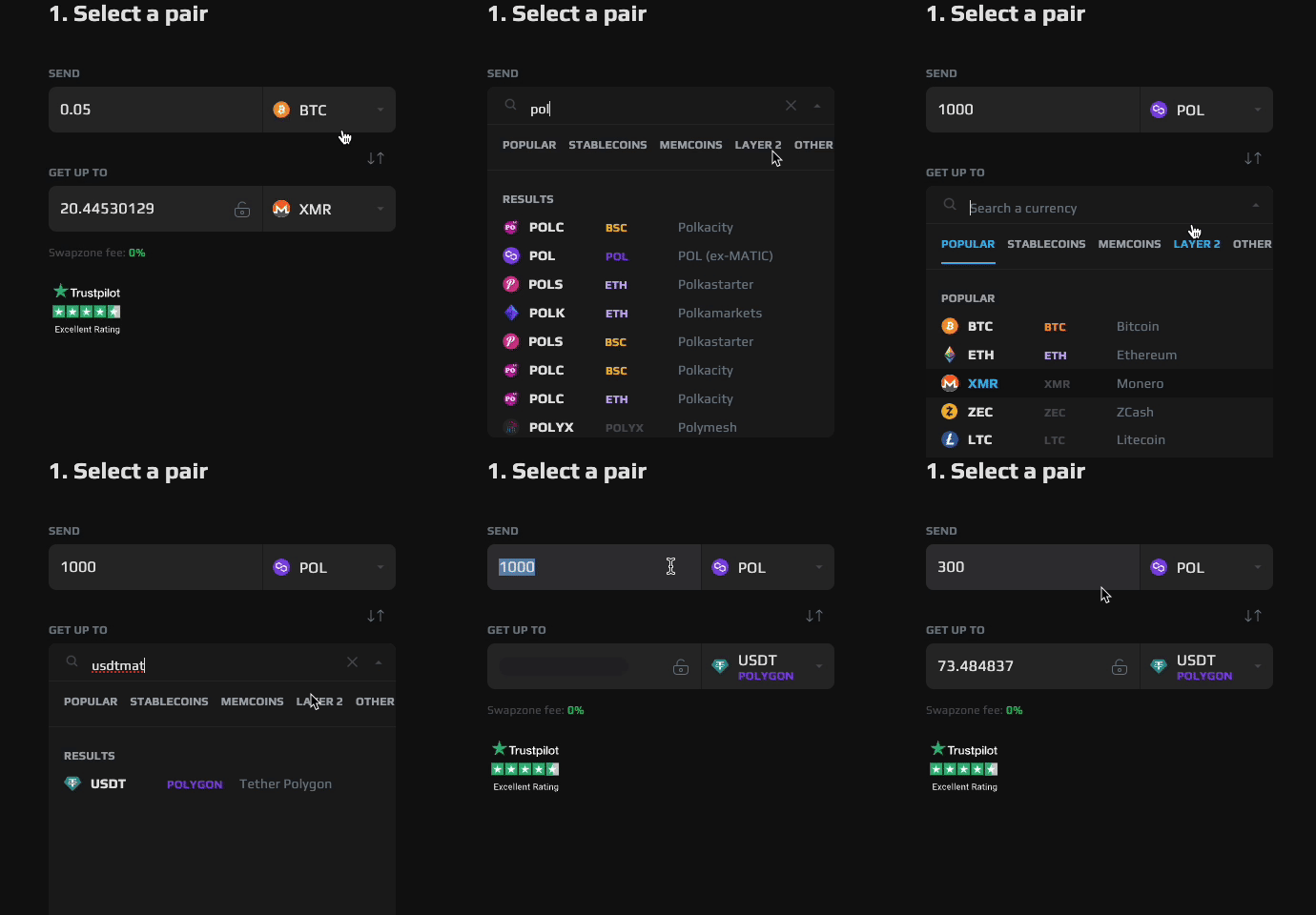
How to Exchange Kaspa on Swapzone

How to Choose a Kaspa Exchange


Kaspa (KAS) Price Analysis

Frequently Asked Questions About Kaspa (KAS)

Kaspa organizes blocks as a directed acyclic graph instead of a single chain. The GHOSTDAG protocol orders blocks that are produced in parallel, which lets the network run at a high block rate. Kaspa is proof of work, so miners compete to produce the blocks.
By mining. Miners earn KAS through proof-of-work rewards, not through staking, governance participation, or protocol fees.
No. Kaspa launched in November 2021 with no premine, no ICO, and no insider allocation. Every KAS in circulation was mined openly from genesis, and there is no team reserve, investor vesting, or foundation pool.
The block reward falls every month by a factor of (1/2)^(1/12), which adds up to one full halving per year in small steps. Bitcoin cuts its reward in one jump every four years. Kaspa's smooth schedule avoids a sudden halving shock for miners.
About 27.78 billion KAS, or about 96.8% of the 28.7 billion total supply, as of October 2026, according to CoinGecko. The hard cap is fixed in the protocol, so no more than 28.7 billion KAS can ever exist.
About 27.5 KAS per second as of May to June 2026, and it declines every month on schedule. Per-block rewards are lower than per-second rewards because there are 10 blocks per second.
On May 5, 2025 it raised the block rate from 1 to 10 blocks per second while keeping the per-second emission rate, so the per-block reward fell proportionally. It made Kaspa the highest-throughput proof-of-work network by blocks per second.
The roadmap targets 32 BPS and ultimately 100 BPS through the DagKnight protocol upgrade and a Rust rewrite of the core codebase. These are targets, not delivered features.
It is Kaspa's smallest unit, equivalent to Bitcoin's satoshi. The reward schedule takes about 36 years to fall below 1 sompi.
With over 95% already mined, new KAS enters circulation more slowly every 30 days, which lowers sell-side issuance pressure over time. Lower issuance does not guarantee a higher price, since demand can also fall.
Open swapzone.io/exchange/kaspa, enter the amount, and compare offers from partner exchanges by rate, time, and KYC label. Paste your Kaspa address, send KAS to the deposit address, and track the order. No account is required.
Why Exchange Kaspa with Swapzone?

Non-custodial aggregator: you send KAS to the partner's deposit address and receive funds in your own wallet, never through Swapzone.

Live KAS offers from exchange partners side by side.

Swap KAS with 1,600+ cryptocurrencies.

Reviews from TrustPilot


Good and Fast Support
Tyler from Swapzone's Support team was very kind and helps me out proactively. Highly recommend this site.
Excellent and reliable platform
Reliable and easy to use without the cumbersome KYC! Excellent exchange platform.
Quick service
Quick service. Transaction was processed with ease. Thank you Swapzone
Learn More About Cryptocurrencies


Our exchange partners for Kaspa
Contact us for partnership