

Bitcoin Cash (BCH) Exchange
BCH is the native token of Bitcoin Cash, a proof-of-work blockchain created through a hard fork of Bitcoin on August 1, 2017. It processes approximately 25,000 transactions per block with sub-cent median fees, prioritising high-volume peer-to-peer payments over Bitcoin's store-of-value positioning.


Swapzone 手续费:0%
Bitcoin Cash Market Data
PriceBitcoin Cash (BCH) Price Chart
Popular BCH Exchange Pairs


Other Cryptocurrencies to Exchange
 Cardano
 Solana
 GRAM
GRAM Pirate Chain
 Velo
Velo Opulous
 Hifi Finance
 FTX Users' Debt
 Blur
Blur Gains Network
 IguVerse
 Gifto
Gifto Synapse
Popular Alternatives to Buy
What Is Bitcoin Cash (BCH)?
What Is BCH?
BCH is the native token of Bitcoin Cash, a proof-of-work blockchain created on August 1, 2017, through a hard fork of Bitcoin. The fork was initiated by developers and miners, including Roger Ver, who argued that Bitcoin's 1 MB block size limit restricted transaction throughput and pushed fees higher during periods of heavy network demand. Bitcoin Cash increased the block size to 8 MB at launch, later expanded it to 32 MB, and in May 2024 introduced the Adaptive Block Limit Algorithm (ABLA) that adjusts block size dynamically based on actual network demand. The result: Bitcoin Cash processes approximately 25,000 transactions per block compared to Bitcoin's 1,000 to 1,500, with sub-cent median fees even during peak usage. BCH shares Bitcoin's SHA-256 mining algorithm, 10-minute block time, 21 million coin supply cap, and halving schedule.
BCH Tokenomics
Bitcoin Cash uses the same fixed-supply deflationary model as Bitcoin: a hard cap of 21 million coins with block reward halvings every 210,000 blocks. Approximately 20.1 million BCH are in circulation as of October 2026, according to CoinGecko; both chains shared identical history prior to the August 2017 fork.
Maximum supply — 21,000,000 BCH, hardcoded and unalterable
Block reward (current) — 3.125 BCH per block, reduced from 6.25 BCH at the April 2024 halving
Next halving — expected April 2028, reducing the reward to 1.5625 BCH
Consensus — SHA-256 proof of work; miners can switch between BTC and BCH based on profitability, with difficulty adjustment algorithms ensuring stable block production
CashTokens upgrade (May 2023) — added native support for fungible tokens and NFTs directly on the BCH blockchain without requiring a separate token standard
ABLA upgrade (May 2024) — replaced the static 32 MB block limit with an adaptive algorithm that raises or lowers the maximum block size based on actual usage
What Determines BCH's Value
BCH's primary value proposition is its utility as a payment cryptocurrency: fees typically under $0.01 per transaction, 10-minute block confirmations with 0-conf acceptance by many merchants for small amounts, and a block size large enough to handle payment volumes without congestion-driven fee spikes. This positions Bitcoin Cash for merchant adoption through BitPay and other processors, and for remittance use cases where per-transaction costs matter. Market capitalisation was approximately $5.6 billion as of October 2026, according to CoinGecko. BCH benefits from broad exchange listing support: Bitcoin Cash is listed on many centralised and non-custodial exchanges, which supports liquidity and fiat off-ramp options. The CashTokens upgrade expanded BCH's use case beyond payments into tokenised assets and on-chain applications.
How to Exchange Bitcoin Cash (BCH) on Swapzone

How to Choose a BCH Exchange Partner


Bitcoin Cash (BCH) Price Analysis
Frequently Asked Questions About Bitcoin Cash (BCH)

Bitcoin Cash was created on August 1, 2017, through a hard fork of Bitcoin. A group of developers and miners — including Roger Ver — argued that Bitcoin's 1 MB block size limit was insufficient to handle growing transaction demand, causing fees to spike during congestion. When a proposed soft fork (SegWit2x) failed to increase block size, this group executed a hard fork, creating Bitcoin Cash with an 8 MB block size limit starting from Bitcoin block 478,558.
ABLA (Adaptive Block Limit Algorithm) was activated in May 2024. Before ABLA, Bitcoin Cash had a static maximum block size of 32 MB. ABLA replaced this with a dynamic algorithm that automatically adjusts the maximum block size upward when blocks are consistently full and downward when they are not. This allows the network to scale to transaction demand without requiring a hard fork to increase the limit manually.
Bitcoin has a 1 MB base block size limit (up to 4 MB of block weight with SegWit). Bitcoin Cash started at 8 MB, expanded to 32 MB, and now operates under ABLA with an adaptive limit. As a result, BCH blocks have room for many more transactions than Bitcoin blocks, and transaction fees are typically under $0.01.
0-conf (zero-confirmation) means accepting a BCH transaction before it has been included in a block. Because BCH fees are low and blocks are fast, double-spend attempts are economically impractical for small transactions. Many BCH merchants accept 0-conf for purchases under a threshold (commonly $50 to $200). For larger amounts, waiting for one or more block confirmations (approximately 10 minutes each) is safer.
CashTokens is a May 2023 upgrade that added native support for fungible tokens and NFTs directly on the BCH blockchain — without requiring a separate token standard or smart contract layer. Previously, tokens on BCH required additional protocols. CashTokens allows developers to issue assets and build simple financial instruments directly within BCH's UTXO model, expanding BCH's use case beyond peer-to-peer payments into basic tokenised assets.
Yes. Bitcoin Cash uses SHA-256 proof of work, the same algorithm as Bitcoin. This means any hardware designed for Bitcoin mining (ASIC miners) can also mine BCH. Miners freely switch between BTC and BCH based on which is more profitable at a given time, and BCH's difficulty adjustment algorithm responds accordingly to maintain approximately 10-minute block times regardless of hashrate fluctuations.
The April 2024 halving reduced Bitcoin Cash's block reward from 6.25 BCH to 3.125 BCH per block — the same event and the same halving schedule as Bitcoin, since both chains shared identical history before the August 2017 fork. The next BCH halving is expected in April 2028, which will reduce the reward to 1.5625 BCH per block.
The next Bitcoin Cash halving is expected in April 2028, following the same schedule as Bitcoin: every 210,000 blocks, approximately every four years. At that halving, the block reward will drop from 3.125 BCH to 1.5625 BCH per block. The halving schedule is hardcoded into the protocol and applies identically to both BTC and BCH.
BCH transaction fees are typically under $0.01 per transaction — often fractions of a cent — thanks to the large block size and low congestion. Bitcoin fees can rise sharply during periods of high demand. Ethereum fees vary by gas price and can range from cents to several dollars or more. BCH is specifically optimised for low-cost, high-frequency payments where fee predictability matters.
The maximum Bitcoin Cash supply is 21,000,000 BCH — identical to Bitcoin's hard cap. Approximately 20.1 million BCH are in circulation as of October 2026, according to CoinGecko. The remaining supply will be issued as block rewards over the coming decades, with each halving cutting the issuance rate in half until all 21 million coins are mined around the year 2140.
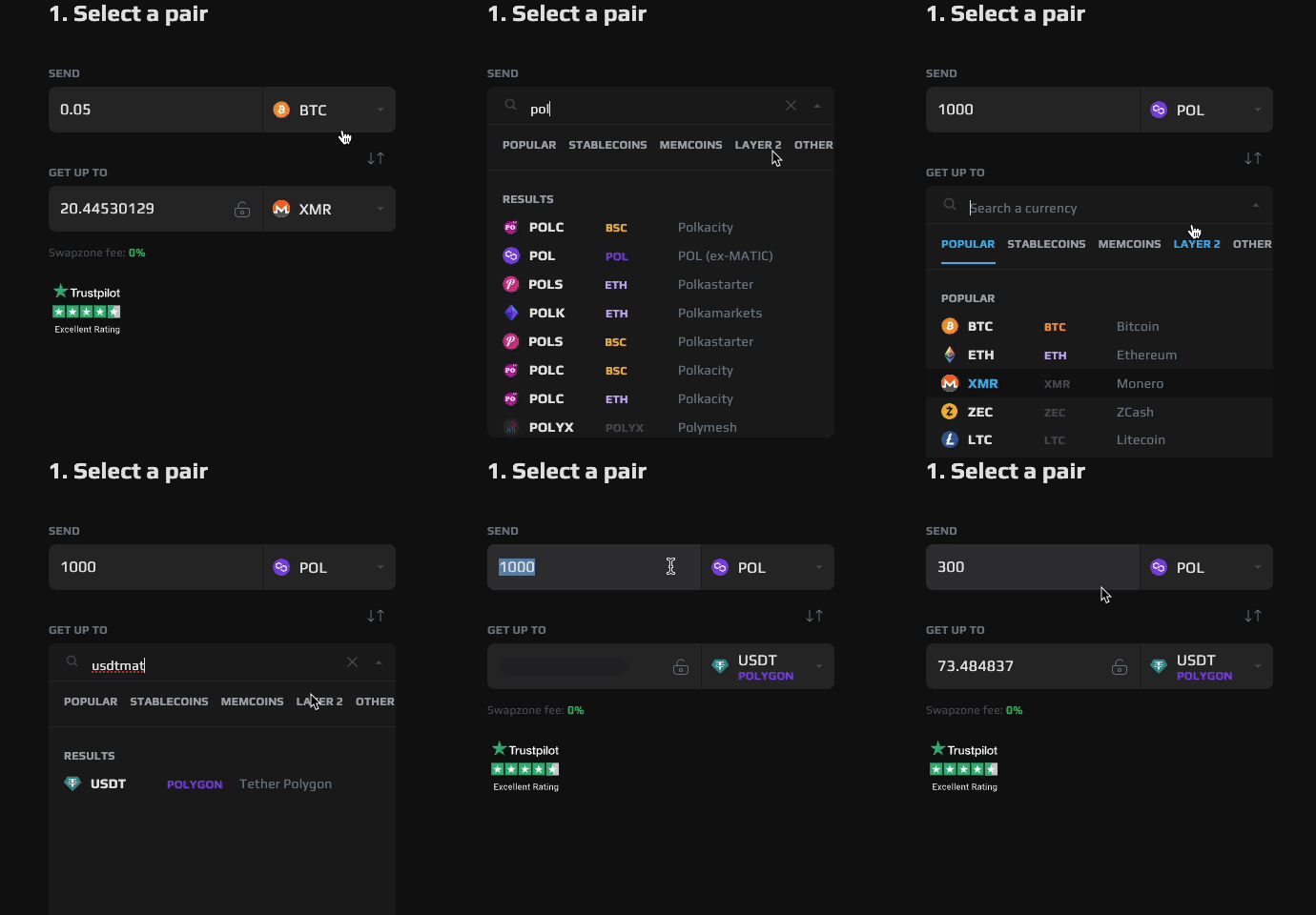
Go to swapzone.io/exchange/bitcoin-cash, enter the BCH amount you want to send or receive, and compare live offers from exchange partners. Each offer shows the rate, estimated completion time, and KYC frequency label. Select the offer that fits your needs, enter your destination wallet address (BCH does not require a MEMO or destination tag), and send BCH to the deposit address provided. No registration is required on Swapzone.
Why Exchange Bitcoin Cash on Swapzone

Non-custodial aggregator — BCH goes directly to your wallet, never through Swapzone

Live BCH offers from exchange partners side by side.

Exchange BCH against 1,800+ cryptocurrencies

Bitcoin Cash Reviews on Trustpilot


Good and Fast Support
Tyler from Swapzone's Support team was very kind and helps me out proactively. Highly recommend this site.
Excellent and reliable platform
Reliable and easy to use without the cumbersome KYC! Excellent exchange platform.
Quick service
Quick service. Transaction was processed with ease. Thank you Swapzone
Learn More About Cryptocurrencies

Our Exchange Partners
Contact us for partnership