

NEAR Protocol (NEAR) Exchange
NEAR is the native token of NEAR Protocol, a Layer 1 blockchain designed for user-facing decentralised applications, using a sharding architecture (Nightshade) to scale throughput, and an AI-oriented strategy positioning NEAR as the settlement layer for decentralised AI computation and agent-driven transactions.


Swapzone 手续费:0%
NEAR Protocol Market Data
PricePopular NEAR Exchange Pairs


Other Cryptocurrencies to Exchange
 Cardano
 Solana
 GRAM
GRAM Pirate Chain
 OM
OM Marlin
 Mirror Protocol
 My DeFi Pet
 Newscrypto
 Only1
Only1 OpenOcean
 Orbs
Orbs USDP
USDP Polkamarkets
 POLS
POLS Prom
Prom RARI
RARIPopular Alternatives to Buy
What Is NEAR Protocol (NEAR)?
What Is NEAR?
NEAR is the native token of NEAR Protocol, a Layer 1 blockchain launched in 2020 by NEAR Foundation, co-founded by Illia Polosukhin and Alexander Skidanov. NEAR is designed for high-throughput smart contract applications with a focus on developer and user experience. Its core technical innovation is Nightshade sharding — a dynamic sharding architecture that splits the blockchain into parallel shards to increase throughput as the network grows. Sharding helps keep NEAR transaction fees low, typically a fraction of a cent.
NEAR Tokenomics
NEAR uses an inflationary supply model with a built-in burn mechanism that offsets inflation when the network is highly active.
Total supply — no hard cap; maximum annual issuance was reduced from 5% to 2.5% in October 2025 with the nearcore 2.9.0 upgrade
Burn — per NEAR's documentation, 30% of the gas burned in a smart-contract call is credited to the contract's account and the rest is burned; House of Stake approved proposal HSP-027, which ends this developer rebate once nearcore v2.14.0 is activated on mainnet (planned for early October 2026), after which all execution gas is burned
Circulating supply — approximately 1.31 billion NEAR as of October 2026, according to CoinGecko
Staking — NEAR holders can delegate stake to validators; staking yield varies with total stake and the issuance rate; unstaked NEAR becomes available after a short delay of about four epochs (roughly two to three days)
Storage staking — smart contracts must stake NEAR proportional to the storage they use on-chain; this locks tokens out of circulation in proportion to blockchain state growth
Human Layer — NEAR's AI strategy term for the NEAR ecosystem's role as settlement and identity infrastructure for AI agent transactions
What Determines NEAR's Value
NEAR's positioning has shifted significantly from a general-purpose smart contract platform to a focused AI-settlement layer. NEAR Foundation explicitly targets the infrastructure for AI agents and decentralised AI computation, positioning NEAR as the blockchain layer for agent-to-agent transactions. NEAR's Chain Abstraction technology (Chain Signatures went live on mainnet in August 2024) allows users to sign transactions on any blockchain using a single NEAR account — enabling AI agents to interact with DeFi on Ethereum, Solana, or BNB Chain through a single NEAR identity without holding native tokens on each chain. Fee burning creates deflationary pressure that scales with network usage.
How to Exchange NEAR Protocol on Swapzone

How to Choose a NEAR Exchange Partner


NEAR Protocol (NEAR) Price Analysis
Frequently Asked Questions About NEAR Protocol (NEAR)

Nightshade is NEAR's dynamic sharding architecture. The blockchain is split into parallel shards that each process a portion of transactions simultaneously. Validators are assigned to shards based on stake, and the shards collectively produce a single-chain block. As the network grows, NEAR can add more shards to increase throughput — scaling horizontally rather than vertically, unlike single-shard blockchains.
NEAR Foundation explicitly positions NEAR as the settlement and identity layer for AI agents — autonomous software agents that execute transactions, hire services, and interact with DeFi protocols. NEAR's Chain Abstraction technology lets a single NEAR account interact with any blockchain, making it suitable as the identity hub for AI agents that need to operate across multiple chains. The pivot reflects the NEAR Foundation's view that AI agents will generate a large portion of blockchain transaction volume and need a blockchain designed for high-frequency, low-cost machine-to-machine settlements.
Chain Abstraction is a NEAR technology (Chain Signatures went live on mainnet in August 2024, and NEAR Intents followed in beta in November 2024) that allows a single NEAR account to sign and execute transactions on any supported blockchain without holding native tokens on each chain. Users control a NEAR account and can authorise actions on Ethereum, Solana, BNB Chain, and other networks through NEAR's signing infrastructure. This eliminates the need to manage separate wallets and native gas tokens on every chain.
Smart contracts on NEAR must stake NEAR proportional to the amount of data they store on-chain. This is called storage staking. A DApp that stores 1 MB of state on the NEAR blockchain must have 1 NEAR staked per 10 KB, meaning approximately 100 NEAR staked per MB. As the NEAR blockchain's state grows with new DApps and user data, more NEAR is locked in storage staking, reducing the tradeable supply.
NEAR burns gas fees paid on the network. According to NEAR's documentation, 30% of the gas burned in a smart-contract call is credited to the contract's account and the rest is burned; the House of Stake approved proposal HSP-027, which ends this developer rebate so that all execution gas is burned once nearcore v2.14.0 is activated on mainnet (planned for early October 2026). Fee burning offsets part of NEAR's new issuance, whose maximum annual rate was cut from 5% to 2.5% in October 2025. A proposal published on 30 September 2026 would lower the maximum issuance further, to 1.6%, phased in over 24 months, but it had not been voted on as of October 2026. The burn rate depends on total gas usage, and the offset has been small relative to issuance.
Bitte is a protocol built on NEAR that enables AI agents to discover, connect, and interact with DeFi protocols across blockchains via NEAR's Chain Abstraction. Bitte agents use NEAR accounts as their on-chain identity and settlement layer. Bitte is one of the AI agent projects building on NEAR and is a practical example of NEAR's AI infrastructure strategy.
Yes. NEAR delegators can stake with validators and withdraw their staked NEAR at any time — there is no mandatory lock-up for delegators. After initiating unstaking, there is a cooldown of approximately 52 to 65 hours (3 to 4 epochs) before the unstaked NEAR becomes available. Validators have a longer unstaking window. The flexible delegation model is a design choice to attract stakers who want liquidity without fixed lock-up commitments.
NEAR fees are low because of Nightshade sharding (parallel processing means each transaction competes for a fraction of total capacity) and because NEAR's fee market uses a deterministic pricing model that adjusts gradually. The fee is not bid-based (unlike Ethereum's EIP-1559 gas auction), which eliminates fee spikes during demand surges.
NEAR allows users to create human-readable account names (e.g. alice.near) instead of 64-character hex addresses. These named accounts can send and receive NEAR and call smart contracts. Named accounts also support sub-accounts (e.g. dapp.alice.near), allowing DApps to create structured account hierarchies. For exchange withdrawals, use the implicit 64-character hex address format unless the partner confirms named address support.
"NEAR scales throughput with Nightshade sharding: transactions are processed in parallel across shards, and throughput can grow as the number of shards increases. Check a block explorer for current transaction counts."
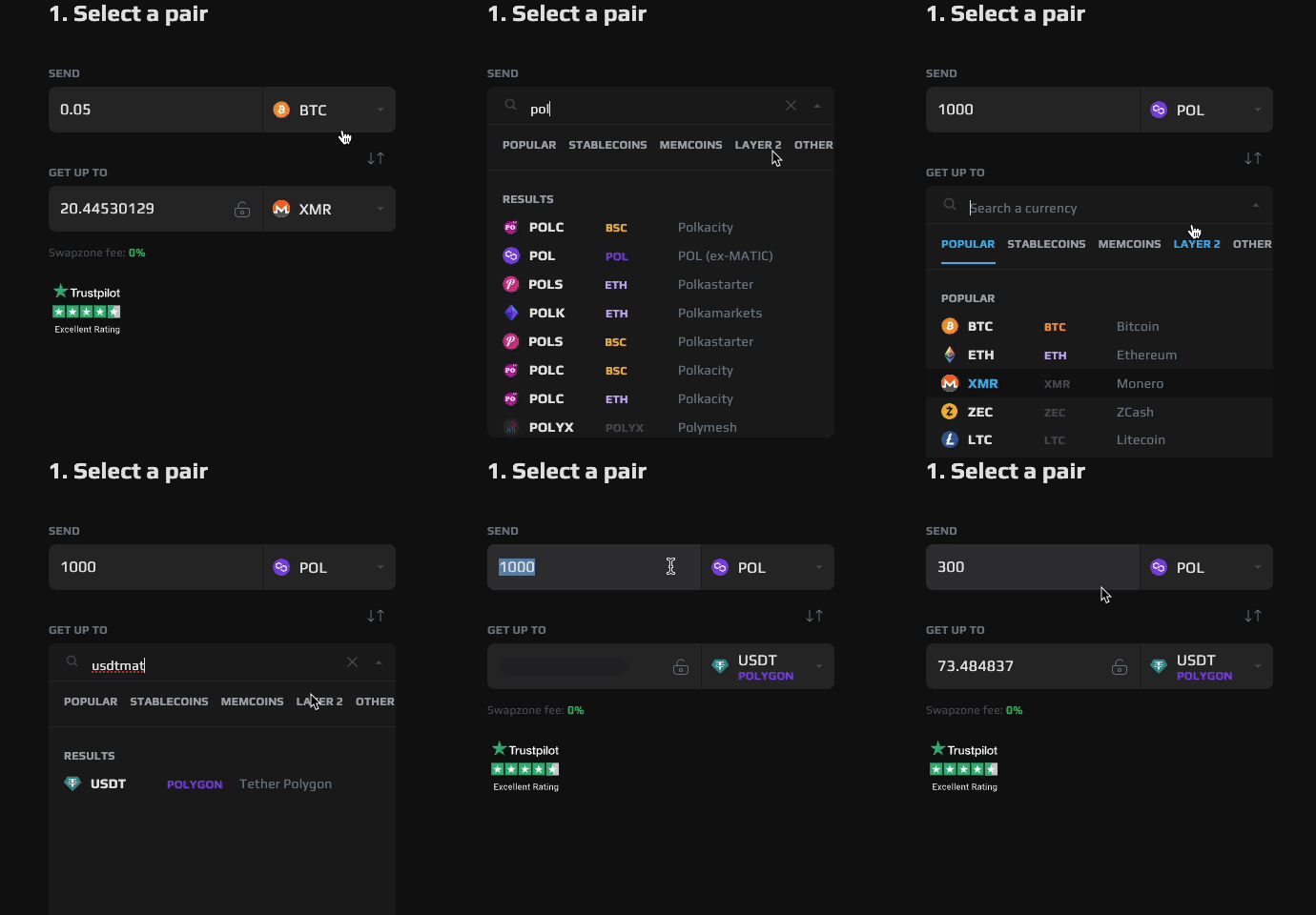
"Go to swapzone.io/exchange/near-protocol, enter the NEAR amount you want to send or receive, and compare live offers from exchange partners. Each offer shows the rate, estimated completion time, and KYC frequency label. Select the offer, enter your NEAR destination address (implicit hex format recommended for exchange compatibility), and send NEAR to the deposit address provided. No registration is required on Swapzone."
Why Exchange NEAR Protocol on Swapzone

Non-custodial aggregator — NEAR goes directly to your wallet, never through Swapzone

Live NEAR offers from exchange partners side by side.

Exchange NEAR against 1,800+ cryptocurrencies

NEAR Protocol Reviews on Trustpilot


Good and Fast Support
Tyler from Swapzone's Support team was very kind and helps me out proactively. Highly recommend this site.
Excellent and reliable platform
Reliable and easy to use without the cumbersome KYC! Excellent exchange platform.
Quick service
Quick service. Transaction was processed with ease. Thank you Swapzone
Learn More About Cryptocurrencies

Our Exchange Partners
Contact us for partnership