

Render (RENDER) Exchange
Looking to exchange RENDER? Swapzone compares live offers from partner exchanges by rate, speed and KYC label. No account, no custody, 0% platform fee. RENDER is a Solana SPL token (migrated from Ethereum's RNDR): confirm which network the partner accepts before sending.


Swapzone 手续费:0%

Render Market Data & Key Metrics
PricePopular RENDER Exchange Pairs


Other Cryptocurrencies to Exchange
 Cardano
 Solana
 GRAM
 Pirate Chain
 Shapeshift FOX Token FOX
 TrueFi
 MATH
 WOO Network
 Acala Token
 Firo
 DeXe
 Celo
 Trust Wallet Token
 VeThor Token
 SafePal
Popular Alternatives to Buy

What is RENDER?
About Render
RENDER is the utility token of Render Network, a decentralised GPU compute marketplace on Solana that connects creators needing rendering power with node operators supplying idle GPU capacity. Creators pay RENDER to node operators for completed rendering and AI compute jobs — not through staking or governance participation, but as direct payment for measurable work delivered on-chain. The token migrated from Ethereum (ticker: RNDR) to Solana in November 2023 at a 1:1 ratio, and exchanges such as Kraken and Binance.US supported the swap.
RENDER tokenomics
Render Network uses a Burn-and-Mint Equilibrium (BME) model introduced through governance proposal RNP-001. Under BME, RENDER tokens spent on compute jobs are burned, while new tokens are minted as rewards for node operators on a declining, predefined emission schedule — linking token destruction directly to actual network utilisation. As of October 2026, approximately 518.8 million RENDER are in circulation, according to CoinGecko.
Burn-and-Mint Equilibrium — tokens paid for rendering jobs are destroyed on-chain; replacement tokens are minted exclusively as node operator rewards under the emission schedule
Emission pool — a 20% inflation pool (~107 million tokens) was added via RNP-001 to fund node rewards under the BME model; unused monthly allocations remain locked by the Foundation and do not enter circulating supply
Circulating supply — approximately 518.8 million RENDER as of October 2026, according to CoinGecko; dynamic due to burn and mint activity
Maximum supply — 644,245,094 RENDER: the original supply of about 536.87 million plus the 107.38 million emission pool, which is scheduled to be issued on Solana over ten years (about 9.13 million in year one and 5.90 million in year two)
Governance — RENDER holders vote on network parameters including emission rates, fee structures, and compute subnet expansion through on-chain proposals
Chain — Solana SPL token; settlement coordinated on-chain while compute data flows off-chain through Render's job infrastructure
What determines RENDER's value
RENDER's primary demand driver is compute job volume: every rendering frame or AI inference task paid for in RENDER triggers a burn event, reducing circulating supply in proportion to actual GPU usage. Render Network processed over 22 million frames in 2025, with the network projecting expansion to 45,000 active nodes, according to CoinMarketCap ecosystem data. In April 2025, the community approved the Render Compute Network (RCN), a dedicated AI subnet for model training and inference workloads — extending the burn mechanism beyond visual rendering into a much larger addressable market.
The secondary driver is node operator supply: the BME model pays GPU providers in newly minted RENDER on a predefined declining schedule, so net supply impact depends on whether tokens burned through compute spending outpace scheduled emissions — a dynamic that gives RENDER's economics a direct connection to GPU utilisation rates rather than abstract tokenomics. Render Network founder Jules Urbach presented at NVIDIA RTX Rendering Day during SIGGRAPH 2026 in Los Angeles, further cementing Render's position at the intersection of professional creative tooling and decentralised infrastructure.
How to Exchange Render on Swapzone

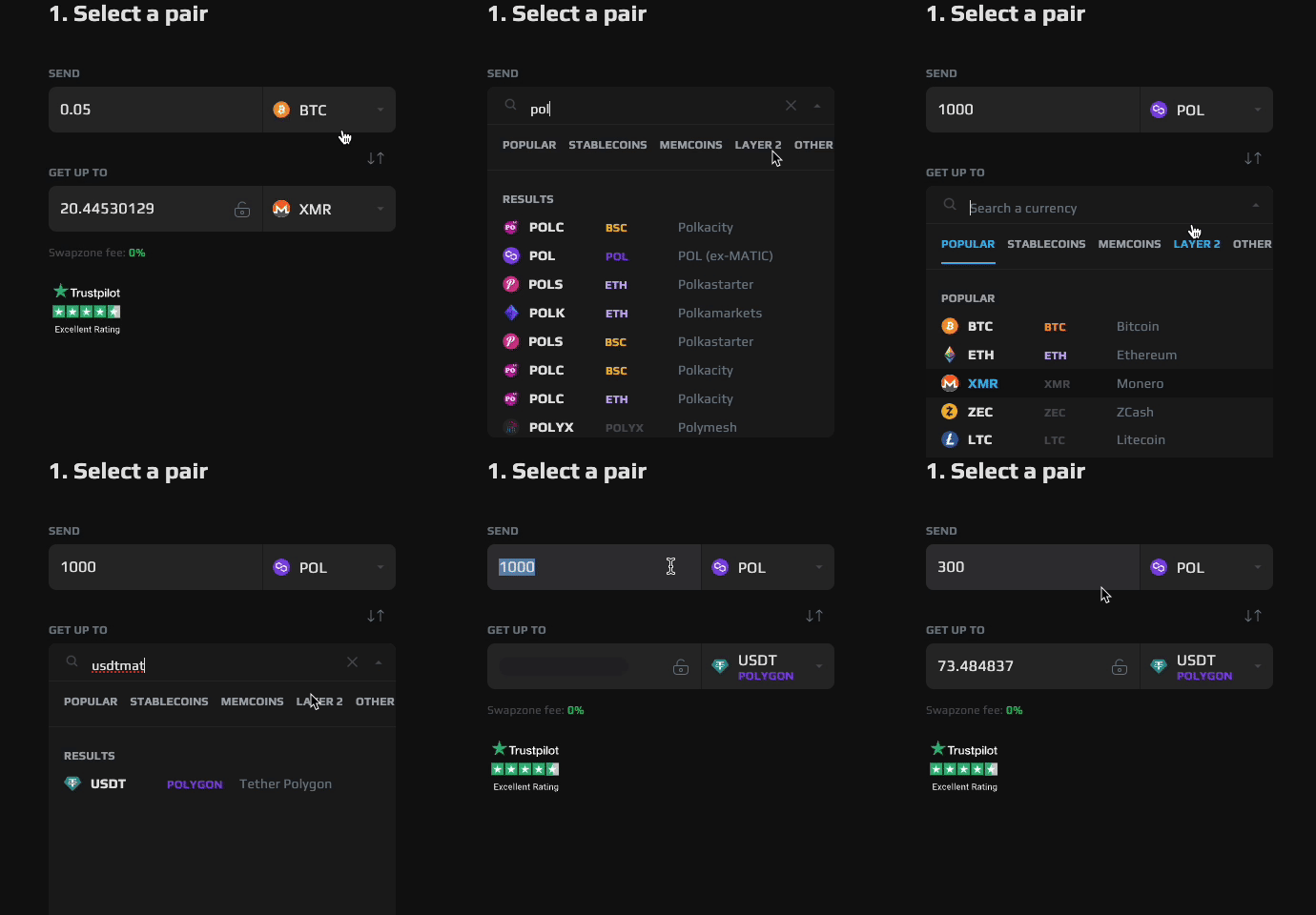
How to Choose a Render Exchange


Render (RENDER) Price Analysis

Frequently Asked Questions About Render (RENDER)

Creators pay RENDER to node operators for completed rendering and AI compute jobs. It is direct payment for measurable work delivered on-chain, not a staking or governance token first.
Under BME, RENDER spent on compute jobs is burned, and new RENDER is minted as rewards for node operators. It was introduced through governance proposal RNP-001 and ties burns to real network usage.
Yes: 644,245,094 RENDER. That is the original supply of about 536.87 million plus a 107.38 million emission pool scheduled to be issued on Solana over ten years.
On a declining schedule: about 9.13 million RENDER in year one and 5.90 million in year two. Unused monthly allocations remain locked by the Foundation and do not enter circulation.
Net supply change depends on whether RENDER burned through compute spending outpaces the scheduled emissions. When job volume is low, emissions can exceed burns.
In November 2023 at a 1:1 ratio, changing the ticker from RNDR to RENDER. Exchanges such as Kraken and Binance.US supported the 1:1 conversion.
The RCN is a dedicated AI subnet for model training and inference workloads, approved by the community in April 2025. It extends the burn mechanism from visual rendering to AI compute.
Over 22 million frames in 2025, with a projected expansion to 45,000 active nodes, according to CoinMarketCap ecosystem data. A projection is not a result.
Network parameters such as emission rates, fee structures, and compute subnet expansion, through on-chain proposals.
Founder Jules Urbach presented at NVIDIA RTX Rendering Day during SIGGRAPH 2026 in Los Angeles. A conference appearance does not change token supply or demand by itself.
Open swapzone.io/exchange/render, enter the amount, and compare offers from partner exchanges. Paste a Solana address that supports SPL tokens, send RENDER on the stated network, and track the order.
Why Exchange Render with Swapzone?

Non-custodial aggregator: you send RENDER to the partner's deposit address and receive funds in your own wallet, never through Swapzone.

Live RENDER offers from exchange partners side by side.

Swap RENDER with 1,600+ cryptocurrencies.

Reviews from TrustPilot


Good and Fast Support
Tyler from Swapzone's Support team was very kind and helps me out proactively. Highly recommend this site.
Excellent and reliable platform
Reliable and easy to use without the cumbersome KYC! Excellent exchange platform.
Quick service
Quick service. Transaction was processed with ease. Thank you Swapzone
Learn More About Cryptocurrencies


Our exchange partners for Render
Contact us for partnership