

Polygon (POL) Exchange
Looking to exchange POL? Swapzone compares live offers from partner exchanges by rate, speed and KYC label. No account, no custody, 0% platform fee. POL exists on Ethereum and on Polygon PoS.


Swapzone 手续费:0%

POL Market Data & Key Metrics
PricePOL Price Chart and Market Analysis

Popular POL Exchange Pairs


Other Cryptocurrencies to Exchange
 Cardano
 Solana
 GRAM
 Pirate Chain
 Zebec Network
 Tether
 Merlin Chain
 Drift
 Lisk
Popular Alternatives to Buy

What is POL?
About POL
POL is the native gas and staking token of Polygon 2.0, a proof-of-stake Layer 2 network that processes Ethereum-compatible transactions off-chain before settling on Ethereum mainnet. Validators stake POL to secure Polygon PoS and earn block rewards; delegators assign their stake to chosen validators — not to a single centralised sequencer. The token replaced MATIC in a 1:1 migration that reached 99% completion by September 2025, according to Polygon Labs.
POL tokenomics
Polygon launched with an initial supply of 10 billion POL, inheriting the existing MATIC circulating base. Unlike hard-capped models, POL operates with a programmatic annual emission rate governed by an on-chain Emission Manager contract. Approximately 10.64 billion POL are in circulation as of October 2026, according to CoinGecko.
Initial supply — 10 billion POL, migrated from MATIC at a 1:1 ratio; Ethereum-held MATIC requires manual migration through Polygon Portal
Annual emission rate — 1% per year for validator rewards under PIP-26 from July 2025, according to Polygon's developer docs; community governance may adjust or freeze this rate
Emission split — 50% to the Polygon PoS staking contract for validator rewards, 50% to a community treasury funding developer grants and ecosystem growth (1% each, a combined 2% a year)
Staking — validators and delegators stake POL in the Polygon PoS staking contract to earn rewards
“Hyperproductive” design — staked POL can simultaneously secure multiple Polygon-connected chains, allowing validators to earn protocol fees from several networks with a single stake position
Emission governance — the Emission Manager contract controls the mint rate with a per-second cap; the community retains the right to reduce, freeze, or redirect emissions through on-chain votes
What determines POL's value
POL's primary demand driver is gas fee consumption across Polygon PoS, where every on-chain transaction requires POL for execution. That activity creates continuous baseline demand for POL as a working asset — validators hold it staked, users hold small balances for fees, and protocols require it for governance participation.
The secondary mechanism is AggLayer, Polygon's cross-chain interoperability infrastructure. As more chains connect through AggLayer, POL's role expands from a single-chain gas token to a shared security asset across the wider Polygon network — each additional chain increases the fee income available to validators staking POL across multiple networks simultaneously.
How to Exchange POL on Swapzone

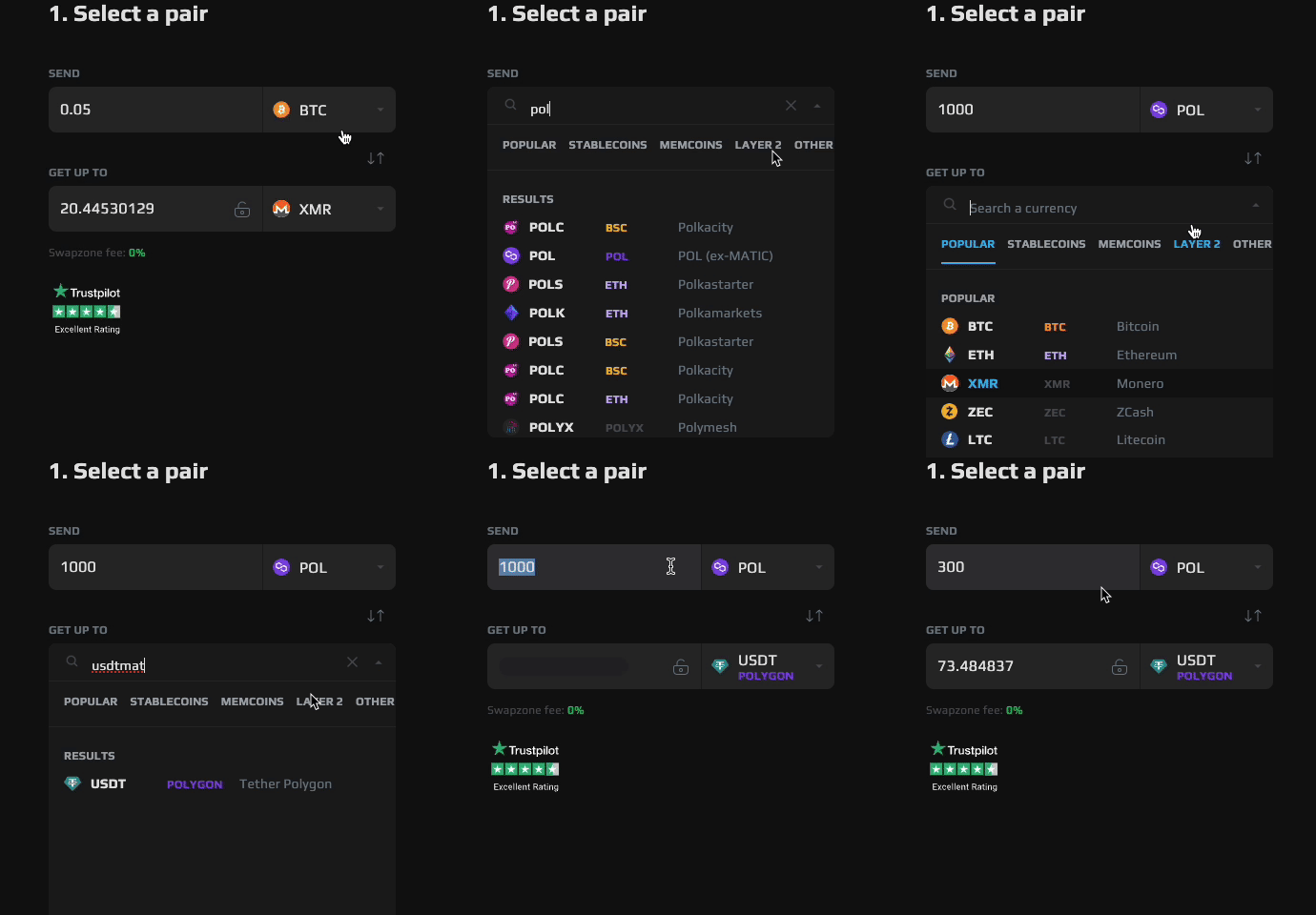
How to Choose a POL Exchange


POL (POL) Price Analysis

Frequently Asked Questions About POL (POL)

POL replaced MATIC as Polygon's native gas and staking token in a 1:1 migration that reached 99% completion by September 2025, according to Polygon Labs. POL is also designed to be staked across several Polygon-connected chains.
MATIC held on Ethereum requires manual migration through Polygon Portal. Check which network your MATIC is on before you swap, because the migration path depends on it.
Under PIP-26 the validator share was 2% in year four, 1.5% in year five and 1% from July 2025, which gives a combined 2% a year with 1% for a community treasury, according to Polygon's developer docs. Governance can adjust or freeze it through on-chain votes, so there is no hard cap.
50% goes to the Polygon PoS staking contract for validator rewards and 50% to a community treasury that funds developer grants and ecosystem growth.
An on-chain Emission Manager contract sets the mint rate with a per-second cap. The community can reduce, freeze, or redirect emissions through on-chain votes.
Staked POL can secure several Polygon-connected chains at once, so a validator can earn protocol fees from multiple networks with one stake position.
Validators and delegators earn rewards from the Polygon PoS staking contract, which receives half of the annual POL emission, and the rate changes with the amount staked. Yields change with emissions and the amount staked, so that figure is a past data point.
Polygon's cross-chain interoperability infrastructure. As more chains connect, POL becomes a shared security asset, and each added chain raises the fee income available to validators staking POL across networks.
Polygon PoS dApp activity is tracked publicly on DefiLlama. Deployed dApps measure supply of applications, not user activity.
POL exists on Ethereum and on Polygon PoS, where it is the gas token. Use the network the swap offer states, since both use 0x addresses and a wrong-network transfer may not be recoverable.
Open the POL exchange page on Swapzone, enter the amount, and compare offers from partner exchanges by rate, time, and KYC label. Paste a 0x address on the stated network, send POL to the deposit address, and track the order.
POL is the native gas and staking token of Polygon PoS, and it replaced MATIC at a 1:1 ratio when the token upgrade activated on September 4, 2024. Polygon Labs confirmed on September 3, 2025 that 99% of MATIC had migrated to POL. Every transaction on Polygon PoS has been paid in POL since the September 2024 upgrade. Circulating supply was approximately 10.64 billion POL with a market capitalisation of roughly $958 million as of October 2026, according to CoinGecko. POL exists on both Ethereum and Polygon PoS.
MATIC held on Polygon PoS on September 4, 2024 converted to POL automatically at 1:1, so no action was required there. MATIC held as an ERC-20 token on Ethereum did not convert automatically: the old MATIC contract and the new POL contract exist as separate tokens on Ethereum, and holders upgrade through the migration contract on the Polygon Portal at a 1:1 rate. Polygon set no deadline for that upgrade, though governance retains the power to introduce one. Centralised platforms handled it on their own schedules.
POL exists on Ethereum as an ERC-20 token and on Polygon PoS as the native token. Both networks use the same 0x address format, so a Polygon PoS address and an Ethereum address look identical, which makes a mismatch easy to trigger. Sending POL over Polygon PoS to a deposit address the partner monitors on Ethereum places the funds on a chain the partner is not watching. Confirm the network in the partner's deposit instructions and in your wallet's send screen before confirming, and contact Swapzone support with the transaction hash and Order ID if a transfer has already gone out.
The requirement depends on which network carries the transfer. Moving POL as an ERC-20 token on Ethereum requires ETH in the same wallet to cover gas, and POL cannot pay that fee. Moving POL on Polygon PoS requires POL, because POL is the native gas token of that network, so a balance slightly above the amount you send is enough. Swapzone charges 0% platform fee on POL exchanges, which leaves two costs: the exchange partner's fee, already priced into the quoted rate, and the network fee you pay from your own wallet.
Polygon PoS produces a block roughly every 2 seconds, and the Heimdall v2 upgrade on July 10, 2025 cut finality from 1 to 2 minutes down to approximately 5 seconds while capping reorganisation depth at 2 blocks. A POL transfer over Ethereum settles more slowly, since Ethereum produces a block every 12 seconds and most exchange partners wait for 2 to 6 confirmations. Total swap time of 5 to 30 minutes is therefore set by the partner's processing step and by the receiving network, and the estimate shown on each offer already reflects that partner's own policy.
POL launched with an initial supply of 10 billion tokens and carries no maximum supply. The emission schedule mints 2% per year, split into 1% for validator and staking rewards and 1% for the Community Treasury that funds grants and network development, according to Polygon's developer documentation. That schedule adds roughly 200 million POL annually, and circulating supply was approximately 10.64 billion as of October 2026. The emission rate is set by Polygon governance and can change, so check Polygon's documentation for the current schedule.
Staked POL sits in Polygon's staking contracts on Ethereum mainnet rather than in your wallet, so it cannot be sent to an exchange partner until you unstake it. Unbonding runs 80 to 82 checkpoints, roughly 3 to 4 days according to Polygon's support documentation, and finalising the withdrawal takes a second Ethereum transaction that requires ETH for gas. Rewards stop accruing the moment you initiate unbonding. Account for that window before you plan a swap, since checkpoint timing stretches when Ethereum is congested.
Why Exchange POL with Swapzone?

Non-custodial aggregator: you send POL to the partner's deposit address and receive funds in your own wallet, never through Swapzone.

Live POL offers from exchange partners side by side.

Swap POL with 1,600+ cryptocurrencies.

Reviews from TrustPilot


Good and Fast Support
Tyler from Swapzone's Support team was very kind and helps me out proactively. Highly recommend this site.
Excellent and reliable platform
Reliable and easy to use without the cumbersome KYC! Excellent exchange platform.
Quick service
Quick service. Transaction was processed with ease. Thank you Swapzone
Learn More About Cryptocurrencies


Our exchange partners for POL
Contact us for partnership