

Ethena USDe (USDE) Exchange
USDE is a synthetic dollar stablecoin issued by Ethena Labs, pegged 1:1 to the US dollar through a delta-neutral strategy combining spot crypto collateral with short perpetual futures positions — not backed by fiat reserves held by a custodian.


Swapzone 手续费:0%
USDE Market Data
PriceUSDE Price Chart

Popular USDE Exchange Pairs


Other Cryptocurrencies to Exchange
 Cardano
 Solana
 GRAM
GRAM Pirate Chain
 CLV
CLV Stargate Finance
 USDD
USDD TrueFi TRU
 Waves
Waves TrueUSD
 DODO
DODO Lido DAO
 SSV
SSVPopular Alternatives to Buy

What Is Ethena USDe?
What Is USDE?
USDE is a synthetic dollar stablecoin issued by Ethena Labs, pegged 1:1 to the US dollar through a delta-neutral strategy combining spot crypto collateral (such as staked ETH and BTC) with short perpetual futures positions on centralised exchanges. USDE passed $1 billion in supply in March 2024, about one month after its public launch in February 2024, according to Ethena's announcement. USDE is an ERC-20 token deployed on Ethereum.
USDE Mechanism and Supply
USDE is not backed by fiat or by overcollateralised crypto alone. Its peg is maintained by a delta-neutral hedge: for every dollar of spot crypto deposited as collateral, Ethena simultaneously opens a short perpetual futures position of equivalent size. If the crypto price falls, the short position gains, keeping the combined position worth approximately $1 per USDE. Ethena has changed USDE's backing over time: in 2026 the reserves also include stablecoins and tokenised funds alongside the delta-neutral hedge, and the current composition is published on Ethena's transparency page.
Collateral — crypto assets such as staked ETH (stETH, weETH) and BTC, held with custodians and used to margin the hedge on centralised exchanges; the current mix is published by Ethena
Hedge — short perpetual futures positions on Bybit, Binance, OKX, and other CEXs; fully collateralised by on-chain assets
sUSDe — staked USDE; depositing USDE into Ethena's staking contract returns sUSDe, an accruing-yield token backed by funding rate income; yield fluctuates and can be negative during bear markets
Circulating supply — approximately $4.8 billion as of October 2026, according to CoinGecko
ENA — Ethena's governance token, separate from USDE itself; ENA holders govern protocol parameters
Reserve fund — Ethena maintains a reserve fund from protocol revenue to absorb periods when funding rates are negative; Ethena reported about $62 million in the fund and a backing ratio of 101.59% at the end of June 2026
Insurance fund — a first-loss buffer funded through protocol revenue, applied before the reserve fund
What Determines USDE's Peg Stability
USDE's peg is maintained through two mechanisms. On the creation side, arbitrageurs can mint USDE by depositing collateral and Ethena opens a corresponding short. On the redemption side, USDE can be burned to redeem the collateral. The peg holds as long as funding rates on perpetual futures are not deeply and persistently negative. During extended bear markets, when everyone is short and funding rates turn negative, Ethena pays rather than receives funding — which erodes yield and, if prolonged beyond what the reserve fund covers, could create depeg pressure. USDE's key risk is therefore not a bank run but a sustained negative funding rate environment. Ethena launched USDtb (backed by BlackRock's BUIDL tokenised Treasury fund) in December 2024 as a complementary stablecoin that earns T-bill yield rather than funding yield, diversifying risk within the Ethena ecosystem.
How to Exchange Ethena USDe on Swapzone

How to Choose a USDE Exchange Partner


Ethena USDe Analysis
Frequently Asked Questions About Ethena USDe

USDE uses a delta-neutral strategy: for every dollar of spot crypto deposited as collateral, Ethena opens a short perpetual futures position of equivalent value on centralised exchanges. If the crypto price falls, the short gains; if it rises, the spot gains. The combined position stays approximately flat in dollar terms, keeping USDE close to $1. Arbitrageurs reinforce the peg by minting or redeeming USDE when it deviates.
sUSDe is the staked version of USDE. Depositing USDE into Ethena's staking contract returns sUSDe, which accrues yield from perpetual futures funding rates earned by the protocol's short positions. When markets are bullish and longs pay shorts, funding rates are positive and sUSDe yield is high. When markets are bearish and shorts pay longs, funding rates turn negative and yield drops — or the protocol draws on its reserve fund to maintain positive returns.
Negative funding rates mean Ethena pays rather than receives from the hedge positions. For short periods, the reserve fund absorbs the loss. If funding rates stay negative for an extended period beyond what the reserve fund covers, the protocol may need to pass losses to sUSDe holders (by reducing the sUSDe/USDE exchange rate) or take other protective measures. Depeg risk for USDE comes from this scenario, not from a collateral bank run.
The reserve fund is a first-loss buffer Ethena maintains from protocol revenue. It is funded from protocol revenue and grows as the protocol earns fees. During periods of negative funding rates, the reserve fund absorbs losses before they reach sUSDe holders. Ethena reported a reserve fund of about $62 million and a backing ratio of 101.59% at the end of June 2026, and publishes current figures in its documentation.
USDtb is a second stablecoin launched by Ethena in December 2024, backed by BlackRock's BUIDL tokenised US Treasury fund. Unlike USDE, which earns yield from perpetual futures funding, USDtb earns yield from Treasury bills. The two products are complementary: when perpetual funding rates are low or negative, Ethena can direct reserves to USDtb to earn T-bill yield, and vice versa — diversifying the risk profile of the overall Ethena ecosystem.
ENA is Ethena's governance token, separate from USDE. ENA holders vote on protocol parameters, fee structures, and strategic decisions. USDE is the stablecoin — a dollar-pegged synthetic asset. ENA has no direct role in maintaining USDE's peg; it is an equity-like stake in the protocol's governance and potential future fee distribution.
Ethena's delta-neutral short positions are held across multiple centralised exchanges including Binance, Bybit, and OKX. This multi-venue distribution reduces single-exchange counterparty risk. Ethena publishes regular reports on position distribution and collateral allocation across venues.
Minting and redeeming USDE requires KYC and approval as a qualified participant in Ethena's minting program. Retail users access USDE through secondary market trading on exchanges — buying and selling USDE just like any other ERC-20 token. Direct minting/redemption with Ethena is reserved for institutional participants who maintain the peg through arbitrage.
DAI is an overcollateralised stablecoin — each DAI requires more than $1 in locked collateral to mint, with automatic liquidation if collateral value falls. USDE is a delta-neutral synthetic dollar — it does not overcollateralise but instead hedges using perpetual futures. DAI's main risk is collateral liquidation cascades during market crashes. USDE's main risk is persistent negative funding rates. DAI has a longer track record (since 2017); USDE scaled faster to $5+ billion in supply.
USDE passed $1 billion in circulating supply in March 2024, about one month after launching in February 2024, according to Ethena's announcement. Its supply was approximately $4.8 billion as of October 2026, according to CoinGecko.
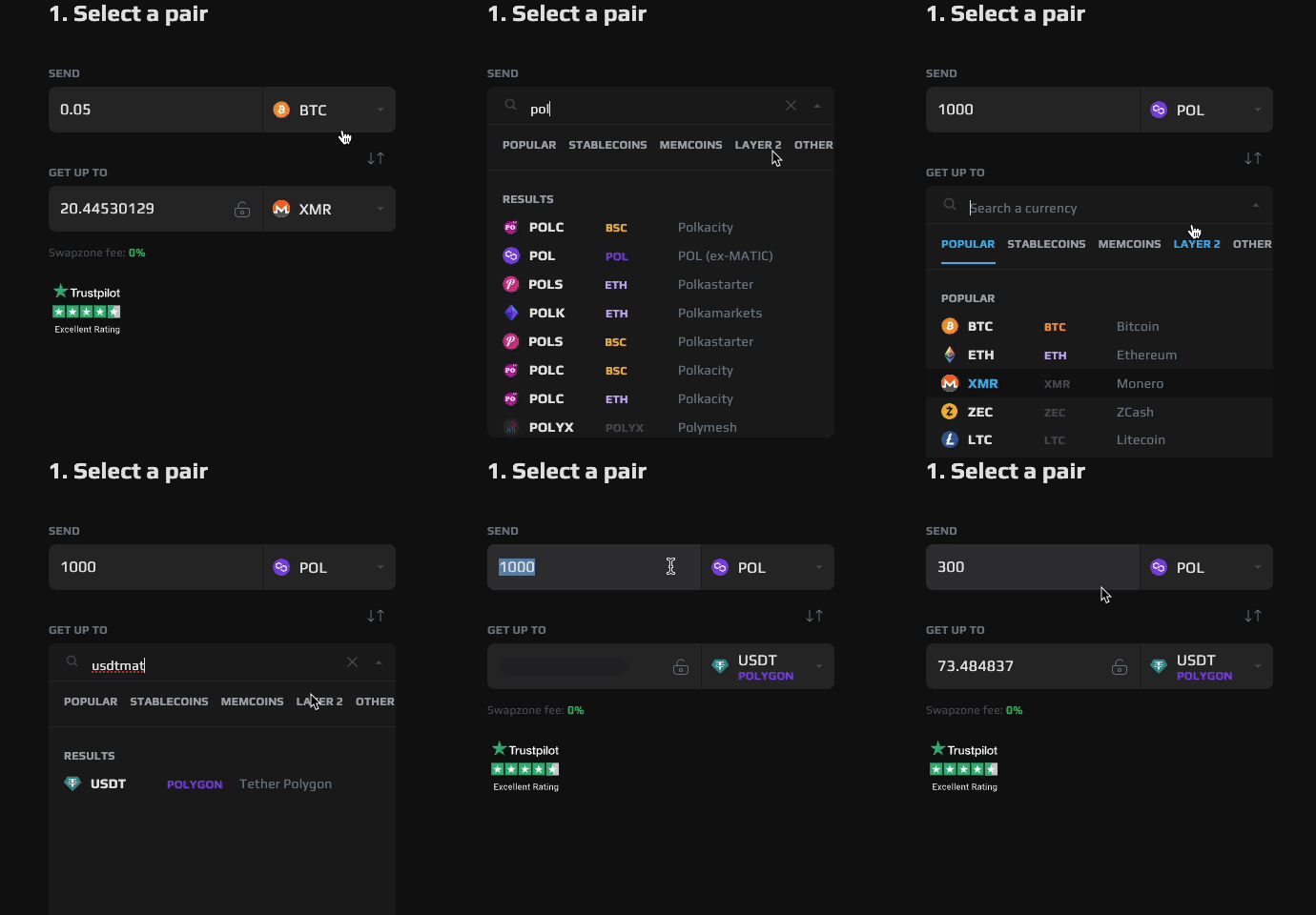
Go to swapzone.io/exchange/ethena-usde, enter the amount of USDE you want to send or receive, and compare live offers from exchange partners. Each offer shows the rate, estimated completion time, and KYC frequency label. Select the offer, enter your destination wallet address (USDE is ERC-20 on Ethereum), and send USDE to the deposit address provided. No registration is required on Swapzone.
Why Exchange USDE on Swapzone

Non-custodial aggregator — USDE goes directly to your wallet, never through Swapzone

Live USDE offers from exchange partners side by side.

Exchange USDE against 1,800+ cryptocurrencies

Ethena USDe Reviews on Trustpilot


Good and Fast Support
Tyler from Swapzone's Support team was very kind and helps me out proactively. Highly recommend this site.
Excellent and reliable platform
Reliable and easy to use without the cumbersome KYC! Excellent exchange platform.
Quick service
Quick service. Transaction was processed with ease. Thank you Swapzone
Learn More About Cryptocurrencies



Our Exchange Partners
Contact us for partnership