

Avalanche (AVAX) Exchange
AVAX is the native token of Avalanche, a Layer 1 blockchain platform designed for high-throughput, low-latency DeFi and institutional asset tokenisation, using a novel consensus mechanism that enables sub-second finality without sacrificing decentralisation.


Swapzone fee: 0%

Avalanche Market Data
PricePopular AVAX Exchange Pairs


Other Cryptocurrencies to Exchange
 Cardano
 Solana
 GRAM
GRAM Pirate Chain
 DODO
DODO Lido DAO
 SSV
SSV ConstitutionDAO
 DeXe
DeXe Wombat Web 3 Gaming Platform
 MBL
MBL QuickSwap
 Telcoin
 KuCoin Token
Popular Alternatives to Buy

What Is Avalanche (AVAX)?
What Is AVAX?
AVAX is the native token of Avalanche, a Layer 1 blockchain platform launched in September 2020 by Ava Labs. Avalanche's core technical innovation is the Avalanche consensus protocol — a probabilistic consensus mechanism based on repeated random subsampling of validators. Unlike Nakamoto consensus (PoW) or traditional BFT (which require all validators to communicate), Avalanche consensus achieves finality in under 2 seconds while supporting thousands of validators simultaneously. This gives Avalanche sub-two-second finality for DeFi applications.
AVAX Tokenomics
AVAX has a fixed maximum supply with a burn mechanism: all transaction fees paid on the network are burned (destroyed) rather than going to validators, creating a deflationary pressure proportional to network usage.
Maximum supply — 720,000,000 AVAX
Circulating supply — approximately 443 million AVAX as of October 2026, according to CoinGecko
Staking rewards — validators earn AVAX staking rewards funded from the remaining uncirculated supply; current annualised reward rates depend on total staked amount and staking duration
Fee burn — all base transaction fees are burned; not distributed to validators
Minimum validator stake — 2,000 AVAX to run a Primary Network validator
Minimum delegation — 25 AVAX to delegate stake to an existing validator
Staking period — minimum 2 weeks, maximum 1 year
Subnets — validators pay a continuous fee in AVAX to the Primary Network to run subnet validators (each subnet validator must also validate the Primary Network)
Avalanche9000 (Etna upgrade, activated in December 2024) — replaced the 2,000 AVAX stake for L1 validators with a continuous dynamic fee of roughly 1.33 AVAX per month, lowering the cost of launching a blockchain
What Determines AVAX's Value
AVAX's primary value drivers are DeFi activity on the C-Chain (Ethereum-compatible chain), subnet creation and validation fees, and institutional tokenisation deployments. The Avalanche9000 (Etna) upgrade, activated in December 2024, replaced the 2,000 AVAX validator stake for new L1s with a continuous fee of about 1.33 AVAX per month, lowering the cost of launching a chain. Institutions have tested tokenisation on Avalanche: Citi ran a testnet pilot on an Avalanche subnet in February 2024, and JPMorgan's Onyx (now Kinexys) took part in a pilot with the Monetary Authority of Singapore on Avalanche. According to Nansen, DEX volume on the Avalanche C-Chain totalled about $8.7 billion in Q2 2026. The fee burn mechanism creates deflationary pressure that scales directly with network activity — as DeFi volume grows, more AVAX is permanently removed from circulation, reducing supply independently of demand growth.
How to Exchange Avalanche (AVAX) on Swapzone

How to Choose an AVAX Exchange Partner


Avalanche (AVAX) Price Analysis
Frequently Asked Questions About Avalanche (AVAX)

Avalanche consensus uses repeated random subsampling: each validator queries a small random subset of other validators, and the network reaches finality when enough validators have been queried and agree. This achieves finality in under 2 seconds while supporting thousands of validators — unlike traditional BFT, which scales poorly beyond a few hundred validators, and unlike Nakamoto consensus, which takes minutes for probabilistic finality.
Subnets (Sovereign Chains after the Avalanche9000 upgrade) are custom blockchains built on Avalanche's infrastructure. Each subnet can have its own virtual machine, consensus rules, validator set, and token economy. Subnets are used to build application-specific blockchains — financial institutions, gaming platforms, and DeFi protocols deploy subnets to customise performance, compliance, and tokenomics without building infrastructure from scratch.
Avalanche9000 (the Etna upgrade, activated in December 2024) replaced the 2,000 AVAX validator stake for new L1s with a continuous dynamic fee of approximately 1.33 AVAX per month. This dramatically reduced the cost barrier for deploying subnets, opening subnet creation to smaller teams and projects that previously could not afford Primary Network validator fees. The upgrade also improved the C-Chain's throughput and fee structure.
Burning fees reduces the circulating supply proportionally to network usage. Validators earn AVAX through staking rewards funded from uncirculated supply rather than from transaction fees. This design separates validator incentives from fee-level fluctuations and creates deflationary pressure that grows with the network — the more DeFi activity on Avalanche, the more AVAX is permanently removed from circulation.
The C-Chain (Contract Chain) is Avalanche's smart contract execution environment, running the Ethereum Virtual Machine (EVM). This means any Ethereum smart contract or tool (MetaMask, Ethers.js, Hardhat) works on the Avalanche C-Chain with minimal or no code changes. DeFi protocols built on Ethereum can be deployed to Avalanche's C-Chain to benefit from faster finality and lower fees while using the same codebase.
Running a Primary Network validator requires staking a minimum of 2,000 AVAX. Delegators can stake a minimum of 25 AVAX to an existing validator to earn a portion of their rewards. Staking duration ranges from a minimum of 2 weeks to a maximum of 1 year per staking period.
Citi ran a testnet pilot on an Avalanche subnet in February 2024, and JPMorgan's Onyx (now Kinexys) took part in a pilot with the Monetary Authority of Singapore on Avalanche. Avalanche's sub-2-second finality and EVM compatibility make it suitable for institutional DeFi and tokenised securities applications. The Avalanche Foundation has a dedicated institutional tokenisation initiative, Avalanche Vista, that invests in on-chain asset issuance projects built on the network.
Avalanche Primary Network consists of three chains: the P-Chain (Platform Chain) for validator coordination and subnet management; the C-Chain (Contract Chain) for EVM smart contracts; and the X-Chain (Exchange Chain) for fast asset creation and trading using a UTXO model. Most DeFi and token transfers happen on the C-Chain. AVAX is natively portable between all three chains.
AVAX on the C-Chain uses Ethereum-style 0x addresses and is compatible with MetaMask and EVM tools. AVAX on the X-Chain uses a different address format (starting with X-avax) and a UTXO-based transfer model. When exchanging AVAX on external platforms, the C-Chain version is the standard — confirm that your receiving wallet and the exchange partner both refer to C-Chain AVAX.
The maximum supply of AVAX is 720,000,000 tokens. Approximately 443 million AVAX are in circulation as of October 2026, according to CoinGecko. The remaining supply is released over time as staking rewards to validators. Because transaction fees are burned rather than distributed, net supply growth depends on the balance between new staking reward issuance and fee burns — high network activity can make the net issuance close to zero or negative.
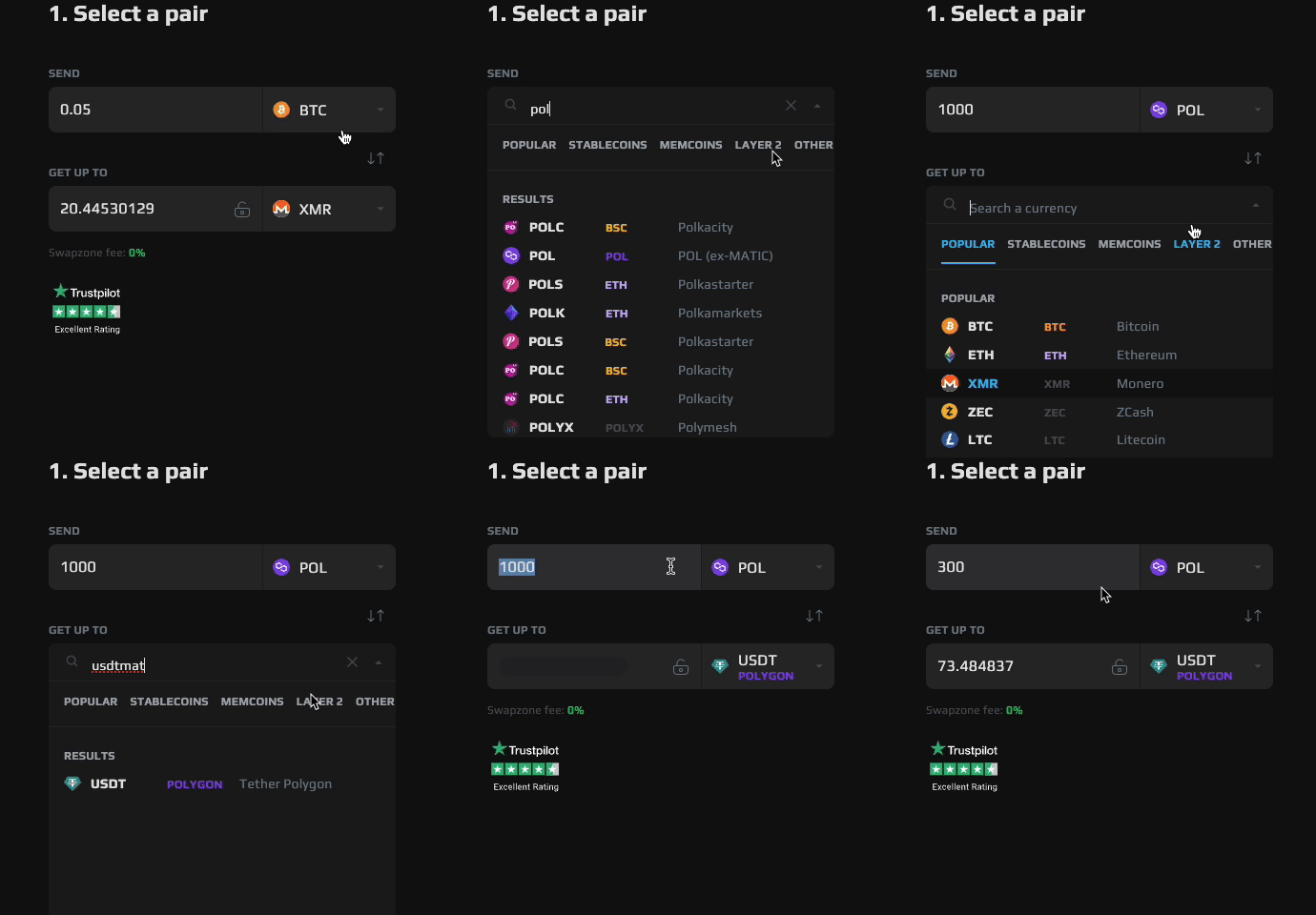
Go to swapzone.io/exchange/avalanche, enter the AVAX amount you want to send or receive, and compare live offers from exchange partners. Each offer shows the rate, estimated completion time, and KYC frequency label. Select the offer, enter your Avalanche C-Chain destination address (no MEMO required), and send AVAX to the deposit address provided. No registration is required on Swapzone.
Why Exchange Avalanche on Swapzone

Non-custodial aggregator — AVAX goes directly to your wallet, never through Swapzone

Live AVAX offers from exchange partners side by side.

Exchange AVAX against 1,800+ cryptocurrencies

Avalanche Reviews on Trustpilot


Good and Fast Support
Tyler from Swapzone's Support team was very kind and helps me out proactively. Highly recommend this site.
Excellent and reliable platform
Reliable and easy to use without the cumbersome KYC! Excellent exchange platform.
Quick service
Quick service. Transaction was processed with ease. Thank you Swapzone
Learn More About Cryptocurrencies


Our Exchange Partners
Contact us for partnership