


 Cardano
 Solana
 Pirate Chain
 DODO
DODO Lido DAO
 SSV
SSV ConstitutionDAO
 DeXe
DeXe Wombat Web 3 Gaming Platform
 MBL
MBL QuickSwap
 Telcoin
 KuCoin Token
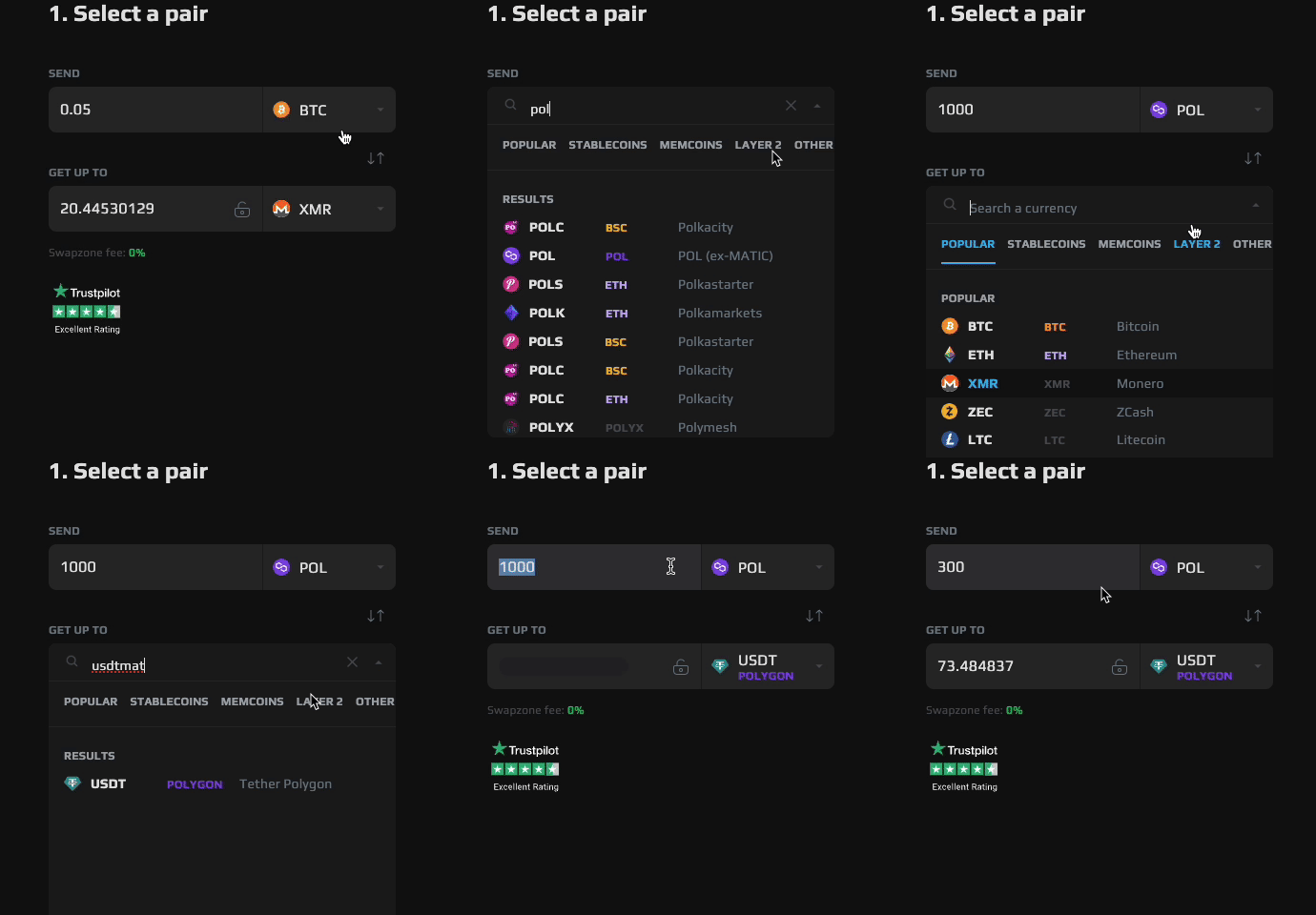

You can exchange crypto without going through KYC (Know Your Customer)
Gram exTON (GRAM) Exchange
GRAM is the native coin of The Open Network – a high-throughput blockchain that grew from Telegram's original ambitions for decentralized payments. The name itself has come full circle: the asset was called Gram in Telegram's 2018 whitepaper, renamed Toncoin when the community took over the project after a regulatory battle with U.S. authorities, and officially renamed back to Gram on June 15, 2026, following a community governance vote that passed with 81.22% approval. The blockchain is still called TON (The Open Network). Only the coin that runs on it changed its label. If you owned Toncoin before the switch, you hold Gram now — same wallet, same address, same balance.
For anyone looking to exchange this asset, that recent history matters practically: you may see it listed as TON, Toncoin, or GRAM depending on how recently a particular platform updated its display. The underlying asset is the same in all cases.
send

TONTON

get

Swapzone fee: 0%
GRAM market data & key metrics
Price$ 22.97
24h % price
-3.39%
7d % price
-7.91%
Market Cap
$ 13,695.55
24h volume
-
Coin supply
596.184
Popular GRAM exchange pairs
Exchange TON ForPairsStatus
Other Cryptocurrencies Exchange Pairs
BitcoinbtcEthereumethMoneroxmrZCashzecLitecoinltcXRPxrpTetherusdtStellarxlmTRONtrxUSD CoinusdcCardanoadaSolanasolPirate ChainarrrUSDCEusdceopDODOdodobep20Lido DAOldoerc20SSVssverc20ConstitutionDAOpeoplebep20DeXedexebep20DeXedexeerc20Wombat Web 3 Gaming PlatformwombatmaticMBLmblontQuickSwapquickerc20UTRUSTutkegldTelcointelmaticTELtelerc20Chilean PesoclpKuCoin TokenkcskccTetherusdtkcc
Popular Alternatives to Buy
What Is Gram exTON (GRAM)?
The Open Network was designed for real throughput from the start. It uses dynamic sharding — the chain automatically splits into parallel workchains under load and merges back when traffic drops — and after the Catchain 2.0 protocol upgrade in April 2026, transaction finality dropped to under one second. Network fees fell with it: a standard GRAM transfer now costs roughly $0.0005, and unlike Ethereum, that figure doesn't spike during periods of high activity. Fees on TON are fixed regardless of network congestion.
GRAM is what makes the network run. Every transaction on TON — a direct transfer, a Jetton token swap, a mini-app interaction, a smart contract call — consumes a small amount of GRAM for gas. Beyond gas, the token is used for staking to secure the network through Proof-of-Stake consensus, purchasing Telegram Stars (the in-app currency for digital goods and creator tools), paying for Telegram Premium subscriptions, and participating in TON-native DeFi protocols like STON.fi and DeDust.
The supply isn't hard-capped. New GRAM enters circulation as validator rewards at roughly 3.6% annual inflation — higher than it was before the Catchain upgrade, because faster block production generates more reward events. Telegram became the network's largest validator in May 2026 as part of the broader Make TON Great Again (MTONGA) roadmap that preceded the rebrand.
Why People Swap Gram
The exchange traffic around GRAM runs in both directions, and the motivations are fairly distinct depending on which way someone is moving.
Moving into GRAM usually means entering the TON ecosystem — buying exposure to stake for yield, funding a Telegram wallet for peer-to-peer transfers, paying for Telegram Premium directly on-chain, or acquiring gas to interact with TON-based DeFi and mini-apps. Users coming from Bitcoin, Ethereum, or stablecoins convert specifically to activate the network's utilities. Someone paying a Telegram channel ad fee in GRAM or tipping a creator through a mini-app is doing exactly this.
Moving out of GRAM is just as common. Taking profits into USDT or USDC is the standard move for traders who want to de-risk a position without fully leaving crypto. Others rotate from GRAM into BTC or ETH as part of broader portfolio rebalancing — the TON/BTC and TON/ETH pairs have historically been high-liquidity directions on aggregators for this reason.
There's also a purely technical motivation: TON requires a small GRAM balance in any wallet to pay network fees, even if you're only moving Jetton tokens (USDT-TON, NOT, or similar). Holders who accumulate Jettons through airdrops or DeFi rewards sometimes find their wallet frozen because they don't have enough GRAM for gas. Swapping a small amount of another asset into GRAM just to unlock outbound transfers is a real, recurring use case.
Technical Notes for Exchanging GRAM
GRAM is a native-chain token — it lives on The Open Network and operates on its own infrastructure, separate from Ethereum, BNB Chain, or any other EVM-compatible network. The receiving address for any GRAM swap must be a TON-compatible address.
TON addresses are base64-encoded strings, typically around 48 characters, starting with EQ or UQ. Both prefixes point to the same underlying account: EQ is the bounceable format (used in smart contract interactions where failed transactions return funds to the sender), and UQ is the non-bounceable format more commonly shown for regular wallet use. Modern TON wallets — Tonkeeper, MyTonWallet, @wallet on Telegram — handle both formats transparently. What matters is that you do not paste a GRAM address into an Ethereum destination field (0x...) or a BNB Chain field. They're structurally incompatible and funds sent there are not recoverable.
If you're depositing GRAM to a centralized exchange after a swap, pay attention to whether the exchange requires a memo or comment alongside the deposit address. Many CEX platforms use a single shared wallet address for all users and distinguish accounts by memo. Skipping the memo is one of the most common support tickets in the TON ecosystem — funds arrive at the exchange's wallet but don't get credited to the right account, requiring manual intervention.
Transaction finality on the TON chain takes roughly one second. A full swap through an exchange partner — deposit, processing, and outbound transfer — typically completes within 5 to 20 minutes depending on the provider and network conditions at the time.
How to exchange GRAM on Swapzone
What you Need to Know About the Name: GRAM, TON, Toncoin, and the Others
The June 2026 rebrand introduced some short-term confusion, and a few persistent naming collisions are worth spelling out before you make an exchange.
On Swapzone, the native GRAM (The Open Network) is listed separately from bridged versions, so you can verify exactly what you're exchanging before confirming the transaction.
There is also a legacy proof-of-work token from 2018 that has historically appeared under names similar to "Gram" and trades at a tiny fraction of a cent with a minimal market capitalization. It predates the current TON blockchain entirely, has no connection to the 2026 rebrand, and is not the same asset. If a result in a search or on a small exchange shows a "Gram" or "GRAM" priced at fractions of a cent with a market cap in the low millions, that is this old token — not the native coin of The Open Network.
On Swapzone, the native GRAM (The Open Network) is listed separately from bridged versions, so you can verify exactly what you're exchanging before confirming the transaction.
There is also a legacy proof-of-work token from 2018 that has historically appeared under names similar to "Gram" and trades at a tiny fraction of a cent with a minimal market capitalization. It predates the current TON blockchain entirely, has no connection to the 2026 rebrand, and is not the same asset. If a result in a search or on a small exchange shows a "Gram" or "GRAM" priced at fractions of a cent with a market cap in the low millions, that is this old token — not the native coin of The Open Network.
Native GRAM
TONERC20
TONBEP20
Native token GRAM (The Open Network, ticker GRAM) is the asset this page covers — the native coin of the TON blockchain, formerly known as Toncoin. It lives exclusively on The Open Network.
Gram exTON (GRAM) Price Prediction
GRAM (TON) price is shaped by a combination of on-chain network activity, exchange liquidity, market sentiment, and broader crypto market conditions. Key factors to track include TON adoption metrics, development milestones, and how GRAM moves relative to Bitcoin during different market cycles.
No GRAM price prediction is certain — TON is a volatile digital asset and can lose value rapidly. Always do your own research (DYOR) and consult independent sources before making any financial decision.
Disclaimer: This content is for informational purposes only and does not constitute financial or investment advice. Swapzone is a non-custodial exchange aggregator; we compare rates across providers, not predict markets.
No GRAM price prediction is certain — TON is a volatile digital asset and can lose value rapidly. Always do your own research (DYOR) and consult independent sources before making any financial decision.
Disclaimer: This content is for informational purposes only and does not constitute financial or investment advice. Swapzone is a non-custodial exchange aggregator; we compare rates across providers, not predict markets.
Frequently Asked Questions About Gram (GRAM) Exchange
My exchange still shows "TON" or "Toncoin" — is that the same as GRAM?
Yes. The rebrand from Toncoin (TON) to Gram (GRAM) took effect on June 15, 2026, and platforms have been rolling out the display update on their own timelines. If you see TON or Toncoin on a platform that hasn't updated yet, it refers to the same native asset on The Open Network. Your balance, address, and holdings are completely unchanged — only the label differs. No action is needed on your part, and no migration or conversion is required.
What address format should I use to receive GRAM after a swap?
You need a native TON address — a roughly 48-character base64 string starting with EQ or UQ. Both variants work fine; the prefix describes how the network handles failed transactions, not which wallet it belongs to. Never send native GRAM to an Ethereum address (starts with 0x) or a BNB Chain address — the networks are incompatible and the funds would be unrecoverable. Use an address from a TON-compatible wallet such as Tonkeeper, MyTonWallet, or @wallet in Telegram.
Do I need to include a memo when receiving GRAM?
Wallet-to-wallet transfers on TON don't require a memo. However, if you're depositing GRAM into a centralized exchange, check the exchange's deposit page carefully — many use a single shared deposit address with a memo field that identifies your specific account. Missing the memo at that stage is a common source of delayed credits. For standard swaps where you receive GRAM directly to your personal wallet, no memo is needed.
What's the difference between native GRAM and TONERC20?
They are distinct tokens on different blockchains. Native GRAM exists on The Open Network and is what you need for staking, TON-based DeFi, paying gas on TON, and using GRAM within Telegram's ecosystem. TONERC20 is a wrapped version on Ethereum, used in Ethereum DeFi. If you're exchanging GRAM to deploy it within the Telegram ecosystem or The Open Network, always confirm the receiving address is a TON-format address (EQ.../UQ...) rather than an Ethereum or BNB Chain address. Sending to the wrong network's address means the assets go to an incompatible chain with no way to retrieve them through Swapzone.
Why exchange GRAM with Swapzone?
Higher security
We check all exchangers for the risk of freezing funds. Your funds will definitely reach you!

Best rates
We're showing the offers from the most popular and reliable exchange providers. Pick the best offer for your crypto pair!

3000+ currencies available
It's really hard not to find the crypto you need on Swapzone :)

Swapzone Reviews

TrustPilot 4.7 |536 reviews


Good and Fast Support
Tyler from Swapzone's Support team was very kind and helps me out proactively. Highly recommend this site.
Excellent and reliable platform
Reliable and easy to use without the cumbersome KYC! Excellent exchange platform.
Quick service
Quick service. Transaction was processed with ease. Thank you Swapzone
Learn More About Cryptocurrencies
How to Exchange Crypto Without Verification
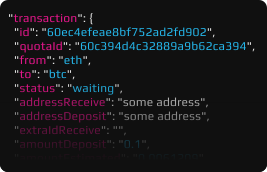
Crypto Exchange API
Enable crypto swaps, staking, loans, and fiat in your app—without building 30 integrations.
Crypto Wallet Security Tips
Why Should You Really Care About Bitcoin and Crypto Security?

Hidden Fees in Crypto: Why You Pay More Than You See
Uncover the hidden costs of crypto trades, from spreads to slippage, and learn how to minimize them
Our Exchange Partners for GRAM
Contact us for partnership