

Canton Coin (CC) Exchange
CC (Canton Coin) is the native utility token of Canton Network, a Layer 1 blockchain built specifically for institutional finance with sub-transaction privacy built into the protocol layer.


Swapzone fee: 0%

Canton Coin Market Data
PriceCanton Coin (CC) Price Chart
Popular CC Exchange Pairs


Other Cryptocurrencies to Exchange
 Cardano
 Solana
 GRAM
GRAM Pirate Chain
 ARC
ARC Aethir
 BULL BTC CLUB
 Bifrost
 CareCoin
 Open Campu
 Goose Finance
 Evedo
Evedo Gemie
Gemie Rupiah Token
 Infinity Games
 UNUS SED LEO
 Matrix AI Network
 Meteora
Popular Alternatives to Buy

What Is Canton Coin (CC)?
What Is CC?
CC (Canton Coin) is the native utility token of Canton Network, a Layer 1 blockchain built specifically for institutional finance by Digital Asset Holdings, a fintech company backed by major financial institutions. Canton provides sub-transaction privacy built into the protocol layer: transaction data is shared exclusively with the parties involved in a trade, not broadcast to every node. The blockchain uses Daml, a purpose-built smart contract language designed for multi-party financial workflows. Canton launched as a production network in 2024.
CC Tokenomics
Canton Coin launched with a fair-distribution model: no presale, no ICO, no founder allocation, and no preferential VC token distribution, according to Canton Network's own materials. CC functions as gas-equivalent through a holding fee model, as the staking token for Super Validators operating the Global Synchronizer, and as the governance token for protocol decisions.
Circulating supply — approximately 39.8 billion CC as of October 2026, according to CoinGecko
Market capitalisation — approximately $4.7 billion as of October 2026, according to CoinGecko
Supply model — burn-and-mint equilibrium; CC is burned when used for holding fees and minted as validator rewards, with dynamic supply tied to network activity
Super Validators — institutions including Blockdaemon, Figment, Kiln, Visa, Goldman Sachs, DTCC, Euroclear, and Moody's Ratings operate the Global Synchronizer and earn CC for securing the network
Institutional backers — Digital Asset's June 2026 round of $355 million was led by a16z crypto, and its June 2025 round was led by DRW Venture Capital and Tradeweb; investors include Goldman Sachs, DTCC, BNP Paribas, Citadel Securities, HSBC, BNY, Nasdaq, S&P Global, Circle Ventures, and Polychain Capital
What Determines CC's Value
CC's primary demand driver is institutional network activity on Canton. Every transaction, contract execution, and data synchronization event requires CC for holding fees, creating structural demand proportional to network usage. DTCC has been testing tokenised US Treasury custody on Canton Network, and JPMorgan's Kinexys plans to bring JPM Coin natively to Canton with a phased rollout through 2026, according to news reports. Goldman Sachs built its Digital Asset Platform (GS DAP) on Daml and Canton for digital issuance of bonds and structured products. HSBC, Franklin Templeton, Visa, and DTCC are among the institutional participants operating on or integrating with the network. This concentration of regulated financial institutions makes CC's price more sensitive to institutional adoption milestones than to broader crypto market sentiment.
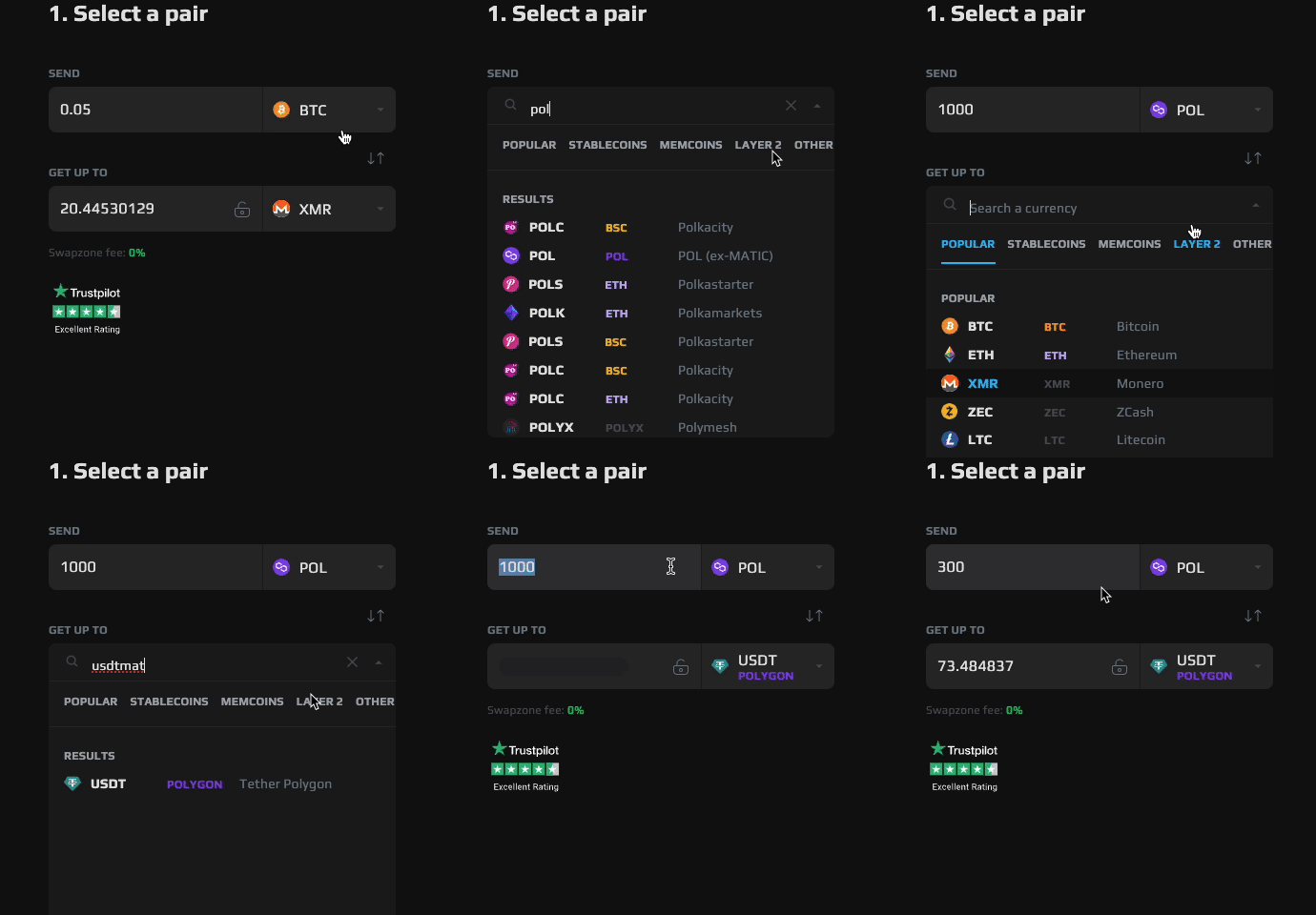
How to Exchange Canton Coin (CC) on Swapzone

How to Choose a CC Exchange Partner


Canton Coin (CC) Price Analysis
Frequently Asked Questions About Canton Coin (CC)

Canton Network is a Layer 1 blockchain built specifically for institutional finance by Digital Asset Holdings. Its primary differentiator is sub-transaction privacy built into the protocol layer: each transaction is visible only to the parties directly involved, not broadcast to every node. It uses Daml, a purpose-built smart contract language designed for multi-party financial workflows with authorization and privacy rules encoded into each contract.
Sub-transaction privacy means transaction details are shared only with the counterparties of each specific trade — not with the entire network of validators or observers. This is architecturally fundamental for institutional finance, where a bank executing a bond trade needs its counterparties to see the transaction but cannot broadcast deal terms to all participants on a public network.
Daml is a purpose-built smart contract language designed for multi-party financial workflows. Unlike Solidity (Ethereum's smart contract language designed for DeFi and dApps), Daml encodes authorisation rules, privacy rules, and legal obligations directly into each contract. This makes it better suited for institutional finance instruments like bonds, settlement agreements, and tokenised securities that require explicit counterparty authorisation at every step.
CC is burned when institutions use it to pay holding fees for their positions on the network, and minted as rewards for Super Validators who secure the network. The net supply at any time reflects the balance between network activity (driving burns) and validator rewards (driving mints). This creates a dynamic supply tied directly to how actively institutions use the Canton Network.
Super Validators are institutional infrastructure providers — including Blockdaemon, Figment, and Kiln, alongside institutions such as Visa, Goldman Sachs, and DTCC — that operate the Global Synchronizer, Canton's consensus layer. The Global Synchronizer is coordinated by the Canton Foundation, an independent non-profit (formerly the Global Synchronizer Foundation) that left the Linux Foundation in December 2025. Super Validators earn CC as block rewards for securing the network and maintaining the consensus infrastructure that institutional participants depend on.
Canton Coin launched with a fair-distribution model that deliberately departed from typical crypto issuance practices: no presale, no ICO, no founder token allocation, and no preferential VC distribution. This decision reflects Canton's positioning as infrastructure for regulated financial institutions, where token launches structured like ICOs carry regulatory risk and signal misalignment with institutional governance standards.
JPMorgan's Kinexys plans to bring JPM Coin natively to Canton with a phased rollout through 2026, according to news reports. Goldman Sachs built its Digital Asset Platform (GS DAP) on Daml and Canton for digital bond issuance. HSBC, Franklin Templeton, Visa, DTCC, S&P Global, Nasdaq, and Circle Ventures are among the institutional participants operating on or integrating with the network.
On most blockchains, gas fees are paid per transaction and fluctuate with network congestion. Canton's holding fee model charges institutions a continuous fee for maintaining open positions on the network — more like a subscription or custody fee than a per-transaction cost. This predictability is designed for institutional treasury management: firms can budget their Canton infrastructure costs without uncertainty from gas price volatility.
The Global Synchronizer is Canton's consensus layer that coordinates validators and ensures state consistency across all participants on the network. It is coordinated by the Canton Foundation, a non-profit governance body that institutions are comfortable with because it is neither controlled by a single company nor by anonymous token holders. This governance structure is a key reason regulated financial institutions chose Canton over alternatives.
Unlike most Layer 1 tokens where price correlates with retail DeFi activity, CC's price is more sensitive to institutional adoption events: new financial institutions going live on Canton, growth in tokenised asset volume (which drives holding fee demand), and governance milestones at the Canton Foundation. Quarterly announcements of tokenised Treasury or bond volumes on Canton are more meaningful price catalysts for CC than crypto market sentiment cycles.
Go to swapzone.io/exchange/canton, enter the amount of CC you want to send or receive, and compare live offers from available exchange partners. Each offer shows the rate, estimated completion time, and KYC frequency label. Select the offer that fits your needs, enter your destination wallet address, and send CC to the deposit address provided. CC does not require a MEMO or destination tag. No registration is required on Swapzone.
Why Exchange Canton Coin on Swapzone

Non-custodial aggregator — CC goes directly to your wallet, never through Swapzone

Live CC offers from exchange partners side by side.

Exchange CC against 1,800+ cryptocurrencies

Canton Reviews on Trustpilot


Good and Fast Support
Tyler from Swapzone's Support team was very kind and helps me out proactively. Highly recommend this site.
Excellent and reliable platform
Reliable and easy to use without the cumbersome KYC! Excellent exchange platform.
Quick service
Quick service. Transaction was processed with ease. Thank you Swapzone
Learn More About Cryptocurrencies



Our Exchange Partners
Contact us for partnership