

GateToken (GT) Exchange
Looking to exchange GT? Swapzone compares live offers from partner exchanges by rate, speed and KYC label. No account, no custody, 0% platform fee. GT is the token of the Gate ecosystem.


Swapzone fee: 0%

GateToken Market Data & Key Metrics
PricePopular GT Exchange Pairs


Other Cryptocurrencies to Exchange
 Cardano
 Solana
 GRAM
 Pirate Chain
 Arbitrum
 ARC
 Aethir
 BULL BTC CLUB
 CareCoin
 Open Campu
 Goose Finance
 Evedo
 Gemie
 Rupiah Token
 Infinity Games
 UNUS SED LEO
 Matrix AI Network
Popular Alternatives to Buy

What is GT?
About GateToken
GT is the native utility and gas token of the Gate ecosystem, a platform suite encompassing Gate.io (centralised exchange), GateChain (proof-of-stake blockchain), and Gate Layer (OP Stack Layer 2 network launched September 2025). Users of Gate.io hold GT to access trading fee discounts across spot, futures, and margin products through a tiered VIP structure; GT also serves as the exclusive gas token on Gate Layer and as the staking and reward asset on GateChain. Gate.io launched GT in 2019 with an initial supply of 1 billion tokens, then immediately burned 700 million — capping the working maximum at 300 million.
GT tokenomics
Gate.io operates a quarterly revenue-funded buyback-and-burn programme that has systematically reduced GT's outstanding supply since 2019. As of Q3 2026, cumulative burns total over 191.9 million GT — approximately 64% of the 300 million working maximum — with an aggregate burn value exceeding $1.504 billion, according to Gate's Q3 2026 burn announcement. Approximately 108 million GT remained of the 300 million working maximum after the Q3 2026 burn (300 million minus about 191.9 million burned).
Working maximum — 300,000,000 GT after the original 700 million burn; no mechanism to increase this ceiling
Remaining supply — approximately 110 million GT after the Q2 2026 burn; further reduced each quarter through active burns
Burn mechanism — Gate.io allocates 15% of profits from crypto-to-crypto, margin, and futures trading to buy back and burn GT, plus 5% toward GT research and development — 20% of qualifying profit in total, adjusted every four years
Q3 2026 burn — 1,987,321 GT (worth over $22.35 million) destroyed on-chain in the Q3 2026 quarterly burn, per Gate's announcement of October 5, 2026; the Q2 2026 burn was 2,570,063 GT, per Gate's report of July 22, 2026
Burn verification — all quarterly burns are executed and verifiable on-chain, with the event date and token quantity publicly announced
Gate Layer utility — GT is the exclusive gas token for Gate Layer transactions, adding on-chain demand independent of CEX fee discount usage
Staking — any GateChain account can participate in block validation by paying standard transaction fees; stakers earn GT rewards proportional to their stake
What determines GT's value
GT's primary demand driver is Gate.io's trading volume: the quarterly burn size scales directly with platform revenue from spot, margin, and futures fees — meaning every increase in exchange activity accelerates the rate at which GT supply contracts. Gate publishes each quarterly burn: the third-quarter 2026 burn removed about 1.99 million GT, worth over $22.35 million at quarterly average prices, and the cumulative total reached about 191.9 million GT, according to Gate's announcement of October 5, 2026.
The secondary driver is Gate Layer adoption: as the L2's transaction activity grows, GT demand for gas fees adds a new supply absorption channel that operates independently of the CEX trading cycle. With 64% of the original max supply already permanently removed and the quarterly burn programme running continuously, the effective float shrinks each quarter regardless of market conditions — provided Gate.io maintains profitability.
How to Exchange GateToken on Swapzone

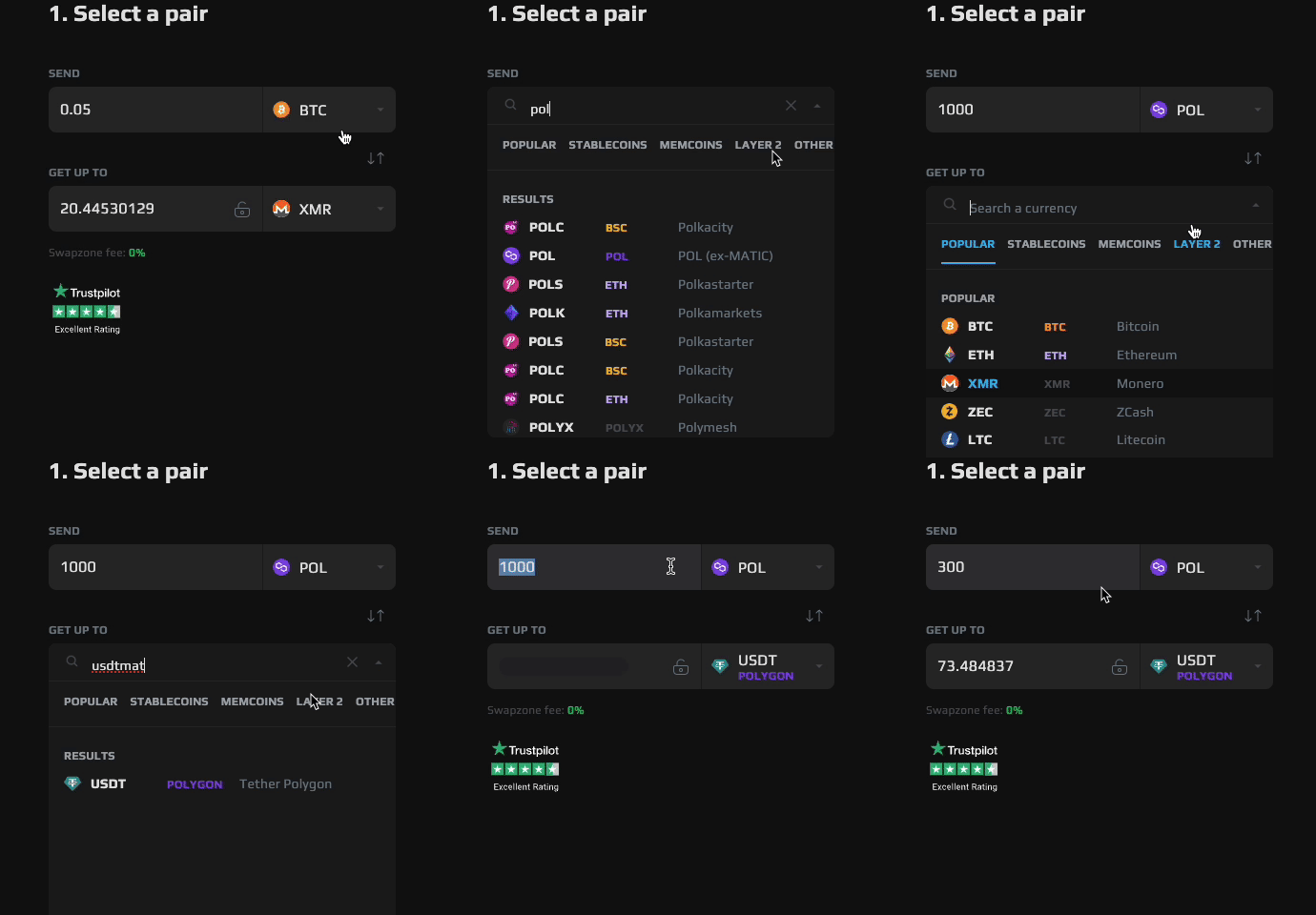
How to Choose a GateToken Exchange


GateToken (GT) Price Analysis

Frequently Asked Questions About GateToken (GT)

On Gate.io it gives trading fee discounts across spot, futures, and margin products through a tiered VIP structure. GT is also the exclusive gas token on Gate Layer and the staking and reward asset on GateChain.
Gate.io launched GT in 2019 with 1 billion tokens and immediately burned 700 million, capping the working maximum at 300 million.
Gate.io puts 15% of profits from crypto-to-crypto, margin, and futures trading into buying back and burning GT, plus 5% to GT research and development, which is 20% in total and adjusted every four years. Each burn is executed on-chain, with the date and quantity announced.
Over 191.9 million GT, about 64% of the 300 million working maximum, valued above $1.504 billion, according to Gate's Q3 2026 burn announcement. That leaves about 108 million GT of the 300 million working maximum.
The Q3 2026 burn removed 1,987,321 GT, per Gate's announcement of October 5, 2026; the Q2 2026 burn removed 2,570,063 GT, per Gate's report of July 22, 2026. The size of each burn follows Gate.io's profit, so it changes from quarter to quarter.
GateChain is Gate's proof-of-stake blockchain. Gate Layer is an OP Stack Layer 2 network launched in September 2025, where GT is the exclusive gas token.
Any GateChain account can take part in block validation by paying standard transaction fees, and stakers earn GT rewards in proportion to their stake.
Gas fees on Gate Layer are paid in GT, which adds on-chain demand independent of how many people use GT for exchange fee discounts.
The burn depends on Gate.io staying profitable, so a drop in trading volume or an exchange-level problem reduces burns directly. GT is tied to one exchange.
The third-quarter 2026 burn removed about 1.99 million GT, worth over $22.35 million at quarterly average prices, according to Gate's announcement of October 5, 2026. Trading volume determines the size of upcoming burns, but a single quarter is not a trend.
Open swapzone.io/exchange/gatetoken, enter the amount, and compare offers from partner exchanges. Paste the receiving address for the stated network, send GT to the deposit address, and track the order.
GateToken (GT) is the utility token of the Gate cryptocurrency exchange and the native gas and staking asset of GateChain, the blockchain Gate operates. GT launched on April 21, 2019 and fills two roles at once: inside the exchange it delivers trading fee discounts, VIP tier progression, and access to new token sales, while on GateChain it pays transaction fees and secures the network through staking. GT launched with 300 million tokens, and regular burns have reduced the supply since. Roughly 104.7 million GT were circulating as of October 2026, with a market capitalization near $1.0 billion, according to CoinGecko.
GT exists in four forms: an ERC-20 token on Ethereum, the native coin on GateChain mainnet, a GateChain EVM version, and GT on Gate Layer, Gate's Layer 2 network. Conversions between them run 1:1 through Gate's official cross-chain gateway. Swapzone lists the asset as GTETH, the Ethereum ERC-20 version, so a deposit sent over GateChain or Gate Layer would land on a network the exchange partner is not monitoring. Confirm the network in the partner's deposit instructions before sending, and contact Swapzone support with the transaction hash and Order ID if a transfer has already left your wallet.
Enter the GT amount in the Swapzone calculator and each exchange partner returns the exact figure you receive at the current rate, so you compare net amounts rather than advertised fee percentages. Fixed-rate offers lock that figure when you create the exchange, holding it steady while the deposit confirms. Floating-rate offers recalculate at execution time, which can move the result up or down. Converting GT to a dollar-pegged stablecoin such as USDT or USDC keeps the transaction crypto-to-crypto and non-custodial, while moving GT into bank-payable dollars requires a separate fiat off-ramp with its own identity verification.
Gate runs a quarterly on-chain buyback and burn funded by platform revenue, publishing each burn with a transaction hash. Cumulative burns passed 189.9 million GT by Q2 2026, reducing the original 300 million supply by approximately 63.32%. The Q1 2026 burn removed 2,557,729 GT on April 27, 2026, with a stated value above $20.68 million, and the Q2 2026 burn removed 2,570,063 GT on July 6, 2026. Burn volume tracks Gate's revenue rather than a fixed schedule of amounts, so the quantity varies each quarter.
No. Swapzone requires no registration, no email address, and no account of any kind, and holds no funds at any point: GT moves from your own wallet to the exchange partner's deposit address, and the receiving asset arrives at the address you provide. That differs from trading GT inside the Gate exchange, where the asset sits in a platform account. Each offer on Swapzone carries the partner's KYC frequency label (Rare / Often / Never), so the identity verification risk is visible before you commit rather than after you deposit.
No. GT's exchange benefits, including trading fee discounts, VIP tier progression, and access to new token sales, apply to GT held in a Gate account, because the platform reads that balance to calculate the tier. GT sitting in self-custody or in transit through an exchange partner earns none of those benefits. GT's on-chain utility works differently: on GateChain it pays transaction fees and can be staked regardless of where the tokens were acquired. Decide which of the two roles matters to you before moving the tokens.
Swapzone charges a 0% platform fee on GT exchanges. Two costs remain: the exchange partner's fee, already built into the rate shown in the offer, and the Ethereum gas fee you pay to move the ERC-20 version out of your wallet. Liquidity deserves a check on this asset: GT recorded roughly $2.4 million in 24 hour volume in October 2026, according to CoinGecko, which is thin relative to major assets, so quotes can differ noticeably between partners. Compare the net receiving amount across offers rather than the headline rate.
Why Exchange GateToken with Swapzone?

Non-custodial aggregator: you send GT to the partner's deposit address and receive funds in your own wallet, never through Swapzone.

Live GT offers from exchange partners side by side.

Swap GT with 1,600+ cryptocurrencies.

Reviews from TrustPilot


Good and Fast Support
Tyler from Swapzone's Support team was very kind and helps me out proactively. Highly recommend this site.
Excellent and reliable platform
Reliable and easy to use without the cumbersome KYC! Excellent exchange platform.
Quick service
Quick service. Transaction was processed with ease. Thank you Swapzone
Learn More About Cryptocurrencies


Our exchange partners for GateToken
Contact us for partnership