

JUST (JST) Exchange
Looking to exchange JST? Swapzone compares live offers from partner exchanges by rate, speed and KYC label. No account, no custody, 0% platform fee. JST is a token on the TRON network.


Swapzone fee: 0%

JUST Market Data & Key Metrics
PriceJUST Price Chart and Market Analysis
Popular JST Exchange Pairs


Other Cryptocurrencies to Exchange
 Cardano
 Solana
 GRAM
 Pirate Chain
 Elrond
 Secret
 Flamingo
 Filecoin
 Aave
 DeFiPulse Index
 Dollar
 Euro
 Chrono.tech
 OKB
 Terra 2.0
 BAND
 Unibright
 Kleros
 SUN
Popular Alternatives to Buy

What is JST?
About JUST
JST is the governance token of JUST, a delegated proof-of-stake DeFi platform on the TRON blockchain that bundles a lending market, liquid staking, stablecoin issuance, and energy rental into a single protocol. Borrowers and stablecoin minters pay interest and stability fees in JST — not to a centralised treasury, but through a revenue routing mechanism that converts a share of those earnings into quarterly on-chain buybacks and permanent burns.
JST tokenomics
JUST launched with a fixed total supply of 9.9 billion JST, which reached full circulation in Q2 2023. In October 2025, JustLend DAO shifted the model from static to actively deflationary by introducing a revenue-funded buyback-and-burn program. Cumulative burns reached 1.88 billion JST — 19.01% of total supply — after the fifth buyback-and-burn round on October 16, 2026, according to JustLend DAO's burn announcements.
Total supply — 9.9 billion JST; fixed at the protocol level with no additional minting
Circulating supply — approximately 8.02 billion JST as of October 2026, according to CoinGecko; 1.88 billion tokens had been permanently removed through burns as of October 16, 2026
Burn mechanism — JustLend DAO allocates 30% of quarterly protocol revenue to purchase JST from open markets and destroy it on-chain; Q2 2026 alone removed 355 million JST (~$34.59M), according to CryptoRank
Revenue sources — lending and borrowing fees from the Supply and Borrow Market, sTRX liquid staking yield, energy rental income on TRON, and USDD/USDJ stability fees
Governance rights — JST holders vote on protocol parameters including interest rate models, collateral ratios, and burn schedule adjustments
Q3 2026 burn — the fifth round on October 16, 2026 burned 170,723,144 JST (about $23.53M, or 1.72% of supply), funded by $9.28M of Q3 net income and $10.34M from a historical revenue allocation, according to JustLend DAO
What determines JST's value
JST's primary demand mechanism is a revenue-to-scarcity feedback loop: fees collected across JustLend DAO's product suite fund quarterly buybacks, which reduce outstanding supply at a rate tied directly to protocol usage — not treasury decisions. JustLend's TVL was about $6.9 billion on October 30, 2026, according to DefiLlama; at that scale, the lending and staking revenue flowing into JST burns is generated continuously rather than front-loaded. Every USDD stability fee paid by stablecoin minters and every borrowing fee collected from margin users increases the quarterly buyback pool.
A secondary driver is governance utility: JST holders vote on the exact parameters that determine how aggressively protocol revenue converts into burns, giving token holders direct structural influence over the deflationary rate. Cumulative burns through Q2 2026 were valued at approximately $94.62M, against a circulating supply worth under $900M at Q2 2026 prices. The burns are executed on-chain and recorded in JustLend DAO's published burn records.
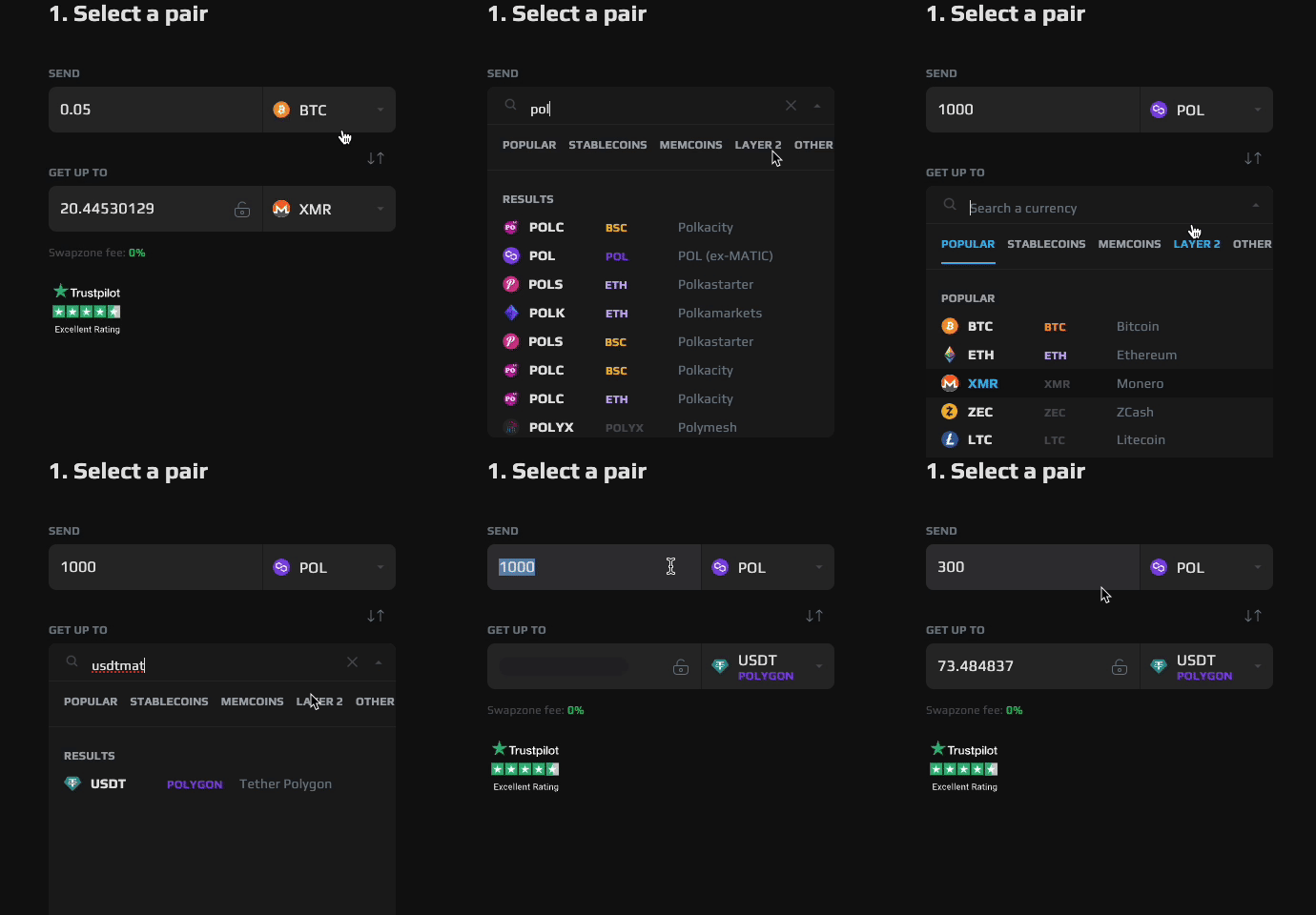
How to Exchange JUST on Swapzone

How to Choose a JUST Exchange


JUST (JST) Price Analysis

Frequently Asked Questions About JUST (JST)

JUST bundles a lending market, liquid staking, stablecoin issuance, and energy rental on the TRON blockchain. It runs as a delegated proof-of-stake DeFi platform, and JST is its governance token.
JustLend DAO allocates 30% of quarterly protocol revenue to buy JST on the open market and destroy it on-chain. The program started in October 2025, and Q2 2026 alone removed about 355 million JST, worth roughly $34.59M, according to CryptoRank.
Cumulative burns reached 1.88 billion JST, which is 19.01% of total supply, as of October 16, 2026, according to JustLend DAO's burn announcements. CoinGecko showed about 8.02 billion JST in circulation on October 29, 2026, which matches 9.9 billion minus the burns.
No. Total supply is fixed at 9.9 billion JST with no additional minting at the protocol level. The supply reached full circulation in Q2 2023, so the main change since then is the burn.
Lending and borrowing fees from the Supply and Borrow Market, sTRX liquid staking yield, energy rental income on TRON, and USDD and USDJ stability fees. Burns shrink if this revenue shrinks.
Protocol parameters such as interest rate models, collateral ratios, and burn schedule adjustments. That gives holders direct influence over how much of the revenue is turned into burns.
The fifth round on October 16, 2026 burned 170,723,144 JST, about $23.53M or 1.72% of supply, funded by $9.28M of Q3 net income and $10.34M from a historical revenue allocation, according to JustLend DAO. The DAO has not yet stated the size of the next round.
About $6.9 billion on October 30, 2026, according to DefiLlama. TVL moves with market prices and borrowing demand.
In JUST the burn size follows protocol revenue, not a one-off treasury decision. A busy quarter produces a larger buyback pool, and a quiet quarter a smaller one.
Burn size depends on lending, staking, and stability-fee revenue, so it can fall with activity. The protocol also sits on one chain, TRON, so ecosystem and stablecoin events there affect it.
Open swapzone.io/exchange/just, enter the amount, and compare offers from partner exchanges by rate, time, and KYC label. Paste your TRON address, send JST to the deposit address, and track the order.
JUST (JST) is a TRC-20 governance token issued on the Tron network and the sole governance asset of the JUST ecosystem, which includes JustLend DAO, Tron's lending protocol. JST holders lock their tokens to vote on JustLend Improvement Proposals covering interest rate parameters and other protocol decisions. Maximum supply is fixed at 9,900,000,000 JST, with roughly 8.02 billion in circulation and a market capitalisation of approximately $1.1 billion as of October 2026 according to CoinGecko. JST is not a coin with its own blockchain: every JST transaction settles on Tron as a smart contract call.
Two different things share a similar name. JustSwap was Tron's first automated market maker DEX, launched on August 18, 2020, and SUN.io acquired it and renamed it SunSwap in October 2021, so JustSwap no longer exists as a standalone platform. Swapping JST, the token, is a separate action that requires no DEX at all. On Swapzone, a non-custodial (meaning Swapzone holds no user funds) crypto exchange aggregator, a JST swap runs through one of the exchange partners, with no liquidity pool, no slippage setting, and no wallet connection needed.
Both routes run as standard crypto-to-crypto swaps. JST to USDT TRC-20 keeps both legs inside the Tron network, so the sending and receiving networks match and confirmation is quick. JST to TRX converts a TRC-20 token into Tron's native coin, which is the asset that pays network fees, so this route helps when your wallet is short on TRX. Enter the amount in the Swapzone calculator and each partner returns the exact figure you receive at the current rate: fixed-rate offers lock that figure when you create the exchange, floating-rate offers recalculate it at execution time.
Tron charges transaction costs in two resources rather than a single gas fee: bandwidth for the transaction data, and energy for the smart contract execution that every TRC-20 transfer triggers. Each Tron account receives 600 free bandwidth points daily, but energy is not free by default. A TRC-20 transfer consumes roughly 65,000 energy, which the network covers by burning TRX from your balance unless you have staked TRX for a recurring energy allowance. Tron governance cut the energy price from 210 SUN to 100 SUN per unit in August 2025, which lowered that cost.
Tron produces a block roughly every 3 seconds, so a JST transfer appears on-chain almost immediately after you send it. Full irreversibility takes longer: a Tron block is solidified once 19 of the 27 Super Representatives have built on top of it, which takes about 57 seconds. Exchange partners set their own confirmation thresholds within that window, and the estimated completion time on each offer already reflects the partner's policy. Total swap time of 5 to 30 minutes is therefore driven by the partner's processing step and by the confirmation speed of the receiving network, not by Tron.
JST transfers on the Tron network use a single address with no MEMO, tag, or payment ID field. Tron addresses begin with T and run 34 characters, and the address alone identifies the recipient. The confusion arises because centralised platforms sometimes share one deposit address across many customers and add a MEMO to route each deposit internally. Read the deposit screen the exchange partner generates: if a MEMO or comment field appears next to the address, treat it as mandatory and copy it exactly, and if no such field appears, the address is all you need.
JustLend DAO runs a revenue-funded buyback and burn program that permanently removes JST from circulation, drawing on income from lending fees and liquidation penalties rather than following a fixed schedule. Cumulative burns reached 1,711,250,000 JST by the end of Q2 2026, equal to 17.29% of the 9.9 billion maximum supply, while CoinGecko listed circulating supply at approximately 8.02 billion JST as of October 2026. The Q2 2026 burn alone removed 355.02 million JST. Supply contraction changes nothing about how an individual swap executes: the amount you receive depends on the exchange partner's quoted rate when you create the exchange.
Why Exchange JUST with Swapzone?

Non-custodial aggregator: you send JST to the partner's deposit address and receive funds in your own wallet, never through Swapzone.

Live JST offers from exchange partners side by side.

Swap JST with 1,600+ cryptocurrencies.

Reviews from TrustPilot


Good and Fast Support
Tyler from Swapzone's Support team was very kind and helps me out proactively. Highly recommend this site.
Excellent and reliable platform
Reliable and easy to use without the cumbersome KYC! Excellent exchange platform.
Quick service
Quick service. Transaction was processed with ease. Thank you Swapzone
Learn More About Cryptocurrencies


Our exchange partners for JUST
Contact us for partnership