

Starknet (STRK) Exchange
Looking to exchange STRK? Swapzone compares live offers from partner exchanges by rate, speed and KYC label. No account, no custody, 0% platform fee. STRK (listed on Swapzone as STRKSTRK) is the native token of Starknet, a zero-knowledge rollup Layer 2 on Ethereum built by StarkWare.


Swapzone fee: 0%

Starknet Market Data & Key Metrics
PricePopular STRK Exchange Pairs


Other Cryptocurrencies to Exchange
 Cardano
 Solana
 GRAM
 Pirate Chain
 LTO Network
 Orchid
 OGN
 STORJ
 SUSHI
 SNX
 TRB
 SAND
 UMA
 WazirX
 YFI
 Alchemy Pay
 NMR
 Alien Worlds
Popular Alternatives to Buy

What is STRK?
About Starknet
STRK is the native token of Starknet, a permissionless zero-knowledge rollup (validity rollup) Layer 2 built on Ethereum by StarkWare. Starknet uses STARK cryptographic proofs (Scalable, Transparent Arguments of Knowledge) to batch hundreds of thousands of transactions off-chain and submit a single validity proof to Ethereum mainnet, scaling computation while inheriting Ethereum's security guarantees. Unlike optimistic rollups (Arbitrum, Optimism) that assume transactions are valid until challenged, Starknet mathematically proves every batch is correct before posting it, which removes the 7-day challenge window that optimistic rollups use. Starknet runs its own virtual machine (Cairo VM) rather than emulating the Ethereum Virtual Machine. Developers write smart contracts in Cairo, a programming language purpose-built for STARK proof generation. The mainnet went live in November 2021, opened to permissionless deployments in 2022, launched the STRK token on February 20, 2024, and activated permissionless staking in November 2024.
STRK tokenomics
STRK had an initial supply of 10 billion tokens, and staking rewards are minted on top of it. About 7.66 billion STRK were in circulation as of November 2026, according to CoinGecko, with the remainder subject to ongoing vesting.
Initial supply — 10,000,000,000 STRK (10 billion); staking rewards add newly minted STRK
Circulating supply — approximately 7.66 billion STRK as of November 2026, according to CoinGecko
Monthly unlocks — approximately 127 million STRK (1.27% of total supply) unlock monthly from April 2025 through March 2027, primarily from early contributor and investor allocations; this creates consistent sell pressure that demand from staking and fee usage must absorb
Token utility — gas fees (v3 transactions require STRK for gas; paymaster services via AVNU allow payment in other tokens), staking (validators secure the network and earn STRK rewards), and governance (voting on protocol upgrades and network parameters)
Native account abstraction — every Starknet account is a smart contract by default, enabling wallets to implement social recovery (Argent), hardware-backed signing (Braavos), and fee payment in arbitrary tokens without protocol-level changes
What determines STRK's value
STRK's value depends on whether Starknet's technical advantages (STARK proofs with no trusted setup, native account abstraction, Cairo's proof-optimized execution) translate into sufficient developer adoption and on-chain activity to justify its valuation against larger, EVM-compatible L2 competitors. Arbitrum and Base host considerably larger DeFi ecosystems. The non-EVM architecture means established Ethereum protocols like Aave and Uniswap cannot deploy unchanged; Starknet's DeFi ecosystem grew around native protocols optimized for Cairo rather than ports.
The STARK proof system offers a fundamental technical advantage: no trusted setup ceremony (unlike SNARK-based competitors), post-quantum resistance, and proof costs that decrease relative to batch size. The S-Two prover upgrade (faster, cheaper proof generation) and the STRK20 privacy standard represent the ongoing technical roadmap that could differentiate Starknet as L2 competition intensifies. Staking locks supply and generates yield, partially offsetting the 127 million monthly token unlocks. The price has declined over 90% from its 2024 all-time high, reflecting post-launch correction, intense L2 competition, and persistent unlock pressure.
How to Exchange Starknet on Swapzone

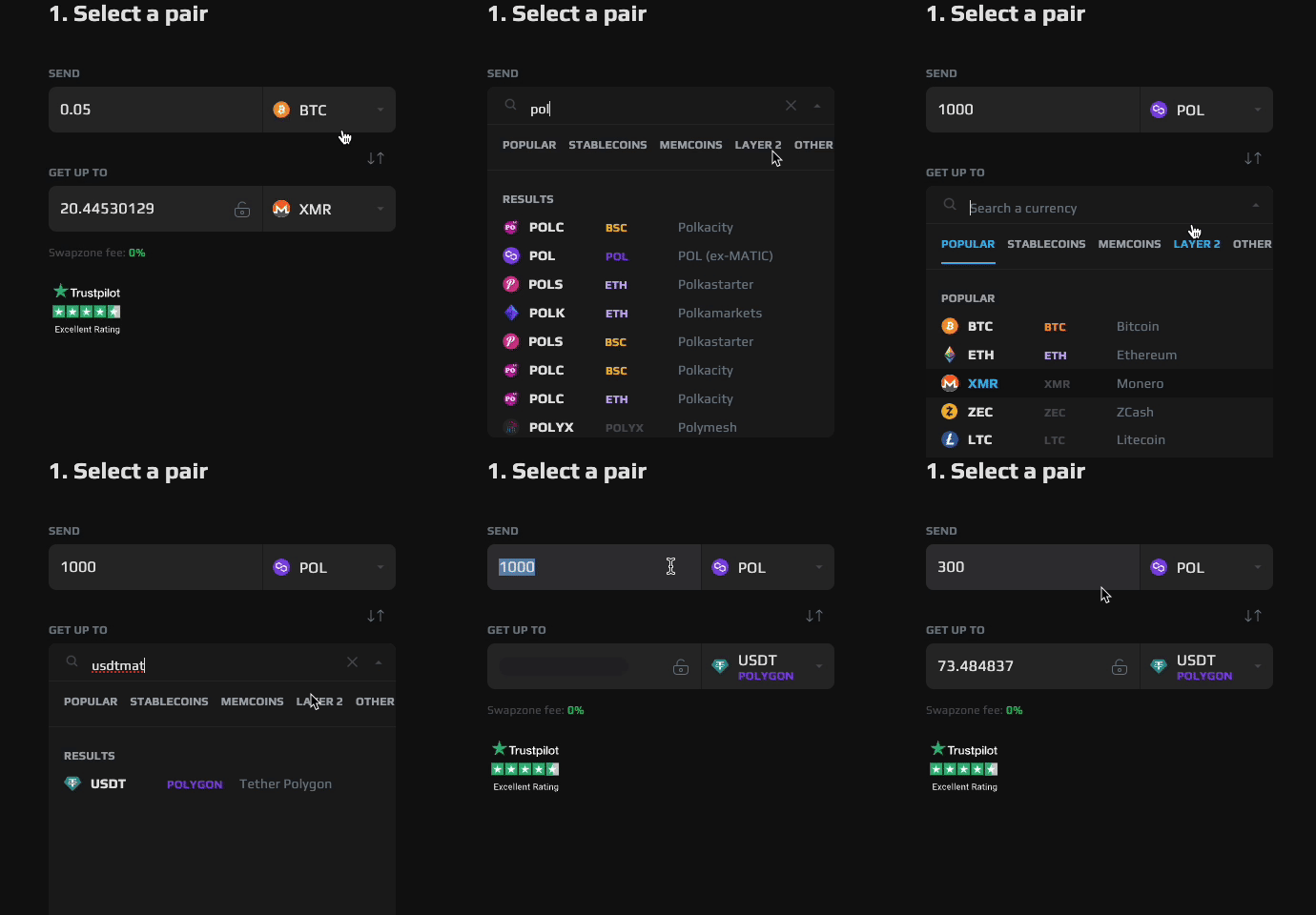
How to Choose a Starknet Exchange


Starknet (STRK) Price Analysis

Frequently Asked Questions About Starknet (STRK)

Starknet is a permissionless zero-knowledge rollup on Ethereum built by StarkWare. It uses STARK proofs to batch many transactions off-chain and posts one validity proof to Ethereum.
Optimistic rollups such as Arbitrum and Optimism assume transactions are valid until challenged. Starknet proves every batch is correct before posting it, so it does not need a 7-day challenge window.
Smart contracts are written in Cairo, a language designed for STARK proof generation. Starknet runs its own Cairo VM instead of emulating the Ethereum Virtual Machine.
STRK pays gas fees for v3 transactions, secures the network through staking, and is used for governance voting.
The STRK token launched on February 20, 2024, and permissionless staking was activated in November 2024.
About 7.66 billion STRK as of November 2026, according to CoinGecko. The initial supply was 10 billion, and staking rewards are minted on top.
About 127 million STRK, or 1.27% of the initial supply, unlock each month from April 2025 through March 2027, mainly from early contributor and investor allocations.
Every Starknet account is a smart contract, so wallets can offer social recovery (Argent), hardware-backed signing (Braavos), and fee payment in other tokens.
S-two is Starknet's faster, cheaper proof system. STRK20 is a privacy token standard on the roadmap.
Open swapzone.io/exchange/starknet, enter the amount, and compare offers from partner exchanges by rate, time, and KYC label. Paste your Starknet address, send STRK to the deposit address, and track the order.
Monthly unlocks add supply, and Starknet competes with larger EVM-compatible Layer 2 networks. The price is more than 90% below its 2024 high.
Why Exchange Starknet with Swapzone?

Non-custodial aggregator: you send STRK to the partner's deposit address and receive funds in your own wallet, never through Swapzone.

Live None offers from exchange partners side by side.

Swap STRK with 1,600+ cryptocurrencies.

Reviews from TrustPilot


Good and Fast Support
Tyler from Swapzone's Support team was very kind and helps me out proactively. Highly recommend this site.
Excellent and reliable platform
Reliable and easy to use without the cumbersome KYC! Excellent exchange platform.
Quick service
Quick service. Transaction was processed with ease. Thank you Swapzone
Learn More About Cryptocurrencies


Our exchange partners for Starknet
Contact us for partnership