


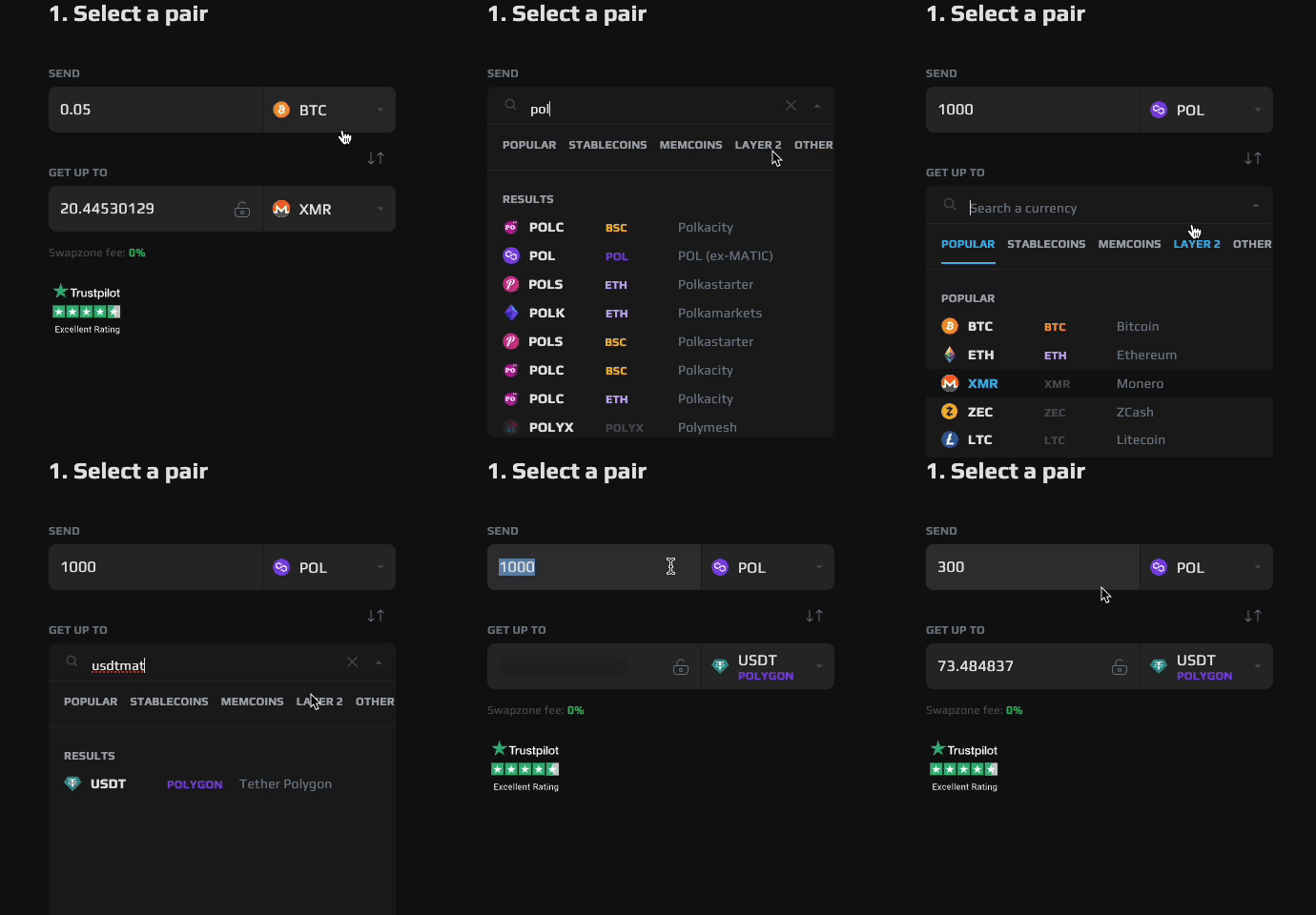

You can exchange crypto without going through KYC (Know Your Customer)
PLS to ETH Exchange

Compare Pulsechain to Ethereum rates from 18 rated providers — updated 22-10-2026
send

pls

get

eth
Private Exchange
Private swaps hide the on‑chain link between your sending and receiving addresses. This is about routing privacy, not bypassing AML/KYC rules.
Swapzone fee: 0%
Select an offer
Best Match
All rates
Fixed
Floating
RATE CHANGE
Pulsechain and Ethereum Market Data
Price$ 0.00
24h % price
61.92%
Market Cap
-
Coin supply
14,814,814,814,815
Price$ 2,457.59
24h % price
3.39%
Market Cap
$ 300,193,228,343.70
Coin supply
122,149,509.856
Popular PLS exchange pairs
Exchange PLS ForPairsStatus
Popular ETH exchange pairs
Exchange ETH ForPairsStatus
How to Swap PulseChain to Ethereum on Swapzone
How to choose a PLS to ETH exchange?
There are dozens of instant crypto exchange services across the Internet and numerous factors to consider when choosing the best PLS to ETH exchange. We show each partner's KYC label, rating, and live rate for both PLS→ETH and ETH→PLS before you commit or send funds — no account or registration required.
By best rates
By the highest transaction speed
By best rating
Both PLS and ETH carry volatility. Fixed-rate offers lock the output amount at order creation. Floating-rate offers execute at market rate at processing time. Note that PLS daily trading volume is typically very low — under $50,000 on most days according to CoinGecko (June 2026), so rate spreads for PLS pairs may be wider than for higher-liquidity assets.
PLS to ETH Conversion Rate
The table below shows PLS to ETH conversion values for the most common amounts — from 1 PLS up to 1,000 PLS — based on the current rate. Use it as a quick reference before choosing a provider.
PLSETH0.01
0
0.1
0
1
0
5
0
10
0
50
0
100
0
1000
0
Please be aware that some of the listed services may perform AML/KYC procedures to prevent criminal activity. Remember that it is the user’s responsibility to conduct due diligence prior to proceeding with an exchange deal. Swapzone cannot be held liable for any crypto exchange losses, delays, computer malfunctions, or any other damages associated with any action taken, regardless of the user’s interpretation of the information provided on cryptocurrency exchange services or crypto exchange offers.
ETHPLS0.01
4456880.7339
0.1
44568807.3394
1
445688073.3945
5
2228440366.9725
10
4456880733.945
50
22284403669.7248
100
44568807339.4495
1000
445688073394.4954
Please be aware that some of the listed services may perform AML/KYC procedures to prevent criminal activity. Remember that it is the user’s responsibility to conduct due diligence prior to proceeding with an exchange deal. Swapzone cannot be held liable for any crypto exchange losses, delays, computer malfunctions, or any other damages associated with any action taken, regardless of the user’s interpretation of the information provided on cryptocurrency exchange services or crypto exchange offers.
PLS to ETH Conversion Rate
Why people swap PLS and ETH?
PulseChain (PLS) and Ethereum (ETH) are separate, non-interoperable blockchains. PulseChain is an EVM-compatible Layer-1 network launched on May 13, 2023, as a hard fork of Ethereum by Richard Heart. It uses PLS as its native gas token, runs Delegated Proof-of-Stake consensus, and produces a block every 10 seconds, according to CoinMarketCap. The network is EVM-compatible — it uses the same wallet addresses (0x format) and smart contract standards as Ethereum.
ETH is the native token of the Ethereum blockchain — the largest smart contract platform by developer activity and total value locked, producing a block every 12 seconds with Proof-of-Stake consensus.
Users swap PLS to ETH primarily to move liquidity from the PulseChain ecosystem back to Ethereum's deeper markets, or to consolidate into ETH as a larger-cap asset. Users swap ETH to PLS primarily to obtain PLS as the gas token needed to interact with PulseChain's DeFi ecosystem, or to bridge assets into the PulseChain network.
What are technical considerations for this pair
PulseChain produces a block every 10 seconds. Exchange partners typically credit PLS deposits after a set number of confirmations — the number varies by partner. At 10 seconds per block, even 15–30 confirmations take 2–5 minutes. The PLS input side of this swap clears quickly.
On the ETH receiving side, Ethereum produces a block every 12 seconds with full finality in approximately 13 minutes (two checkpoints). Most exchange partners credit ETH deposits after 12–64 confirmations depending on their risk policy, which takes approximately 2–13 minutes
.
Total swap time under normal network conditions: 10–25 minutes from PLS send to ETH credited, or ETH send to PLS credited, with partner processing time contributing most of the window.
Neither PLS nor ETH requires a MEMO or payment tag. Both use standard 0x format addresses — no additional destination data is required beyond the wallet address.
Address warning: PulseChain and Ethereum both use the same 0x address format. An Ethereum address is technically valid as a PulseChain address and vice versa, because PulseChain is EVM-compatible. However, the networks are separate — sending PLS to an address only works if that address is connected to PulseChain, not Ethereum. Ensure your destination wallet is on the correct network before sending.
What are common mistakes when swapping PLS and ETH
• Sending to an address on the wrong network Because PulseChain and Ethereum share address formats, it is possible to paste a valid-looking address that belongs to a wallet on the wrong network. PLS sent to an address only accessible via Ethereum MetaMask settings will not appear until the wallet is switched to PulseChain (chain ID 369). Verify your destination wallet is connected to the correct network before confirming.
• Expecting PulseChain DEX liquidity to match Ethereum PulseChain DeFi liquidity is substantially thinner than Ethereum's. For larger PLS amounts, the rate shown in an offer may differ from the final executed rate if liquidity is insufficient. Fixed-rate offers help manage this.
• Sending ETH from PulseChain instead of Ethereum PulseChain has its own bridged version of ETH (Ethereum on PulseChain). Ensure you are sending native ETH on the Ethereum network, not bridged ETH from PulseChain, to an ETH deposit address.
• Insufficient PLS for gas on PulseChain When sending PLS from your wallet, a small amount of PLS is required as gas for the transaction. Ensure your wallet balance exceeds the swap amount slightly to cover the outgoing network fee.
Why Exchange PLS to ETH with Swapzone?
Higher security
We check all exchangers for the risk of freezing funds. Your funds will definitely reach you!

Best rates
We're showing the offers from the most popular and reliable exchange providers. Pick the best offer for your crypto pair!

3000+ currencies available
It's really hard not to find the crypto you need on Swapzone :)

Swapzone Reviews

TrustPilot 4.7 |536 reviews


Good and Fast Support
Tyler from Swapzone's Support team was very kind and helps me out proactively. Highly recommend this site.
Excellent and reliable platform
Reliable and easy to use without the cumbersome KYC! Excellent exchange platform.
Quick service
Quick service. Transaction was processed with ease. Thank you Swapzone
Learn More About Cryptocurrencies

How to Exchange Crypto Without Verification
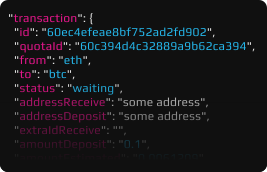
Crypto Exchange API
Enable crypto swaps, staking, loans, and fiat in your app—without building 30 integrations.

Crypto Wallet Security Tips
Why Should You Really Care About Bitcoin and Crypto Security?

Hidden Fees in Crypto: Why You Pay More Than You See
Uncover the hidden costs of crypto trades, from spreads to slippage, and learn how to minimize them
İş Ortaklarımız
Ortaklık için bize ulaşın